
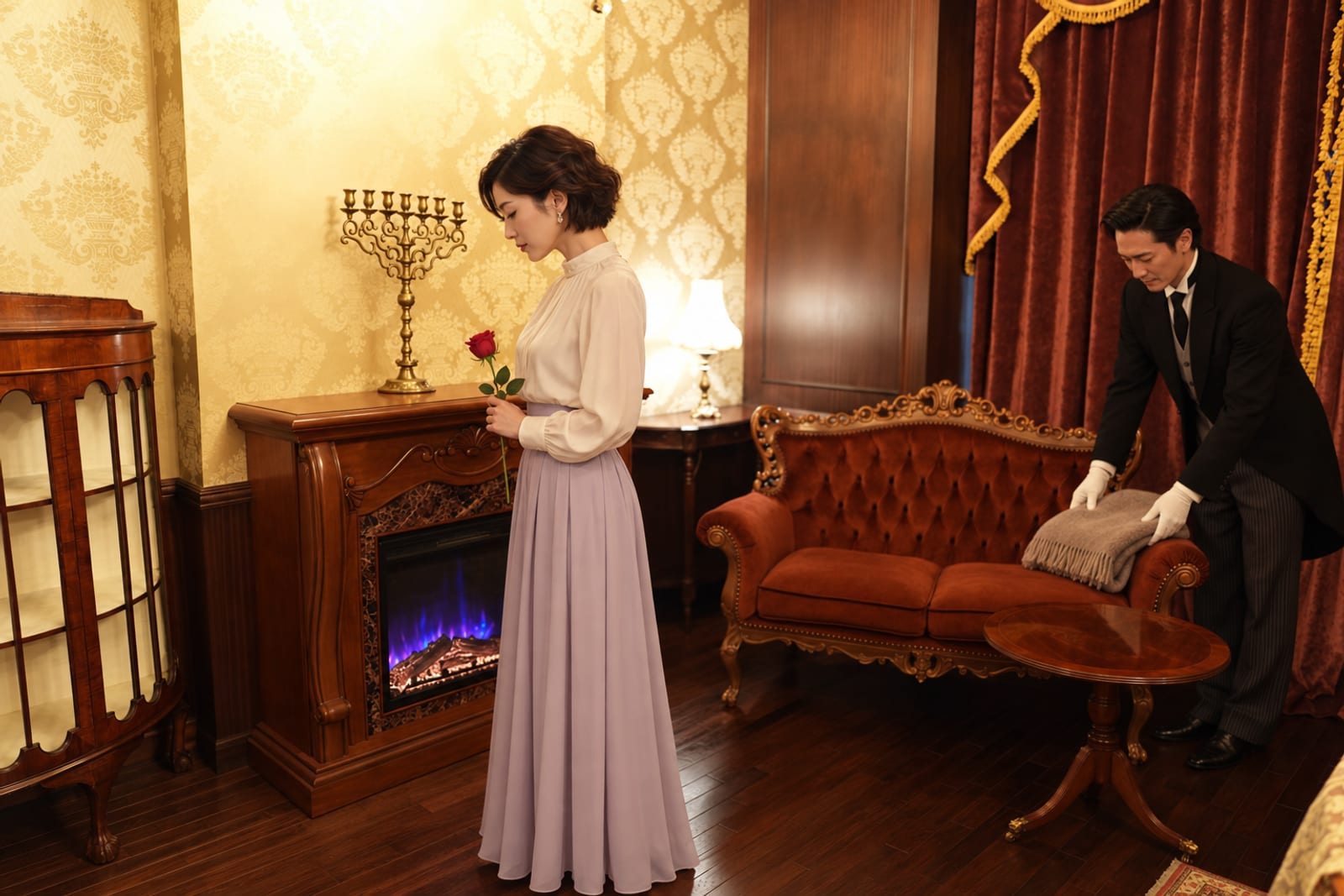
The Fireplace and Mantelpiece
Around the flame, the eyes of the room gather.
About The Fireplace and Mantelpiece
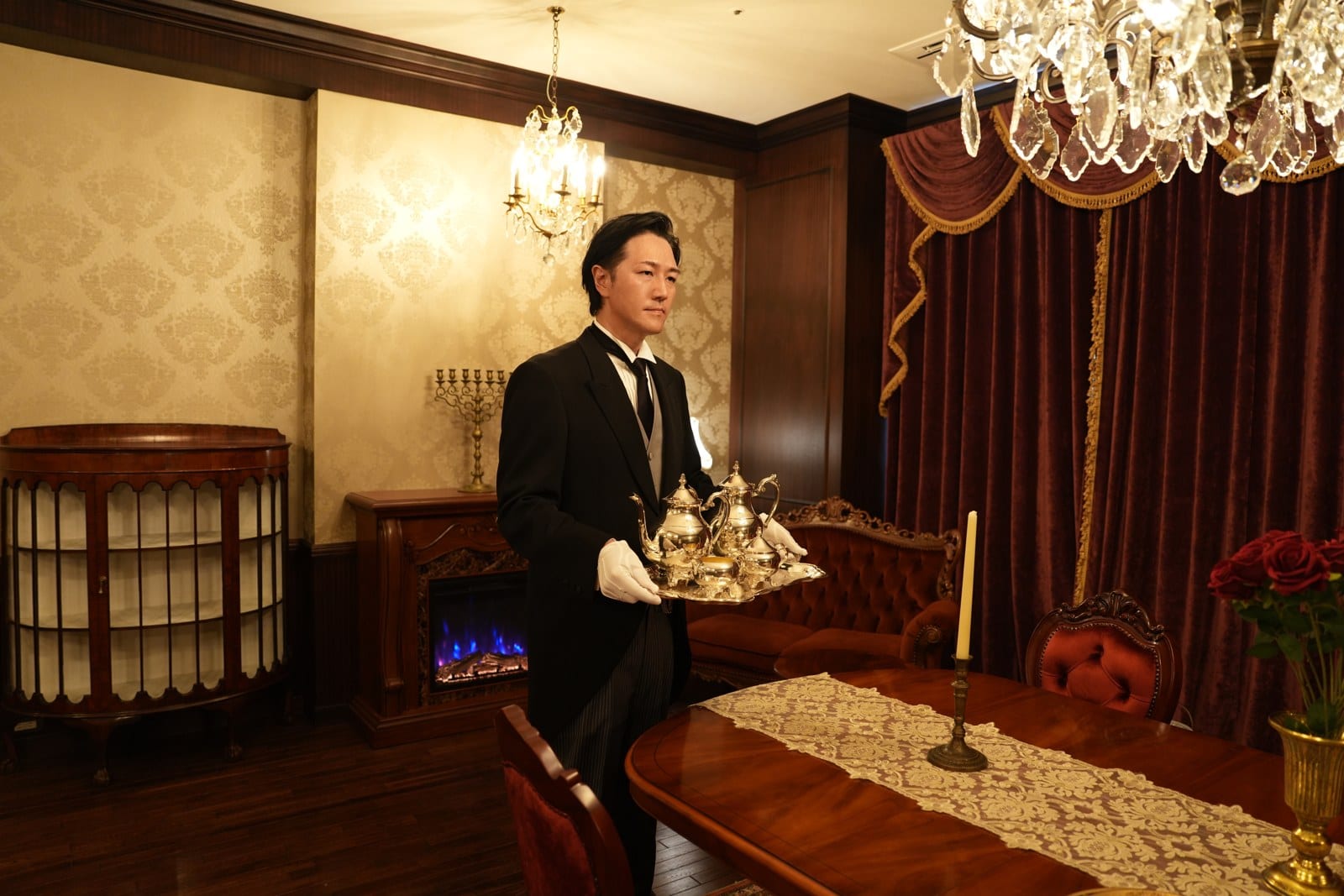
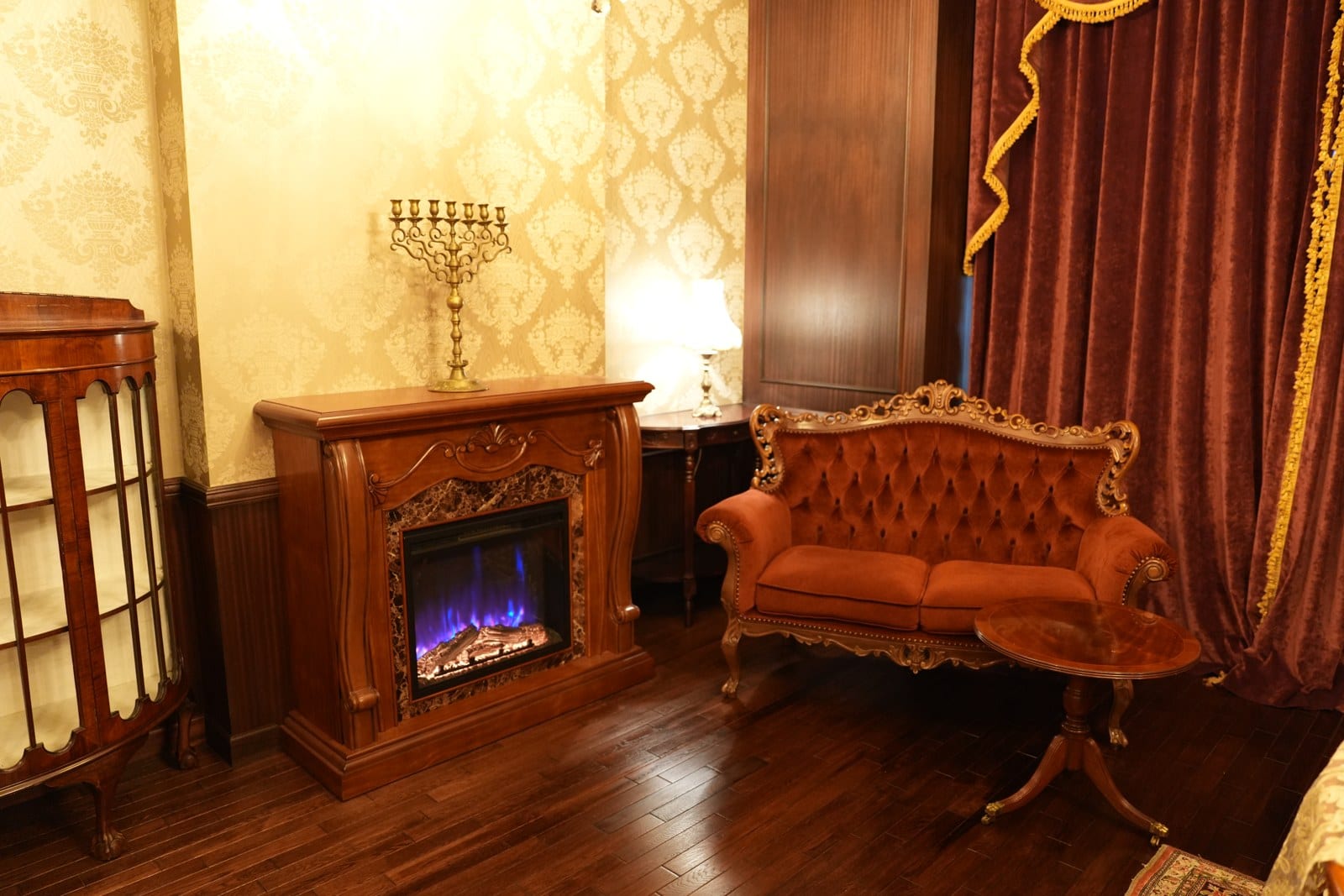
The fireplace is the place that holds the flame; the mantelpiece is the surround that frames it architecturally. At the Manor, an electric fire is framed by a walnut and marble-effect mantelpiece, a mirror, a clock, candlesticks, an oil painting and velvet seats, making it the centre of gaze and light in a Victorian salon.
IThe fireplace is the flame; the mantelpiece is its frame
Around the opening that holds the flame, the columns to either side, the lintel above and the shelf together form the mantelpiece. The Manor's is 1,150 mm wide and 1,019 mm high. The colour of walnut and a marble-effect surface frame the electric fire.
Seen alone, the flame is a single light; widen your view to the mantelpiece and it becomes a stage receiving clock, candlesticks, mirror, painting and flowers. In the European houses of the 18th and 19th centuries, the fireplace was the centrepiece of the room, and the standing of the mantelpiece was taken as the standing of the room, precisely because of this centrality.
Beyond the flame, a single composition
Surround, shelf, mirror, clock and candlesticks shape the face of the room.
IIThe electric fire flickers as one of the Manor's lights
The fireplace at the Manor is electric. It burns neither wood nor fuel, but shows its flicker as a light within the room. Knowing this, and not mistaking it for a real fire, is essential to appreciating the fitting properly. The butler lights and extinguishes it on request, matching it to the brightness of the chandelier and candlesticks.
Even though electric, there is meaning in the low position of the flame. While the six-light chandelier above illuminates the whole room, the light of the fire flickers below the eye-line of those seated on the sofa. When high and low light overlap, depth emerges in the gold damask wallpaper, the red fabrics and the gilt of the mirror.
What we hold dear at the Manor is not the display of one kind of flame, but the idea that 'the fireplace is the centrepiece of the room'.
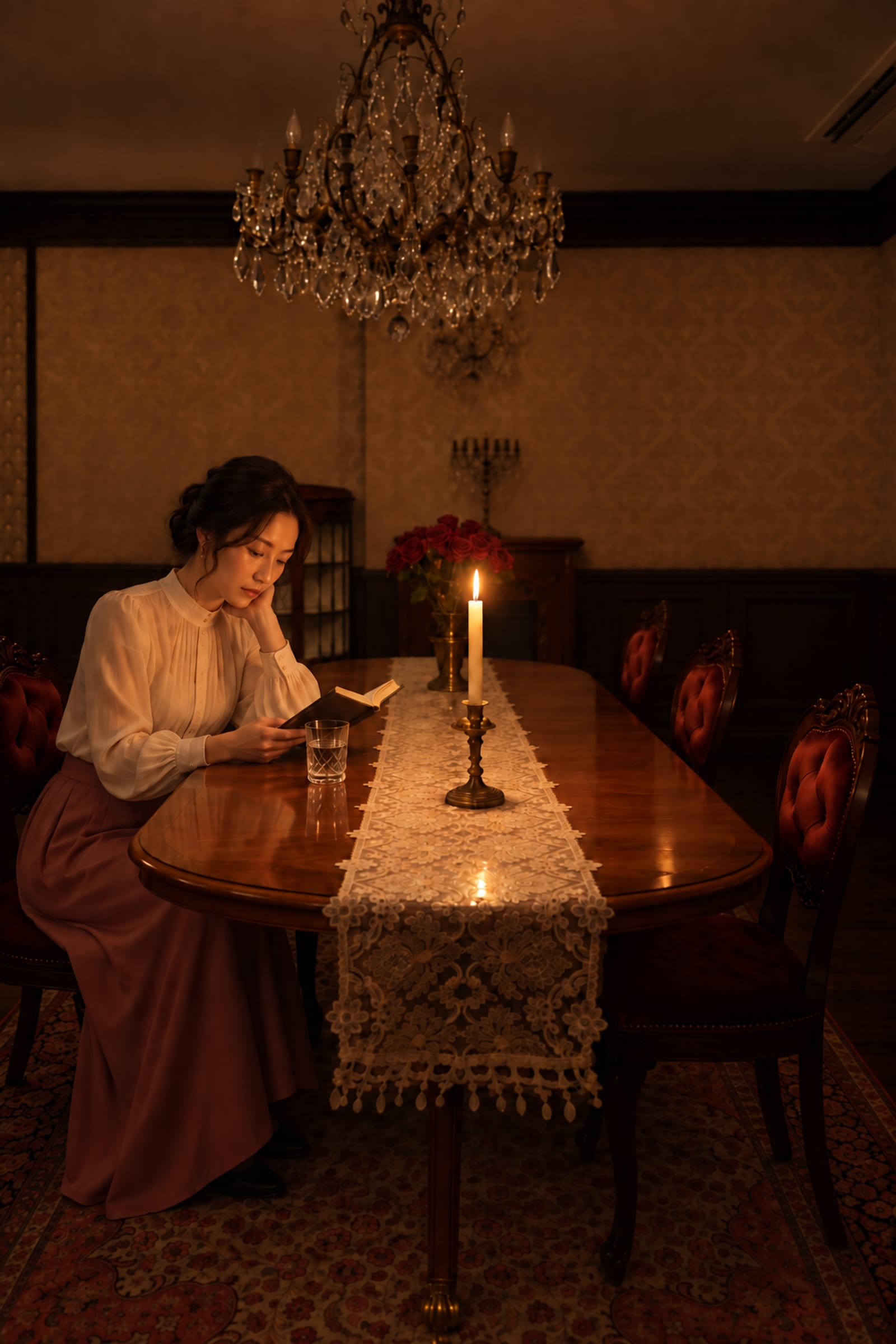
Keeping the flicker low
The butler does not simply darken the room, but chooses a light on which the eye can rest.
IIIReading the material and dimensions of the mantelpiece
The Manor's mantelpiece is 1,150 mm wide and 1,019 mm high. At the centre of the shelf stands a clock, with a pair of candlesticks to either side and a gilt-framed mirror above. Seeing the dimensions together with the actual arrangement gives the whole picture of the surround and its garniture.
The deep colour of the walnut links the wine-red curtains and velvet sofa, while the marble-effect surface catches the light of mirror and candlesticks. The marble-topped mantelpiece is regarded as a staple of aristocratic houses from French rococo to the Second Empire.
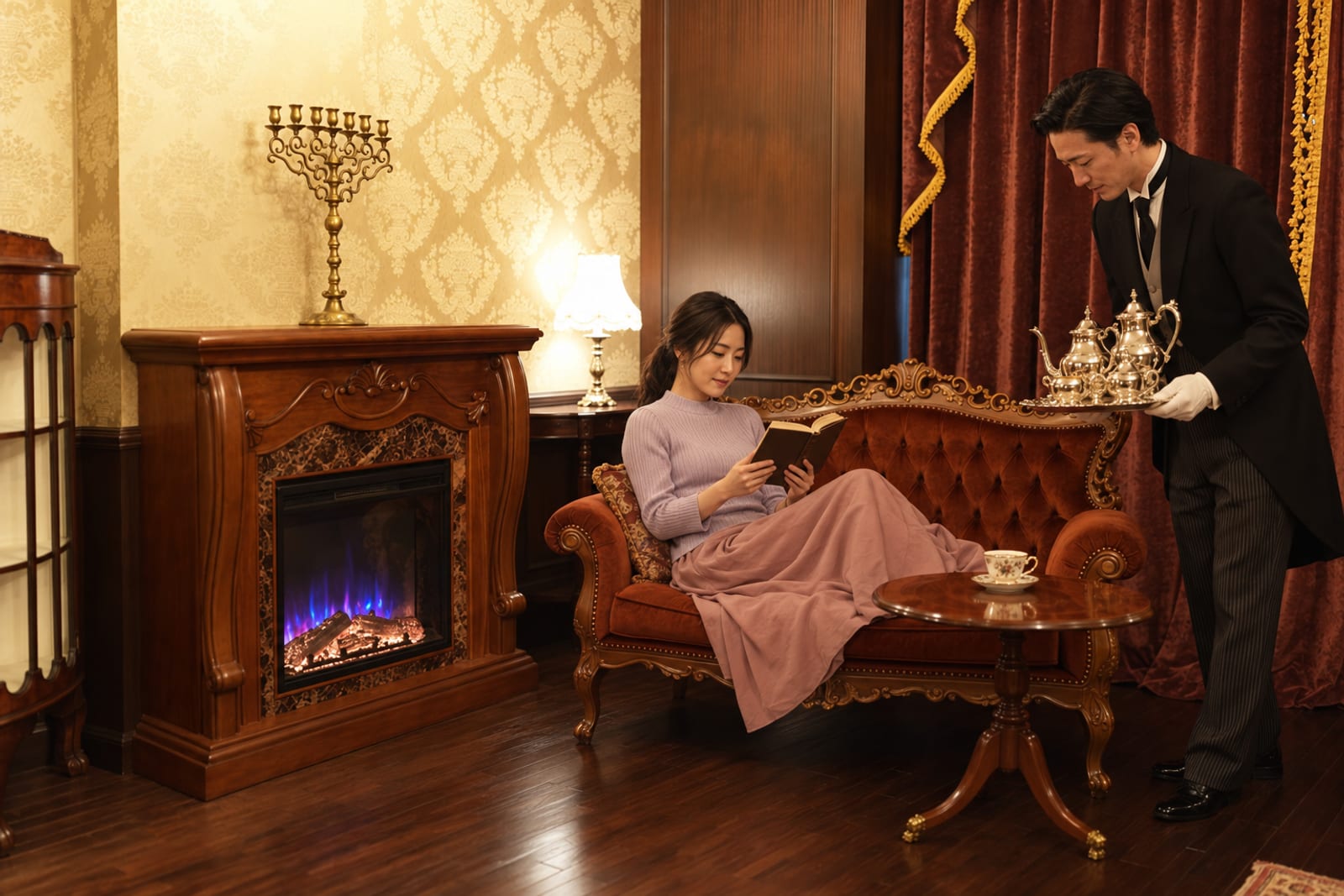
Read the dimensions by their distance from a person
Standing, sitting, opening a book: once a person's eye-line enters, the role of the width and height becomes clear.
IVThe clock and the pair of candlesticks create balance
On the mantelpiece, a clock at the centre and a pair of candlesticks to left and right, with a gilt-framed mirror above. The time at the centre, the light to either side, the mirror returning depth: these three form the vertical and horizontal axes and strengthen the frontality of the fireplace. An oil painting and roses add a soft variation within the strict symmetry.
The butler does not believe that more ornaments raise the standing of a room. Is the clock face visible? Do the candlesticks overlap the edge of the mirror? Do the flowers hide the flame? Each interval is set one by one. Empty space, too, is a component of the mantelpiece.
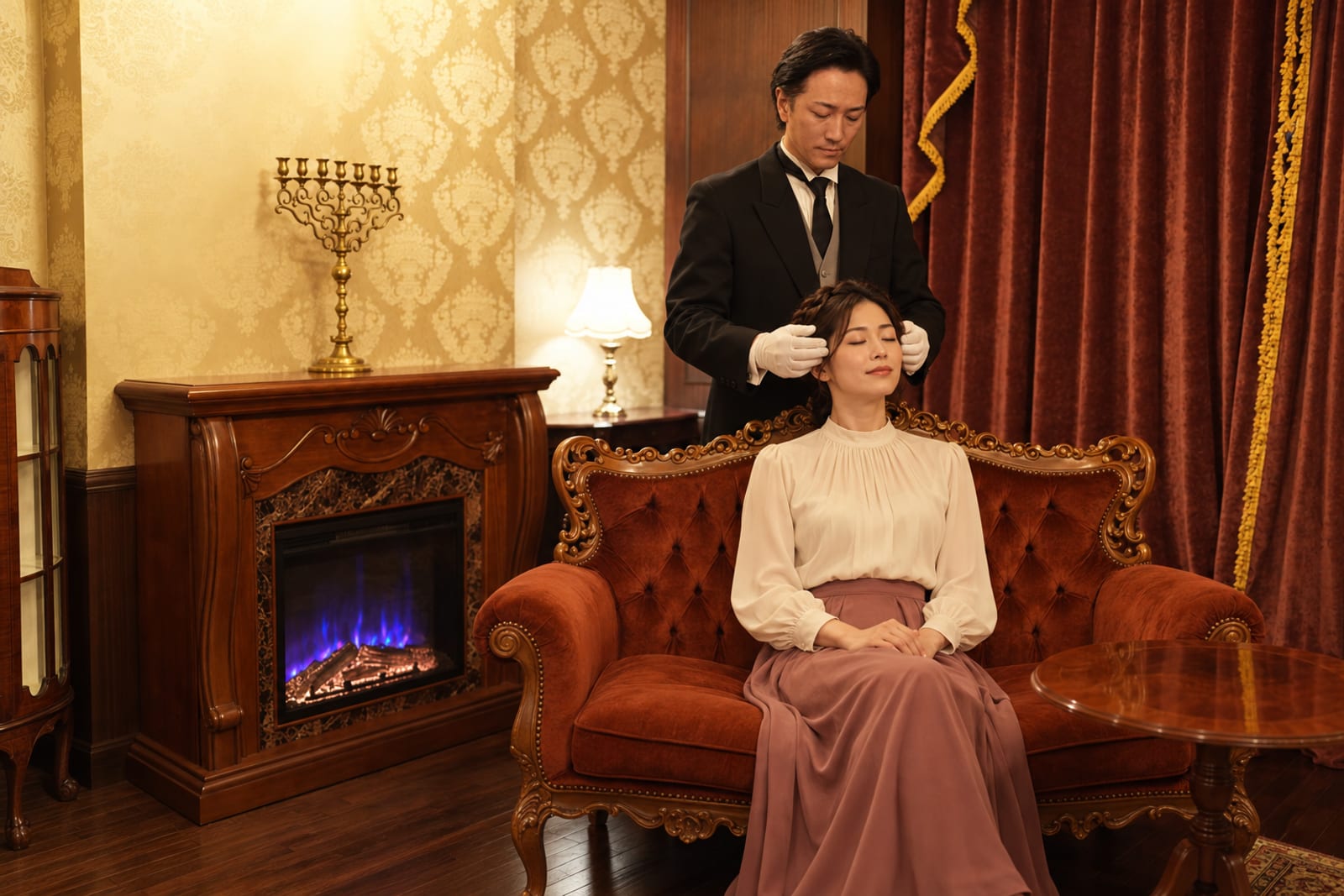
Within the symmetry, the softness of flowers and fabric
Keeping the axis of clock and candlesticks, roses and a blanket add a human presence.
VDamask, red fabric and gilt edges enfold the room
The walls are papered in gold damask. The name of damask weave derives from Damascus in Syria, and it has long been a pattern of distinction in Europe. At the windows, wine-red curtains with gold fringe. Not only the front of the fireplace but the walls and windows too are joined in the same vocabulary of colour.
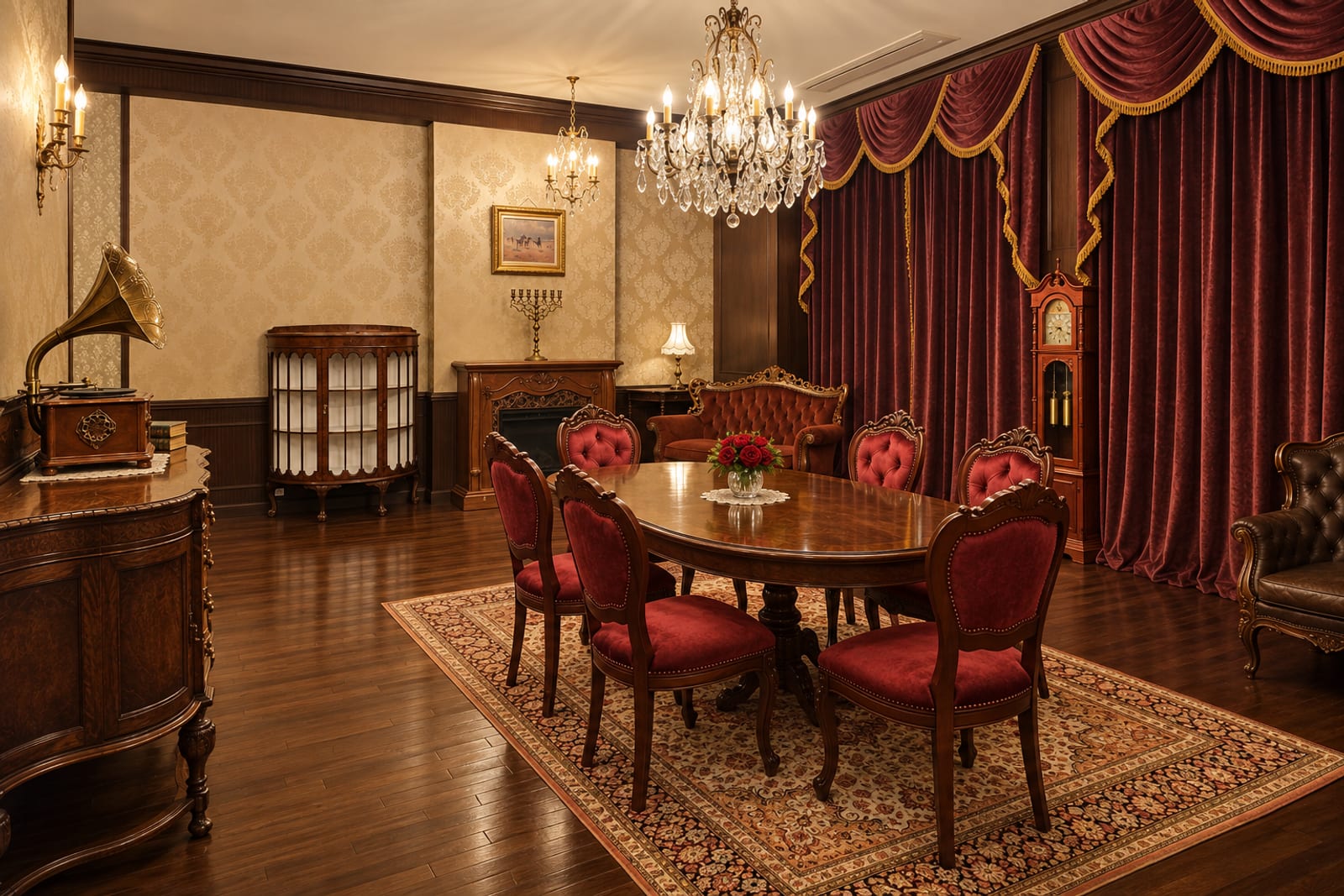
For seating, a rococo-style wine-red velvet sofa, a coffee table and a single chair. They are placed not only to face the fireplace, but at a distance that allows people to talk.
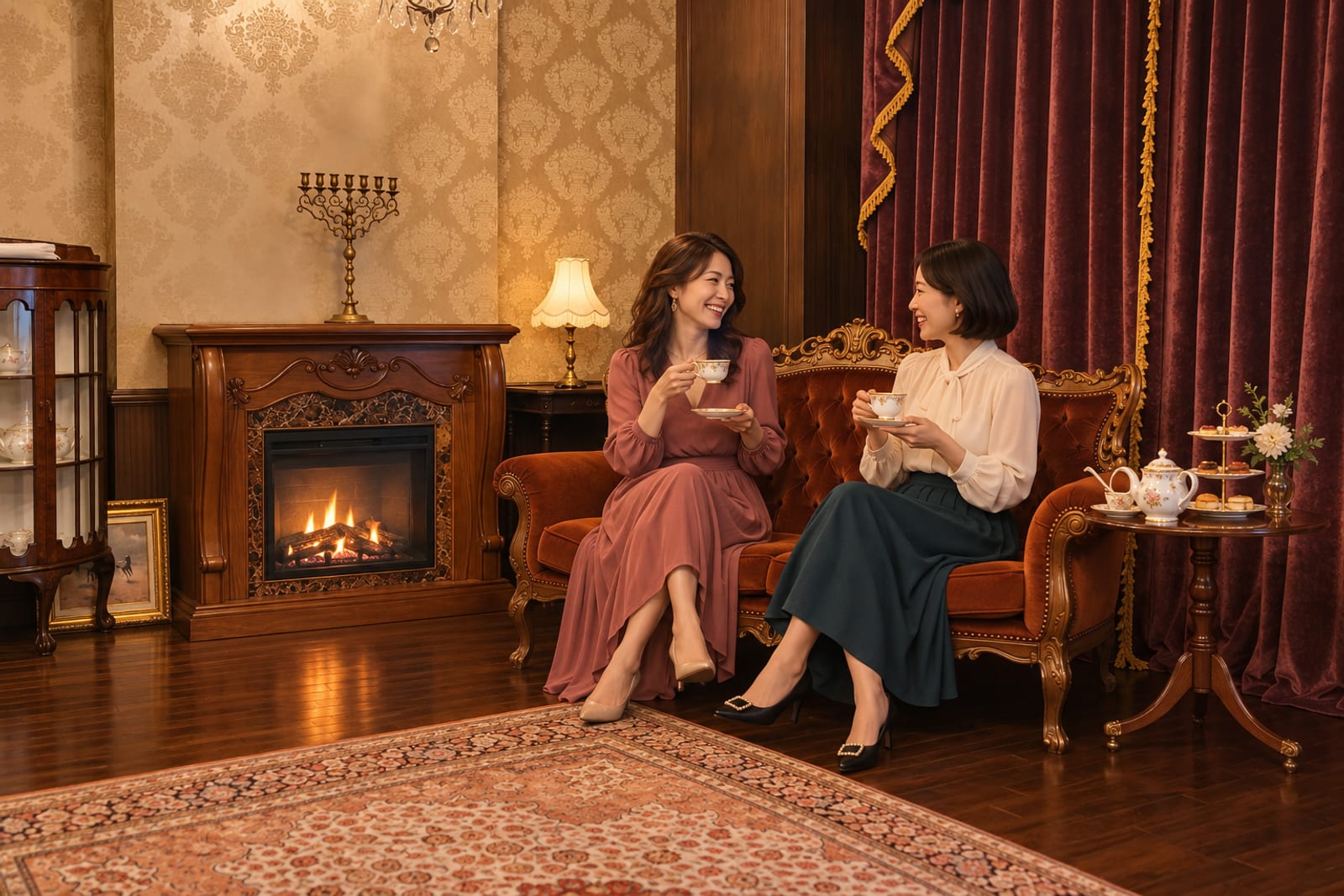
Around the fireplace, the distance between people is arranged
The salon's setting joins the seats so that the eye turns both to the flame and to the conversation.
The elements that make up the Lounge
| Element | At the Manor | Role in the room |
|---|---|---|
| Fireplace | Electric fire | Places a flicker low in the room |
| Mantelpiece | Walnut with marble effect, 1,150 mm wide × 1,019 mm high | Frames the flame and receives the ornaments |
| Garniture | Clock, pair of candlesticks, gilt-framed mirror | Creates the central and lateral axes |
| Walls and windows | Gold damask, wine red, gold fringe | Binds the colours of the whole room |
| Ceiling light | JOGLAR A0822, six lights, France, 1920s | Illuminates the whole from above |
| Seating | Rococo-style velvet sofa, coffee table, single chair | Turns the eye to the flame and to conversation |
The fireplace at the Manor is electric. The mantelpiece is walnut with a marble-effect finish.
VILayering the six-light chandelier with the flame of the fire
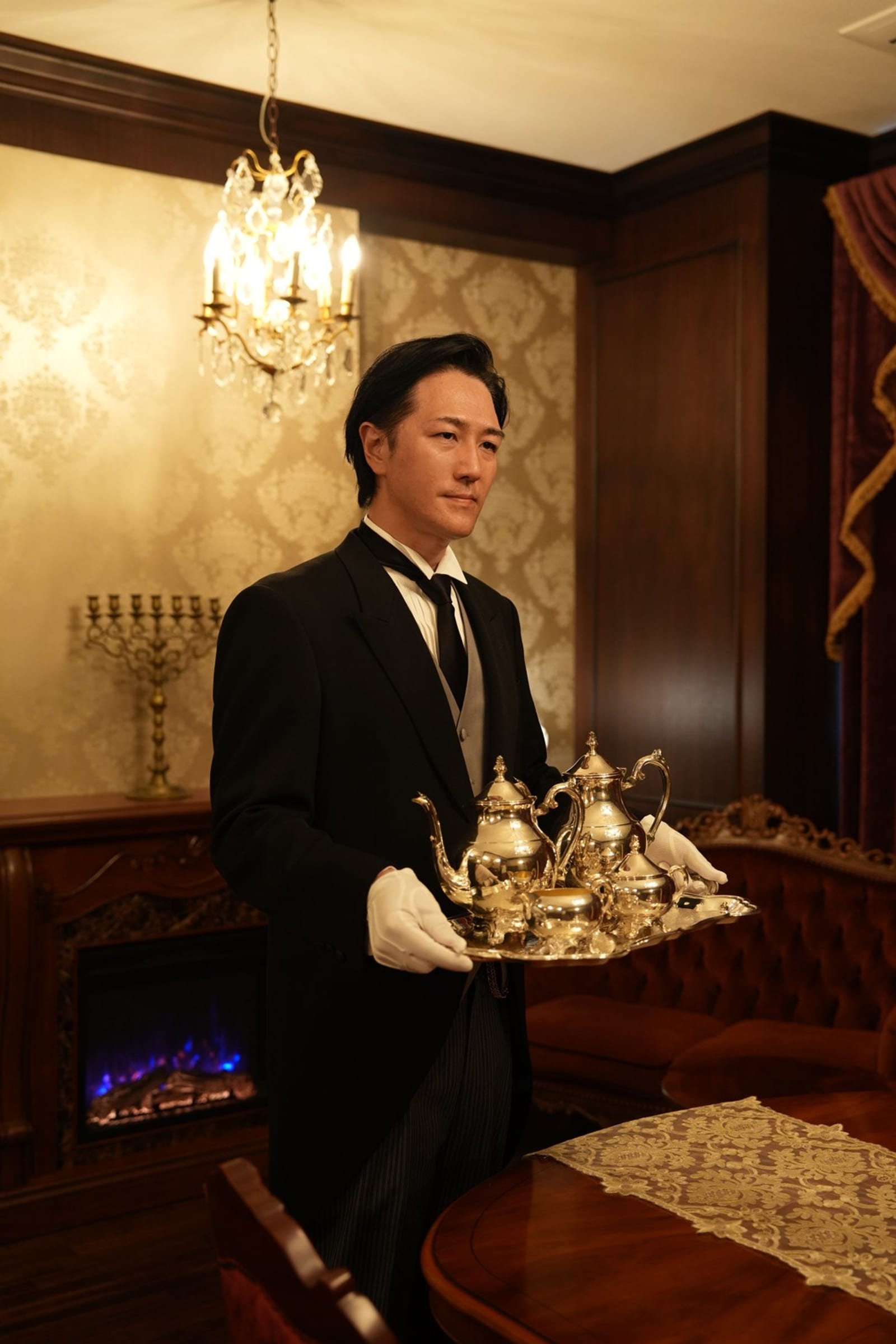
On the ceiling of the Lounge hangs a JOGLAR A0822 six-light chandelier, France, 1920s. Even light from the ceiling, and a local flicker from the fire. By layering the two heights, the mirror, candlesticks, oil painting and the texture of the velvet each come into their own.
Our male and female butlers ask whether the lady of the house will read, enjoy conversation or watch a film, and choose the light accordingly. Is the reflection in the mirror too strong? Are the hands too dark? The beauty of the furnishings and ease of the hour are arranged in the same place.
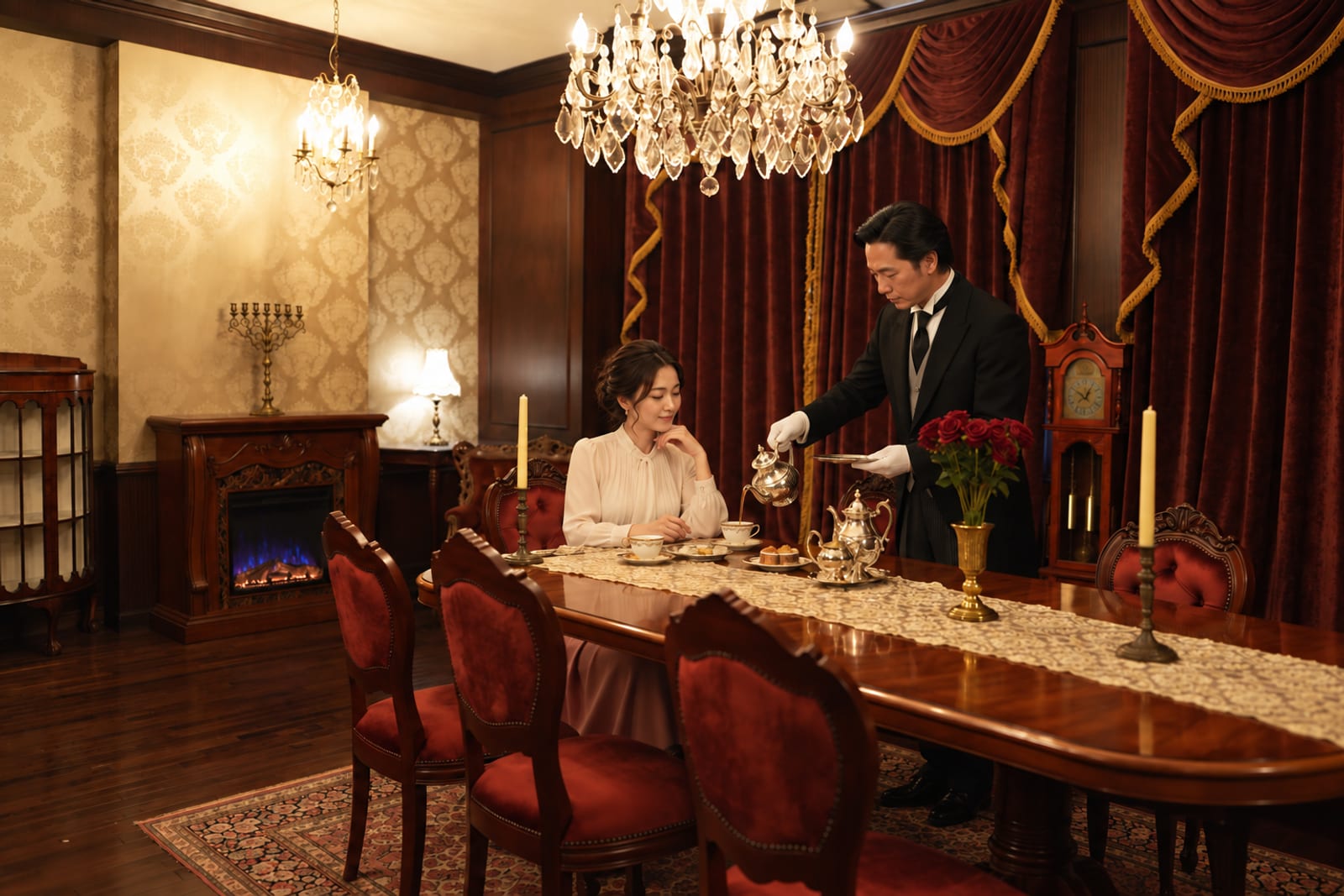
Choosing the height of the light to suit the hour
The light one looks up to, the light at hand and the low flicker of the flame are gathered by the butler into a single scene.
VIIEven when the screen rises, the centre of the room remains
From beside the wall of the Lounge, a 120-inch floor-standing motorised screen rises quietly. When not in use it disappears, and the mantelpiece, mirror, painting and sofa carry the expression of the room. Even while watching a film, leaving only the electric fire alight keeps the centre of the Manor visible in the dark.
Concealing modern fittings and revealing them only when needed is not the same as imitating old design. The butler keeps remote controls and cables out of the foreground and first sets the scenery of the Manor. It is a room in which the modern mechanisms of an electric fire and a motorised screen coexist with the classical composition of the mantelpiece without disturbing it.
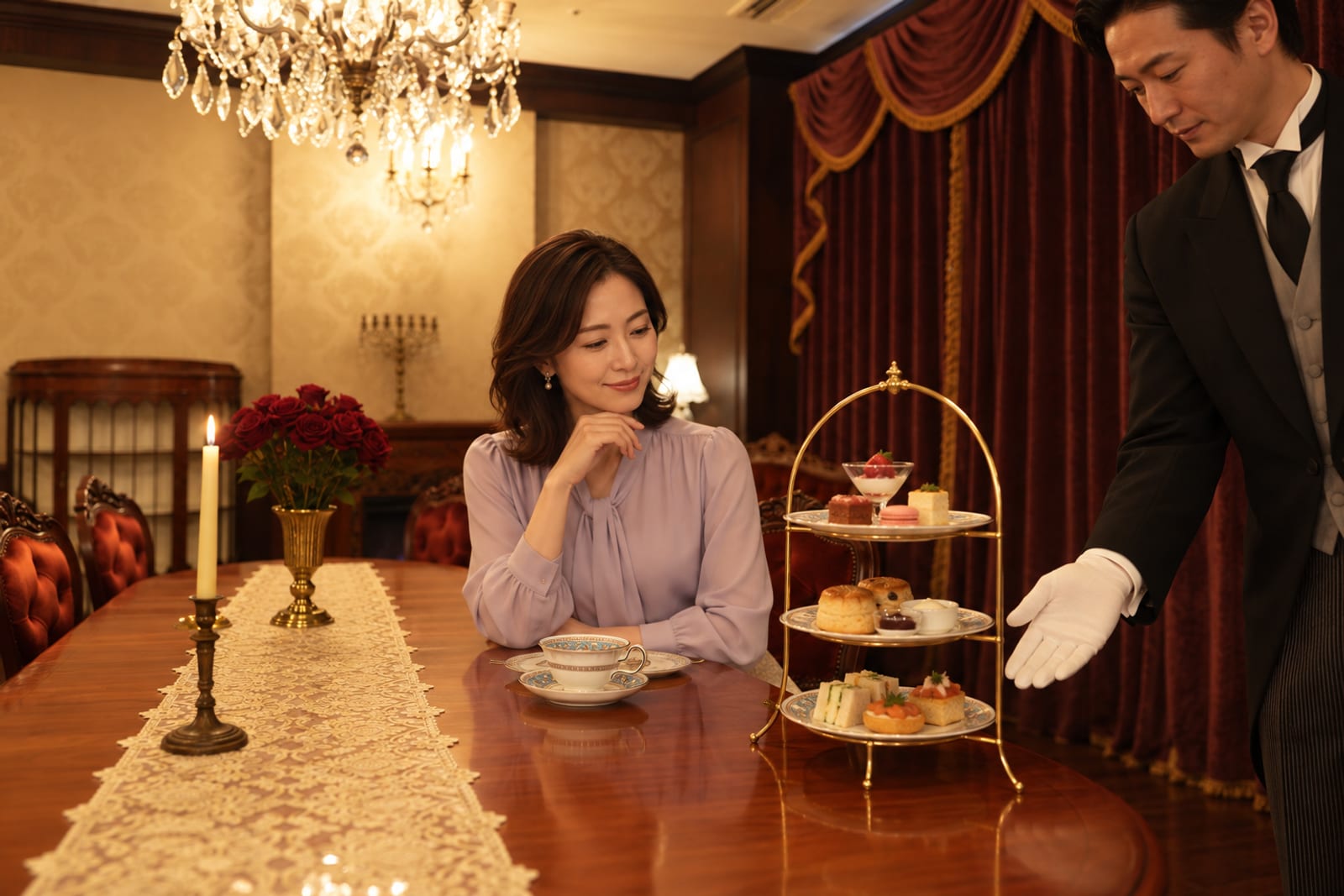
Fittings appear only when needed
Even with modern functions housed within, the axis of the room around the fireplace does not change.
VIIIWhich seat before the fire makes for the easiest hour?
Choosing a seat before the fire is not a matter of taking the place nearest the flame, but of settling a position from which the flame, one's companion and one's own hands fall naturally within view.
When you open a book alone, the butler checks the light at hand and the angle from which the mantelpiece is seen. For two, the line of sight for conversation comes first; for several, the path and the space around the table are kept wide. Even with six, we do not align everyone in a single posture, but choose an arrangement in which reading, talking and watching the flame can overlap.
The electric fire is the centre of the room not as a source of heat but as a low flicker. After lighting it, the butler checks the reflection in the mirror and the seated eye-line, adjusting the six lights or the wall lights if needed. Arranging from the point of view of the one who sits is how the fireplace is made the centrepiece.
IXWhy is the mantelpiece arranged symmetrically?
A symmetrical setting is not simply a matter of placing identical pieces side by side; it means balancing the weight of the pair of candlesticks, the mirror, the flowers and the oil painting against the clock at the centre. Once the frontal axis is fixed, the eye rises naturally from the electric fire to the mirror.
The butler checks that the clock face is not hidden by the flowers, that the candlesticks do not overlap the edge of the mirror too much, and that the space to left and right breathes evenly. Roses and fabric break the perfect symmetry a little and add a human presence. With both rule and variation, the ornaments do not look stiff.
The mantelpiece's dimensions of 1,150 mm wide and 1,019 mm high are also the size of the frame that receives the garniture. Seeing not only the opening of the fire but the shelf, mirror and candlesticks as one, you can understand from the present setting why it once bore the standing of the room.
XHow does the butler change the light between reading and film?
Adjusting the light is not a choice between a bright room and a dark one, but leaving the light where it is needed, where the eye is turned. For reading, the hands are lit; for conversation, a light is kept in which faces can be seen; for a film, reflections on the screen are subdued while the path is never lost.
The chandelier in the Lounge is a JOGLAR A0822, France, 1920s, with six lights. The 120-inch screen that rises from beside the wall is a modern fitting. Rather than setting the two, so different in age and purpose, against each other, the screen is revealed only when in use, and the electric fire remains as the Manor's low light.
Before your chosen film begins, the butler sets the light and the seats, and during the viewing waits at a distance that obstructs neither the sound nor the screen.
Five steps in looking at the fireplace
Establish the kind of flame
Knowing the Manor's is electric, see its flicker as a light.
Trace the outline of the surround
Look at the columns to either side, the lintel and the shelf, and grasp the composition of the mantelpiece.
Look at material and dimensions
Compare the walnut, the marble effect and the width and height against a person's eye-line.
Look at the axis of the garniture
Check the balance of clock, candlesticks, mirror and flowers at the centre and to either side.
Widen your view to the whole room
Read the centrality including walls, windows, sofa, chandelier and screen.
The words of the Lounge, by position and role
| Fireplace | At the Manor, the part that holds the electric fire and places a flicker low in the room |
|---|---|
| Mantelpiece | The architectural frame surrounding the flame to either side and above, receiving ornaments on its shelf |
| Mantel | The shelf at the top of the mantelpiece, where clock and candlesticks stand |
| Gilt frame | The gold edge surrounding the mirror, returning flame and light to the front |
| Damask | The design used on the wallpaper, creating a repeating pattern on a gold ground |
What the butler sets in the Lounge
- Choosing which light to leave from the electric fire, the six lights and the wall lighting
- Checking the axis and spacing of clock, candlesticks, mirror and flowers
- Arranging seats that keep lines of sight and paths clear, from one guest to six
- Revealing the screen only when in use, and returning to the view of the fireplace when it is stowed
What we do not do in the Lounge
- Presenting it as a fitting that burns wood or fuel
- Dating each piece by the name 'Victorian salon' alone
- Leaving the screen in the foreground of the room at all times
Before the fire, three ways to spend the time
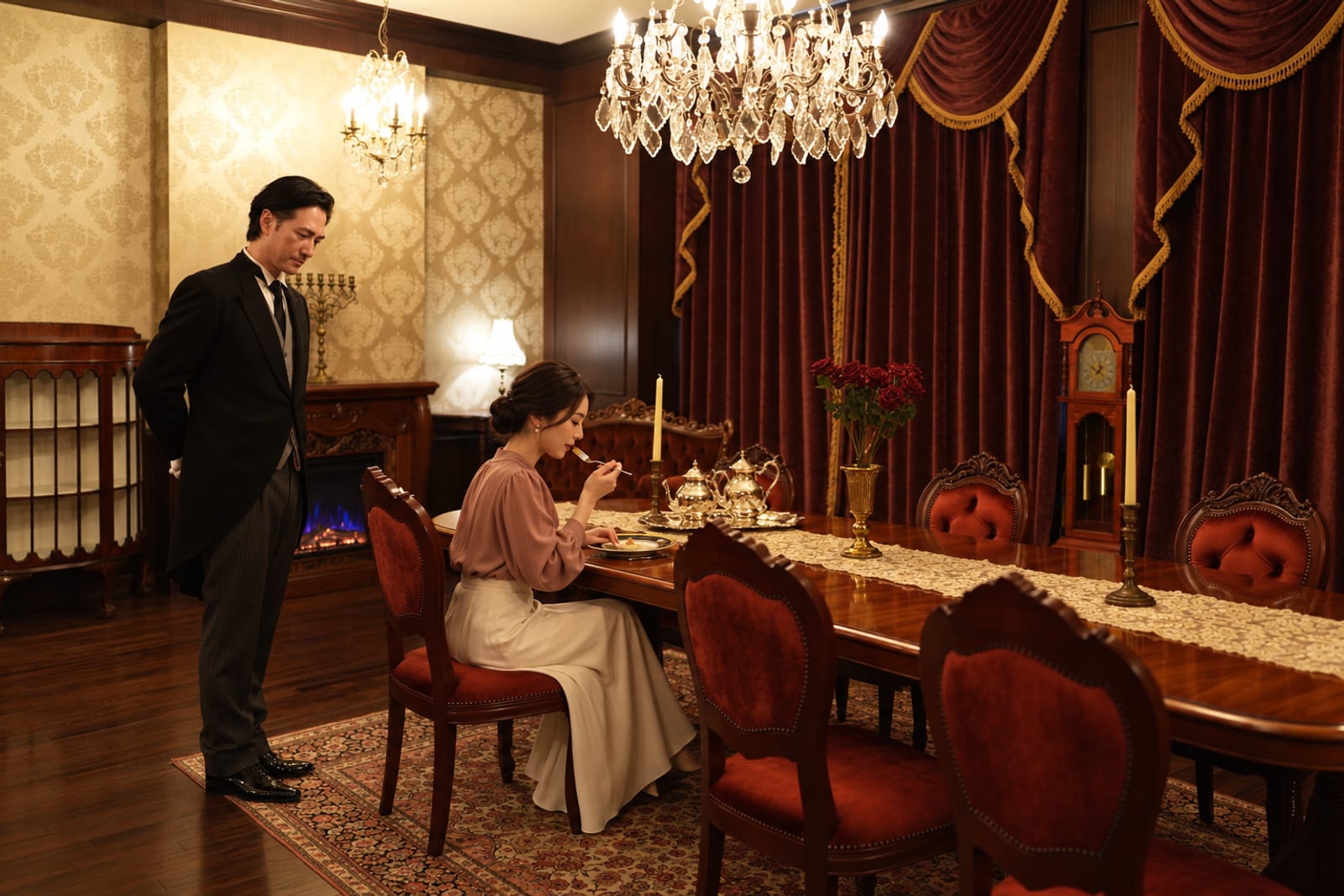
Open a book between the flame and your hands
The butler secures the light at hand and sets a seat from which the electric fire and mirror are in view, then withdraws to a distance that does not disturb the turning of pages, keeping the quiet of reading.
Read more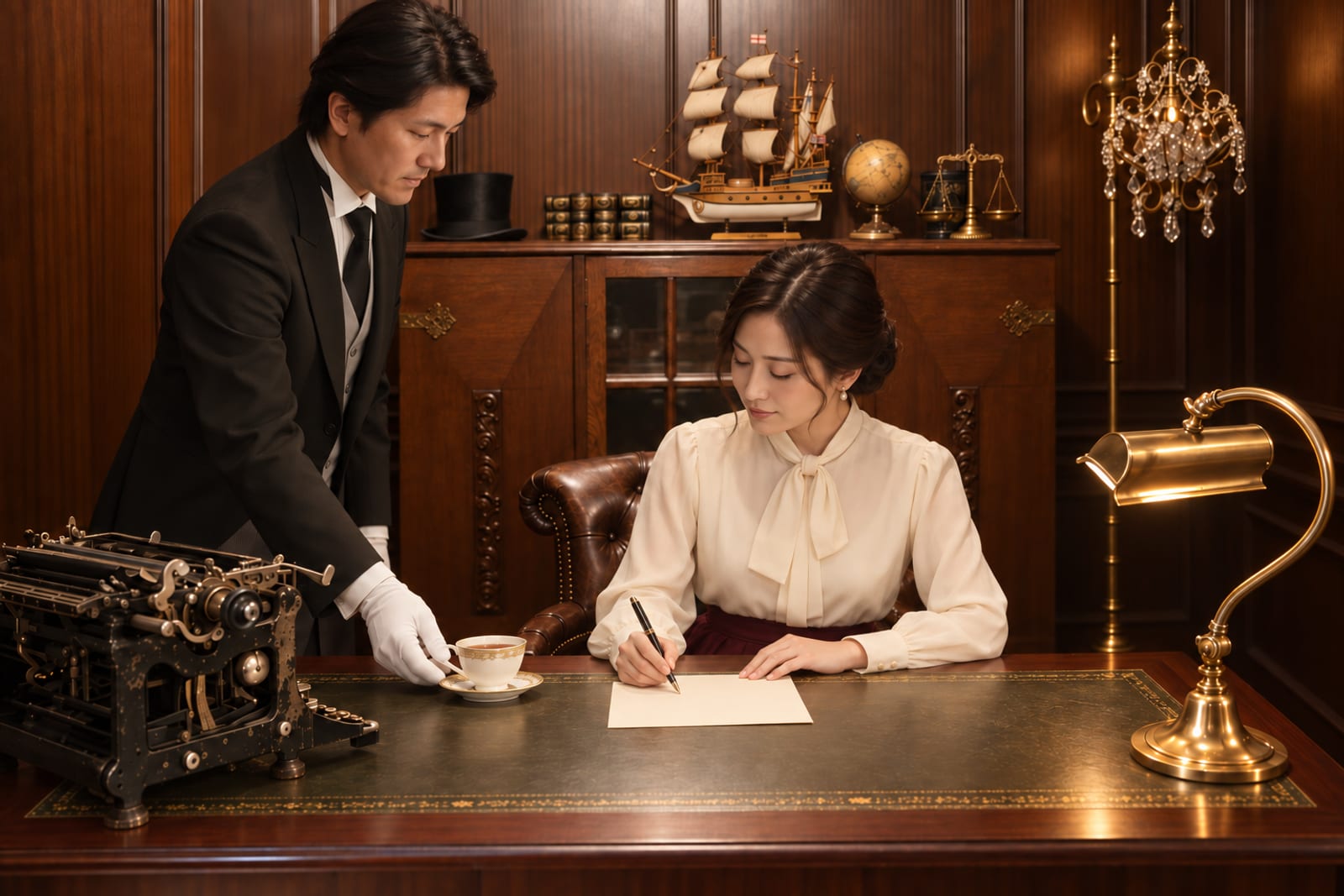
Let conversation slow in facing seats
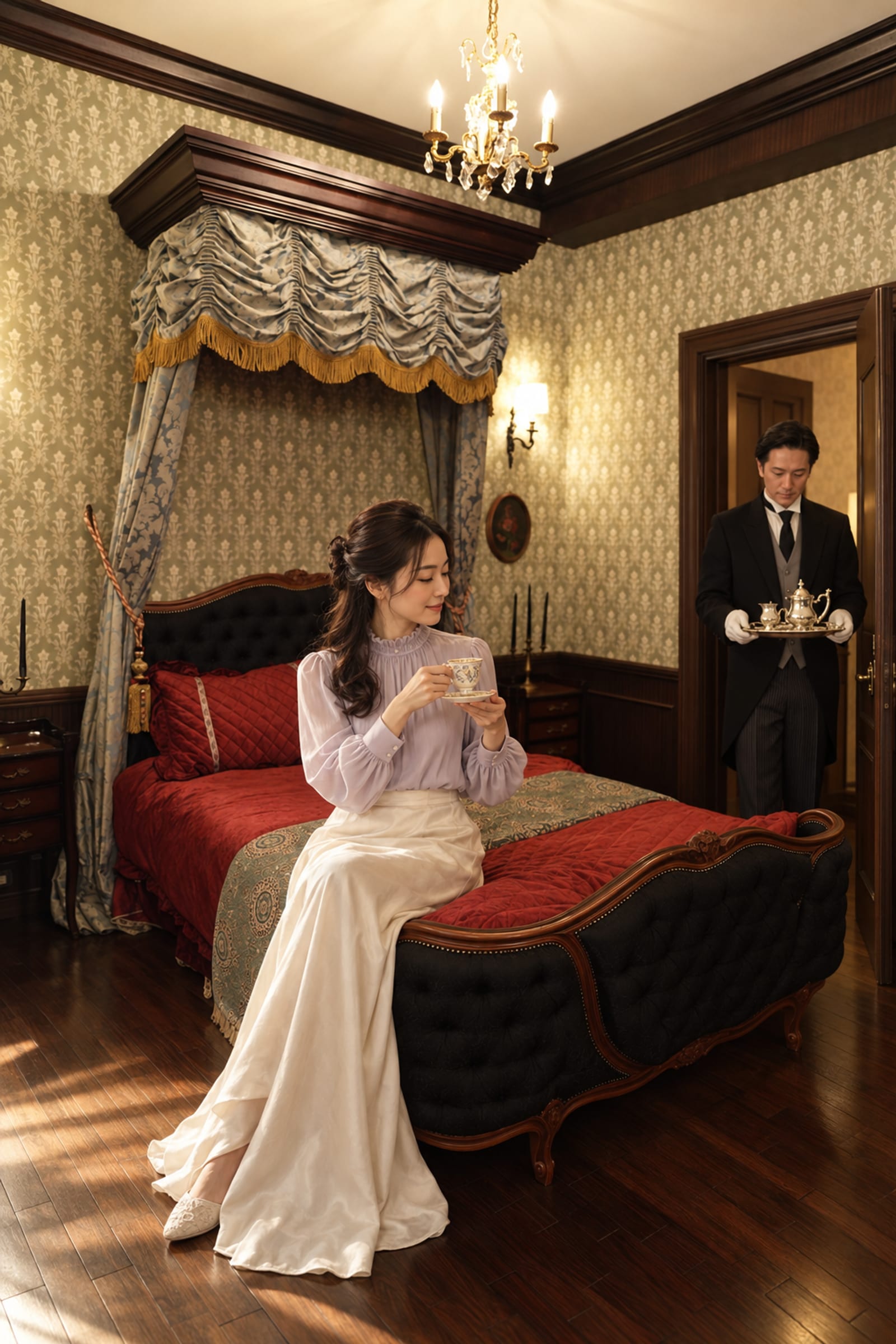
Making use of the angle between sofa and single chair, we arrange the seats so that both your companion's face and the flame are within view. The butler waits nearby until called.
Read more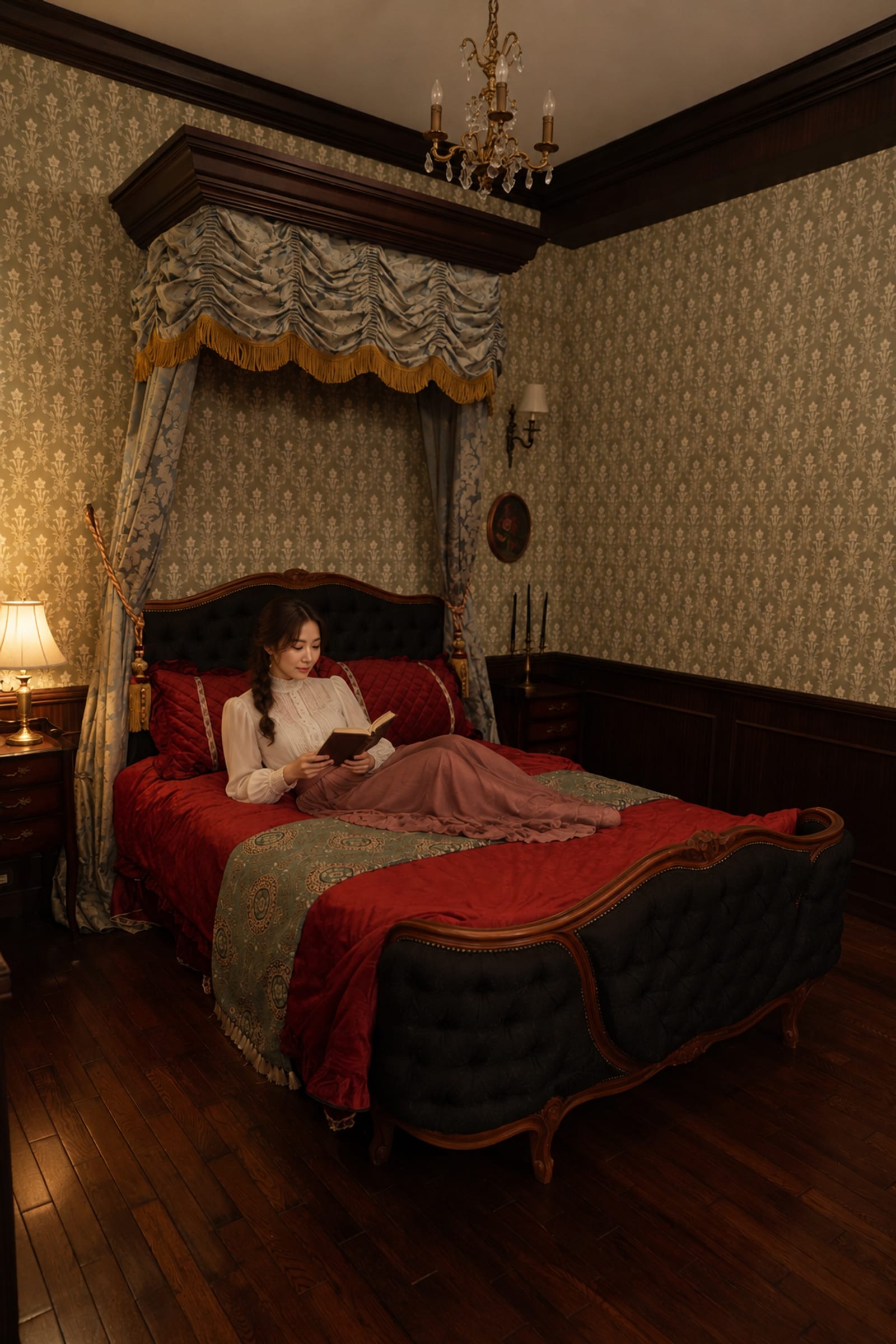
Watch a film with the low flame left alight
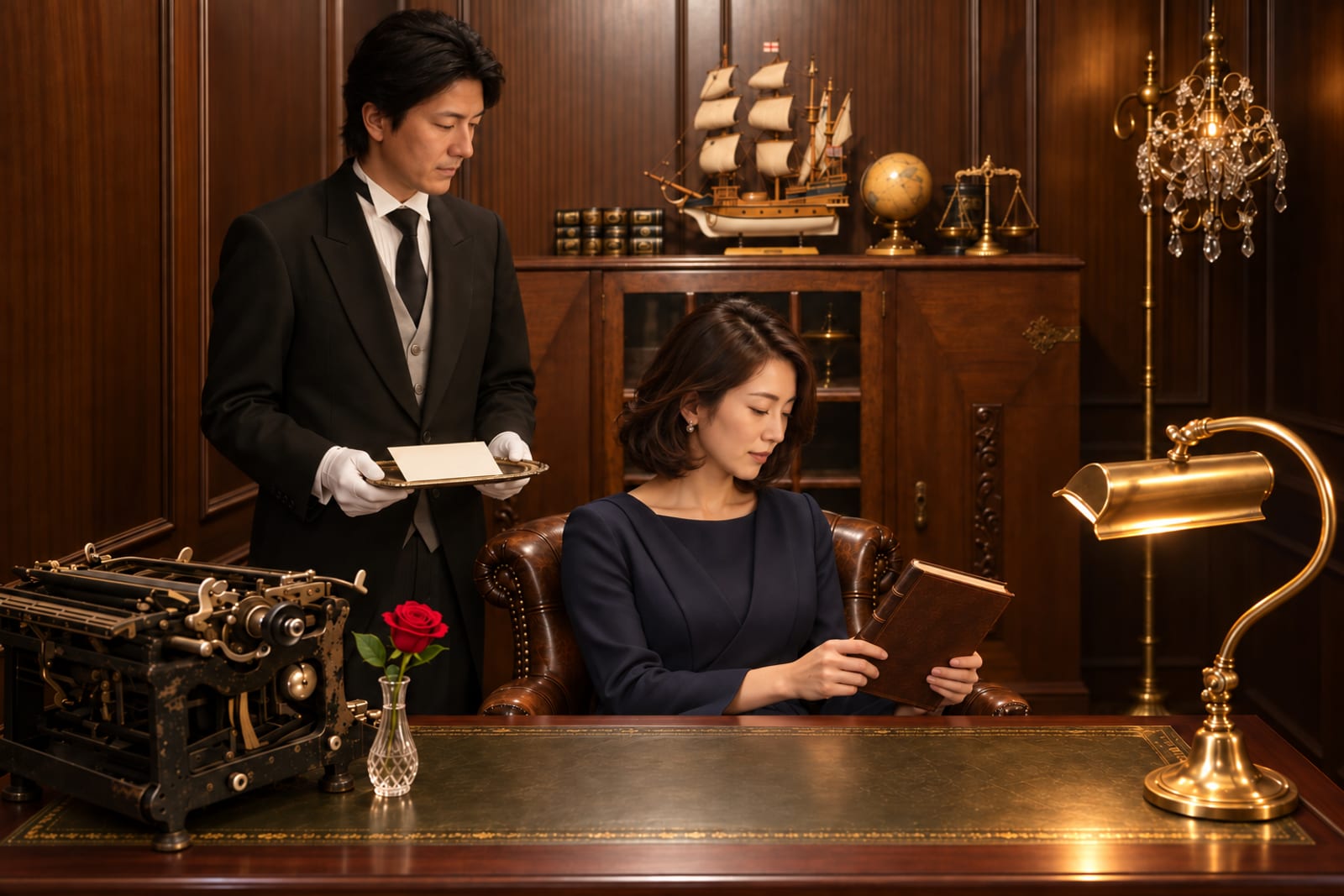
We raise the 120-inch screen, subdue reflections, and choose a light in which you will not lose your footing.
Read moreQDoes the Manor's fireplace burn wood?
No. The Manor's fire is electric. The butler lights and extinguishes it on request, matching it to the chandelier and wall lights.
QWhat is a mantelpiece?
The architectural surround of the fireplace opening, formed by the columns to either side, the lintel and the shelf. At the Manor it is also where the clock, candlesticks, mirror and flowers are placed.
QDoes the name 'Victorian salon' refer to the date of the fireplace?
No. It describes the setting of the Lounge as a whole. For the dates of individual pieces, we give only what is in the Manor's records.
QCan a female butler set the lights for me?
Yes. Both male and female butlers are in residence, and set the light to suit reading, conversation, film and other ways of spending the hour.
QCan I spend time in the Lounge alone?
Yes. The butler checks the light at your hands, the flame and the position of the mirror, and prepares a seat where you can settle. When you wish for quiet rather than conversation, we wait at a distance that can reach you when needed.
QHow are films watched?
The butler sets the screen, the light and the seats.
You may also wish to read


A seat before the flame, prepared by your butler.
See the centre of the room created by the electric fire, the mantelpiece, the mirror and the light.