
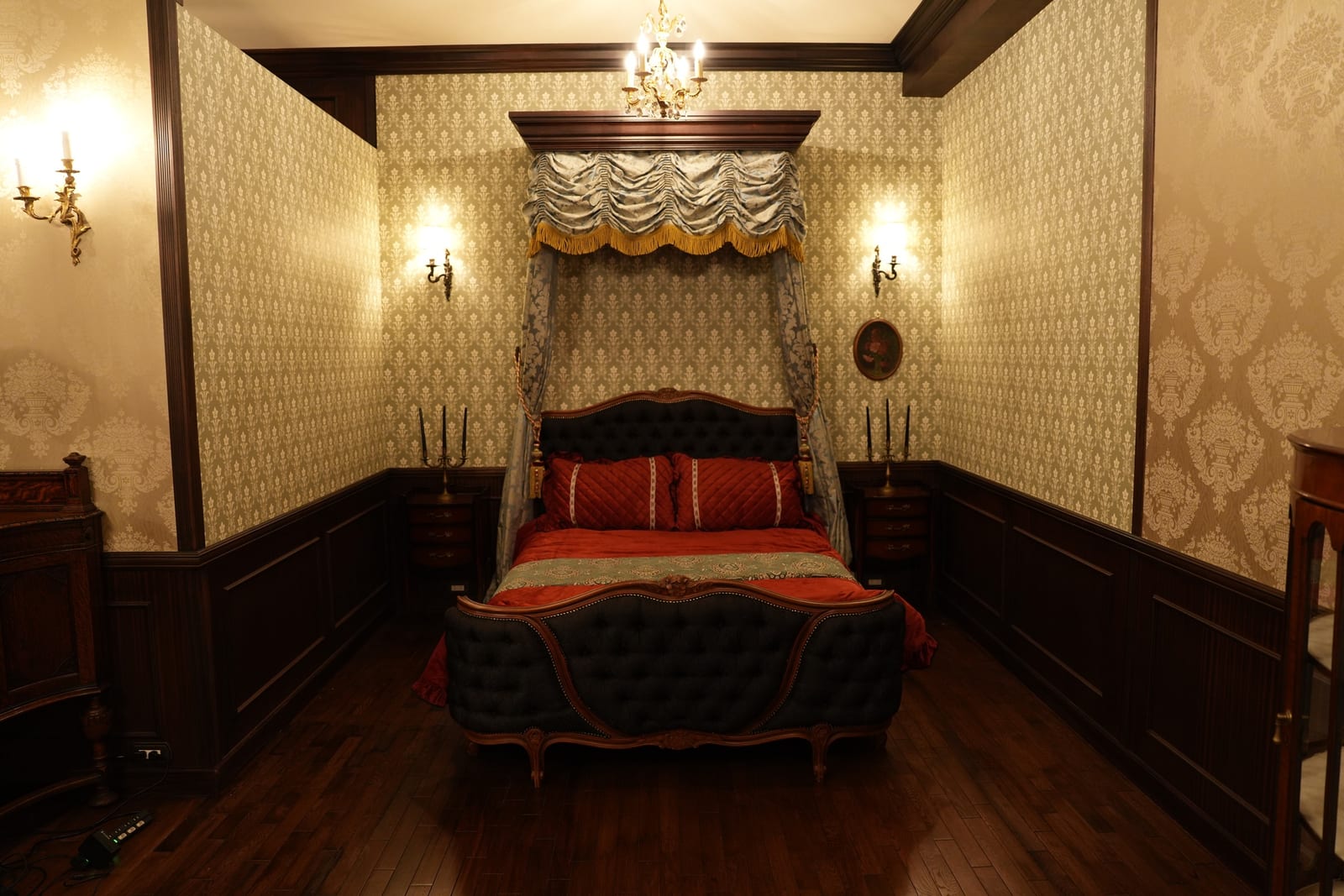
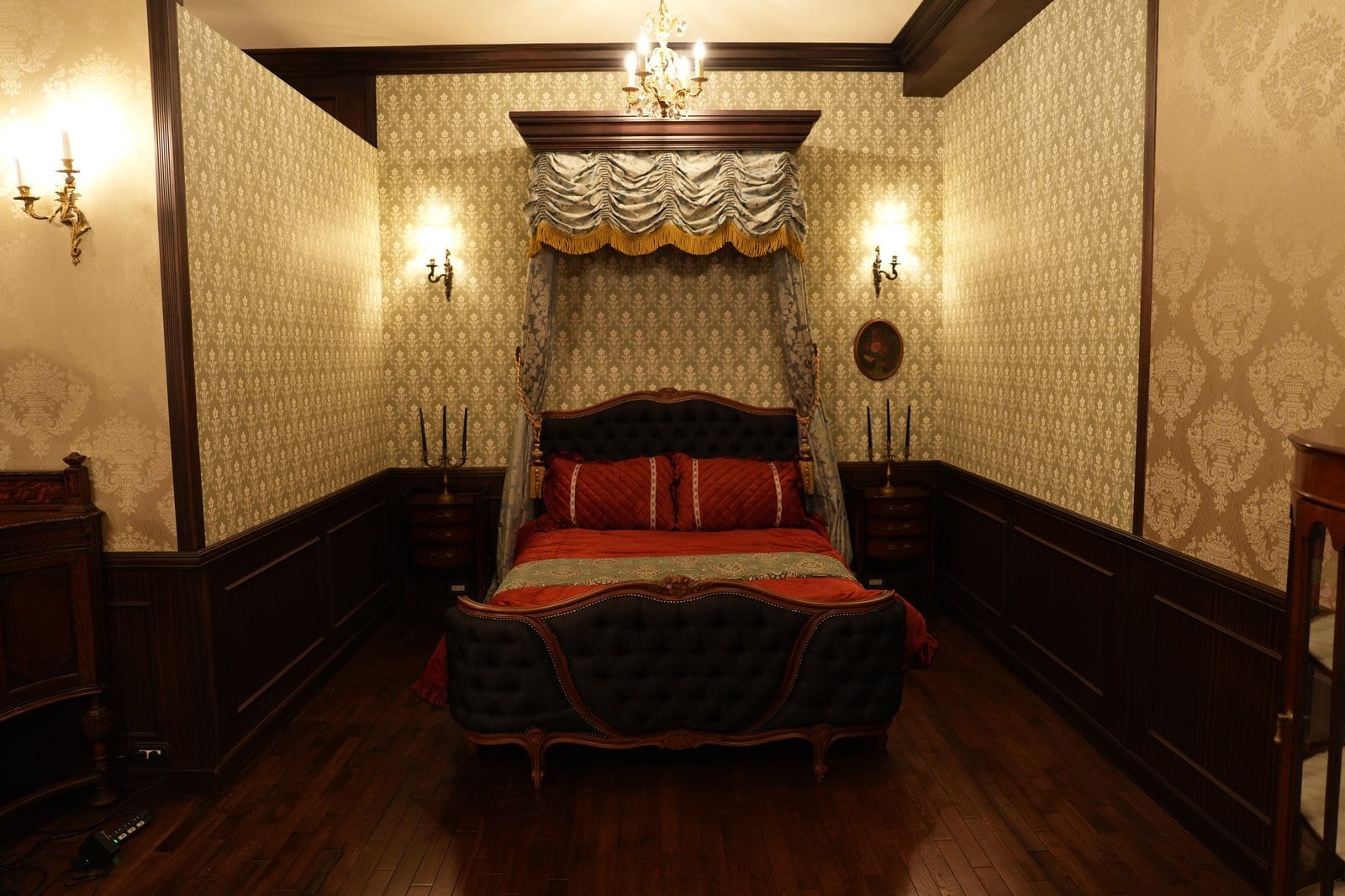
19th-Century French Corbeille Bed
Like a flower basket, it cradles the one who sleeps.
About 19th-Century French Corbeille Bed
A corbeille bed is a 19th-century French form of bedstead in which both the head and the foot rise in tall curves, enclosing the sleeper like a basket (corbeille, a flower basket). Ours is upholstered in black silk damask, worked in capitonné and framed in full carving. The bed is a training fixture for butler education, and you are welcome to rest on it during your stay.

An original 19th-century French piece, examined through its fabric, carving and linen
| Name | Corbeille bed. A form of bedstead named after the flower basket |
|---|---|
| Period and origin | An original 19th-century French piece |
| Upholstery | Black silk damask |
| Technique | Capitonné (button-tufted padded decoration) |
| Frame | Fully carved, with curved head and foot |
| Linen | Burgundy and gold damask, 1,000-thread-count Egyptian cotton, gold embroidery |
Corbeille is the French word for a flower basket
Corbeille means flower basket in French, and describes a form of bedstead in which the frame rises in tall curves not only at the head but also at the foot, enclosing the body like a basket. Our piece dates from 19th-century France; it is upholstered in black silk damask, its surface worked in capitonné and its perimeter framed in full carving.
Seen from the side, the resting place is sheltered between two high edges. From the front, the carving and fabric carry a strong sense of volume; from an angle, the basket-like curve becomes clear. Before anyone sits on the bed, the butler checks the condition of the linen and frame and arranges the sequence: where to take in the whole, where to look at the details, and how to approach it to rest.
Once you notice how the tall curves at head and foot enclose a person, the name and the object come together. Your butler briefly states the period, origin and form, then leaves you time to trace the curves with your own eyes.
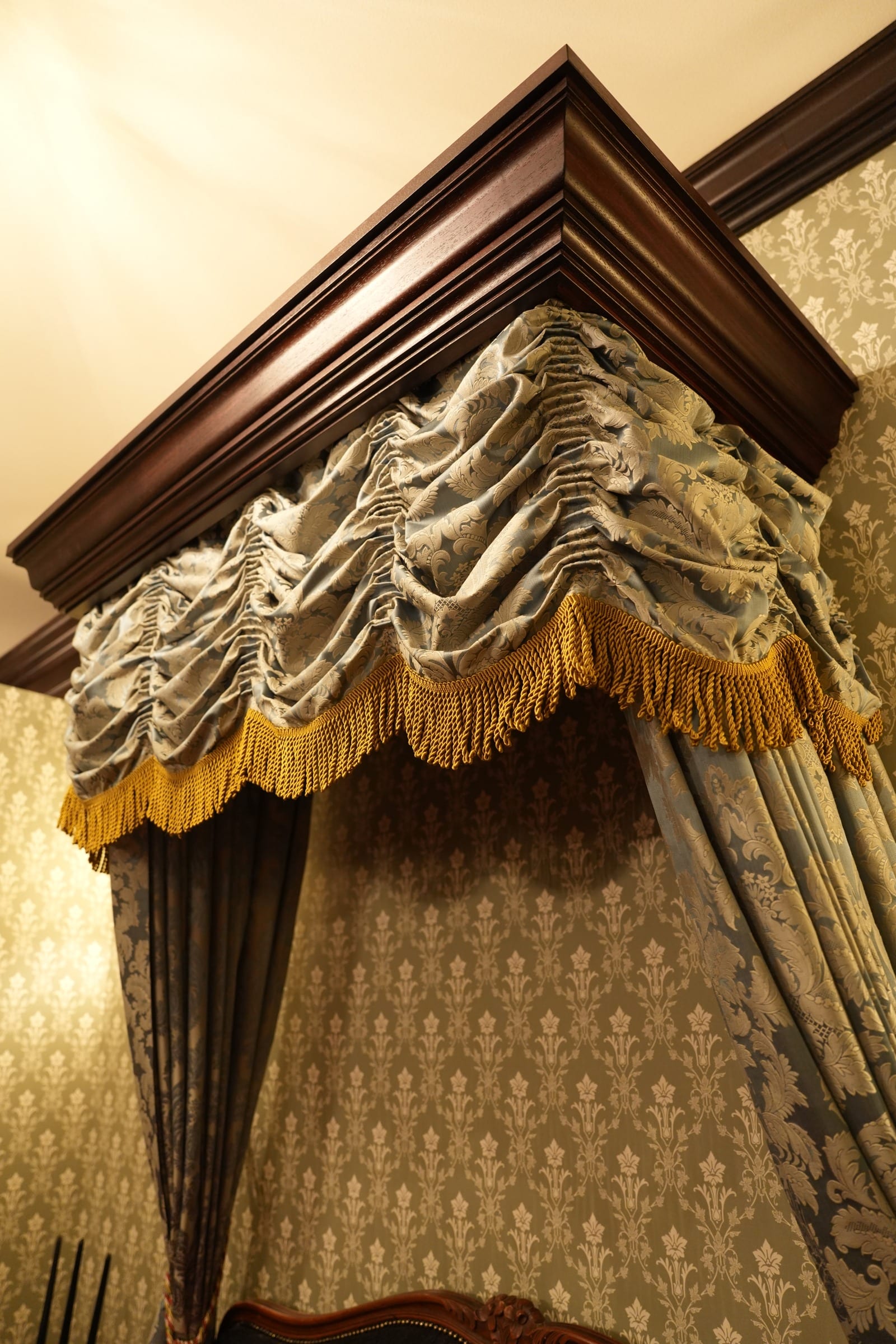
The canopy lets silk pleats and gold tassels fall from a wooden cornice
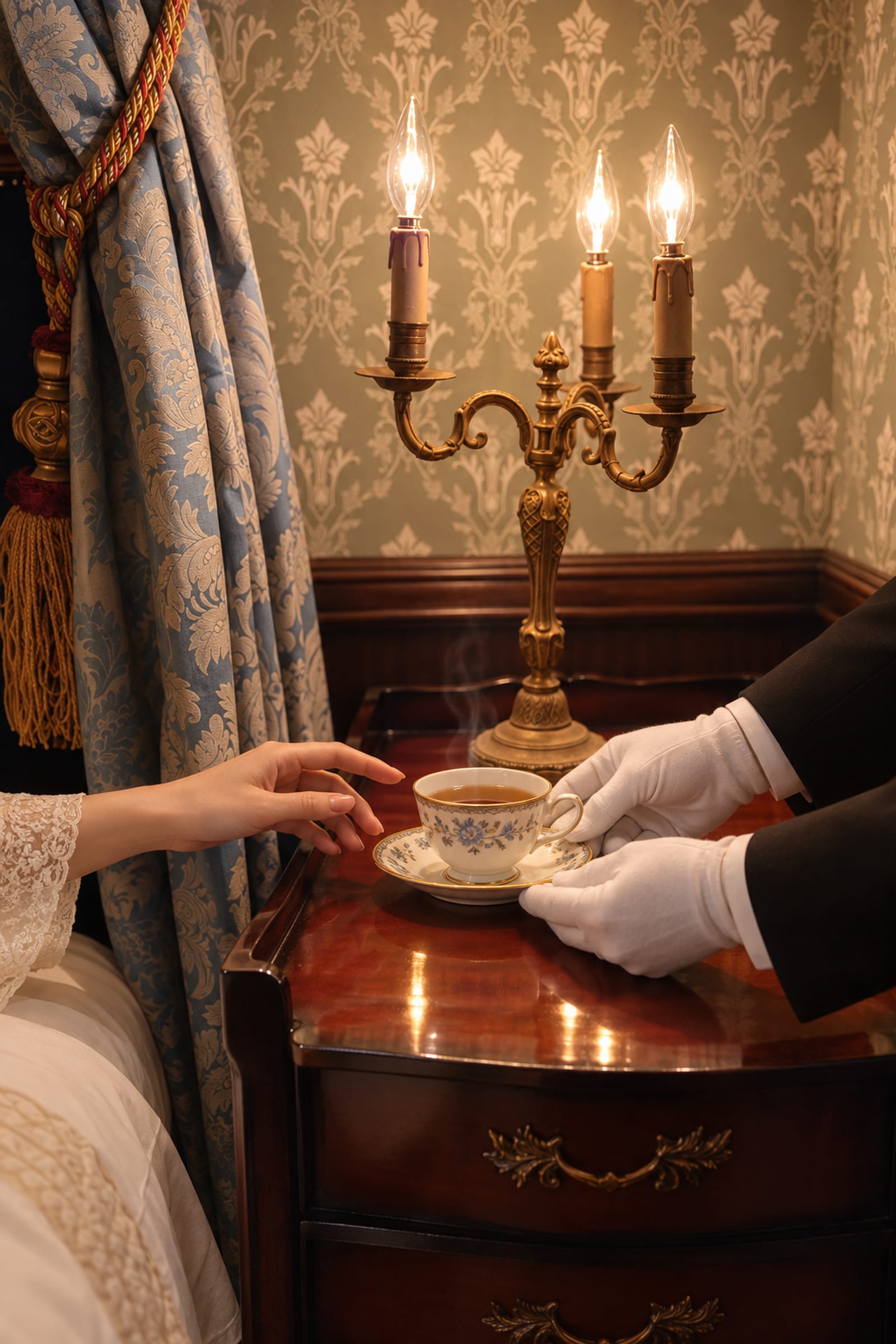
Above the head of the bed hangs a wall-mounted canopy. From a mahogany-coloured wooden cornice, a valance of finely gathered blue-grey damask hangs down, its edge trimmed with gold fringe. The drapes flowing to either side are held back with cord and large tassels.
The canopy turns the bed into a room within the room. Before you rest, your butler arranges the drapes and lowers the candlestick lamps so that only the inside of the canopy is softly lit.
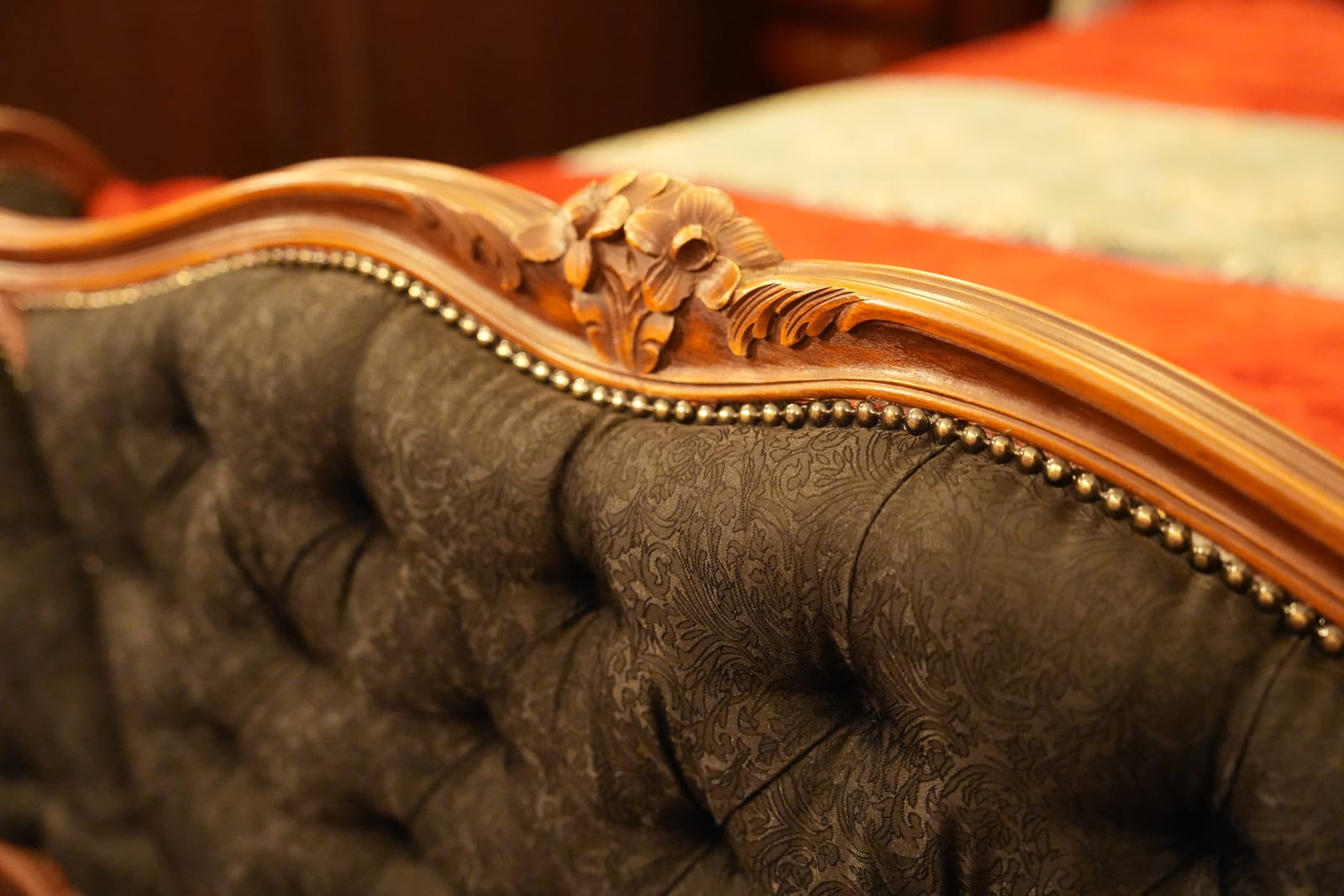
Capitonné is the technique of buttoning fabric into diamonds to create fullness
Capitonné is an upholstery technique in which fabric is buttoned into a diamond pattern, creating a regular rhythm of swells and hollows. It is one of the techniques that symbolise the salon culture of 19th-century France, and on this bed it is used across the black silk damask.
Up close, look at a single diamond; from a little further back, take in the whole repeating field. The hard outline of the full carving sits beside the soft fullness of the capitonné, and even within the black fabric, different textures emerge. Your butler will show you the distance from which it can be seen without pressing the fabric, and for photographs will find the position where raking light does not flatten the pattern.
In the bedroom at Queen's Butler, the black silk damask becomes the background that sharpens the burgundy and gold linen. Rather than counting colours, look in this order: black upholstery, gold embroidery, deep red. You can then separate the outline of the bed from the role of the linen that is arranged each day.
On either side of the bed, lamps and cabriole-legged chests balance left and right
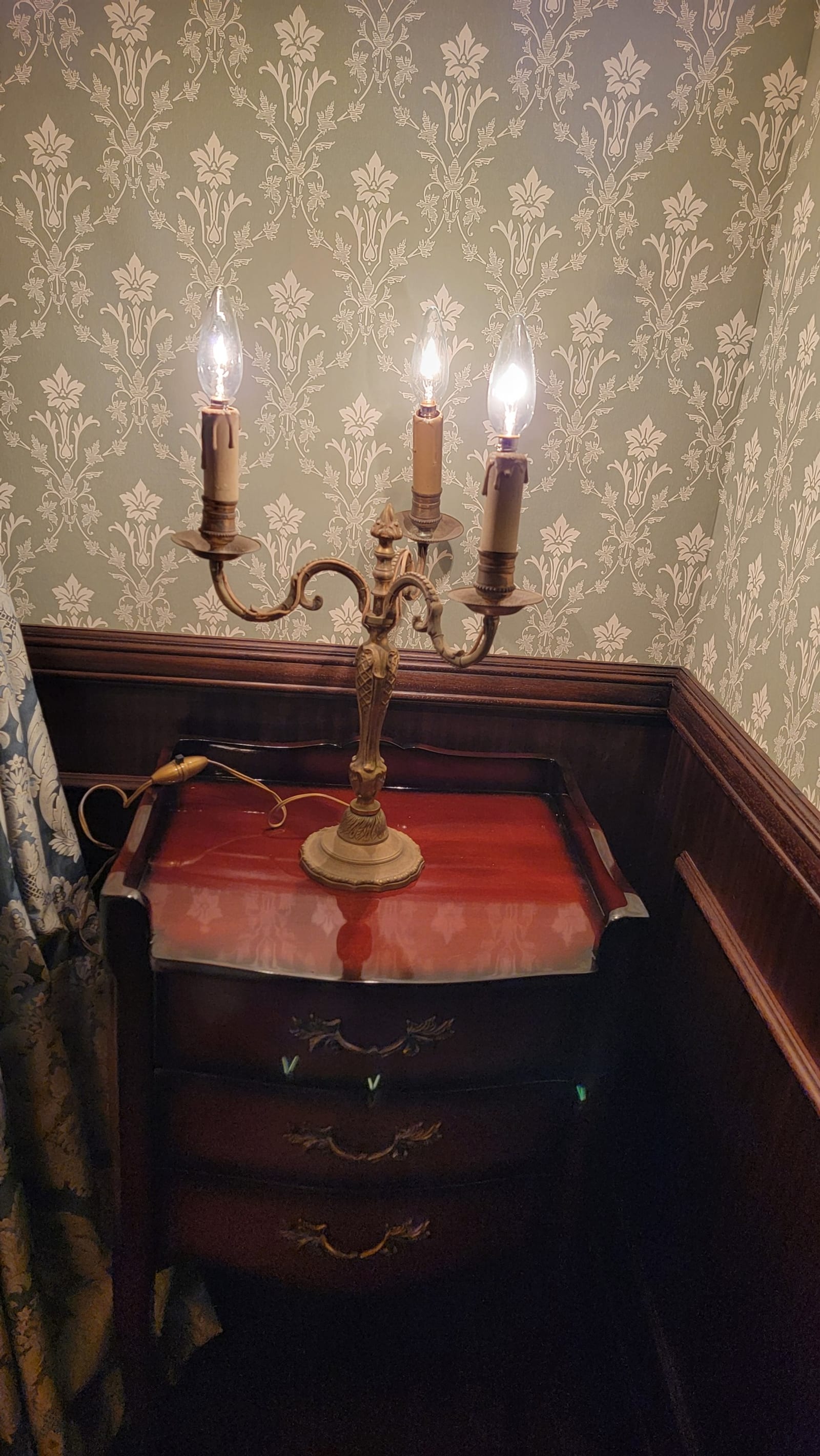
The setting of the bed includes not only the corbeille itself, but the Majorelle four-light bronze chandelier on the ceiling, a pair of Rococo-style wall brackets and a four-light crystal-drop bracket on the walls, and the mahogany three-drawer side chests to either side.
The side chests stand on cabriole legs. Mahogany was a timber prized in 18th-century English furniture, so beside a French bed stands a material that belongs to the English furniture tradition. Rather than confining everything to one period or country, the Manor is furnished so that different origins gather around the bed.
At night the wall lamps cast close shadows across fabric and carving; in a scene that suggests morning, the embroidery on the linen shows more clearly. Your butler adjusts the light and, depending on your purpose — resting on the bed, a commemorative photograph in the manner of morning tea, or a photograph in costume — tells you in advance what may be touched and where belongings may be placed.
Five points of observation lead you from the basket's form to the fabric's detail
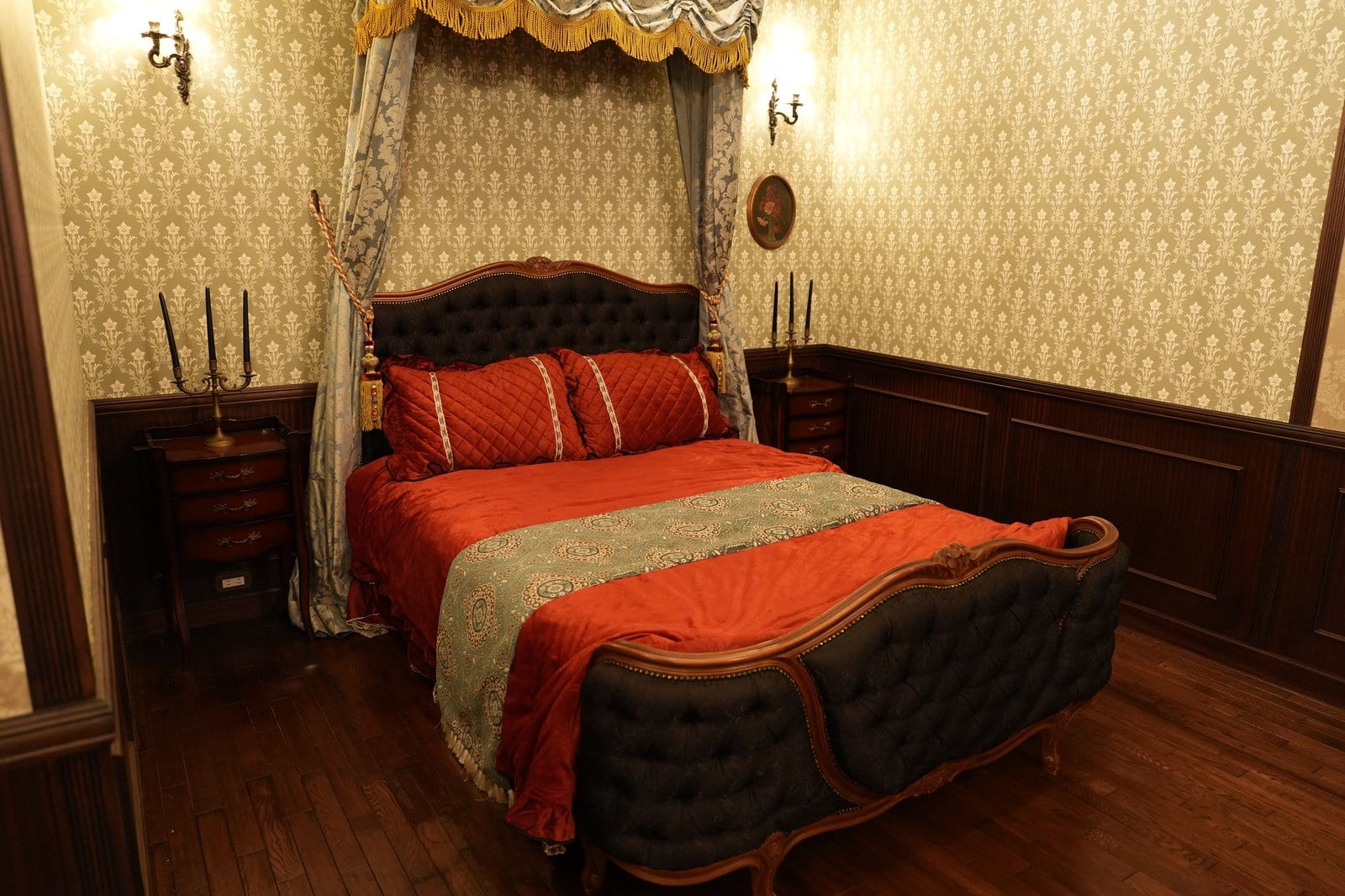
The curves at head and foot
From the doorway, take in the whole and see how two tall curves enclose the body.
Read more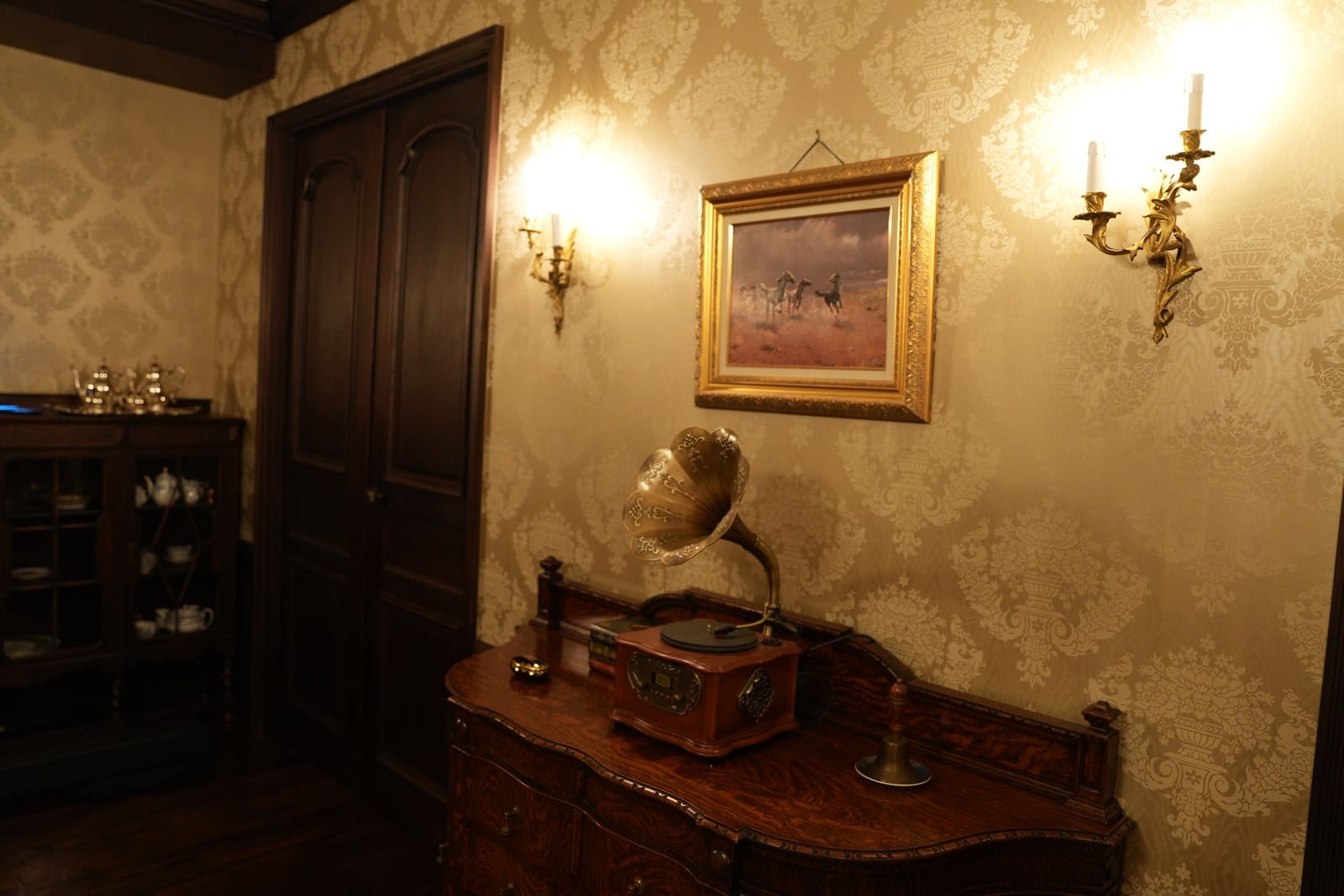
The fully carved outline
Follow the frame from an angle and see the carving that continues beyond the curves.
Read more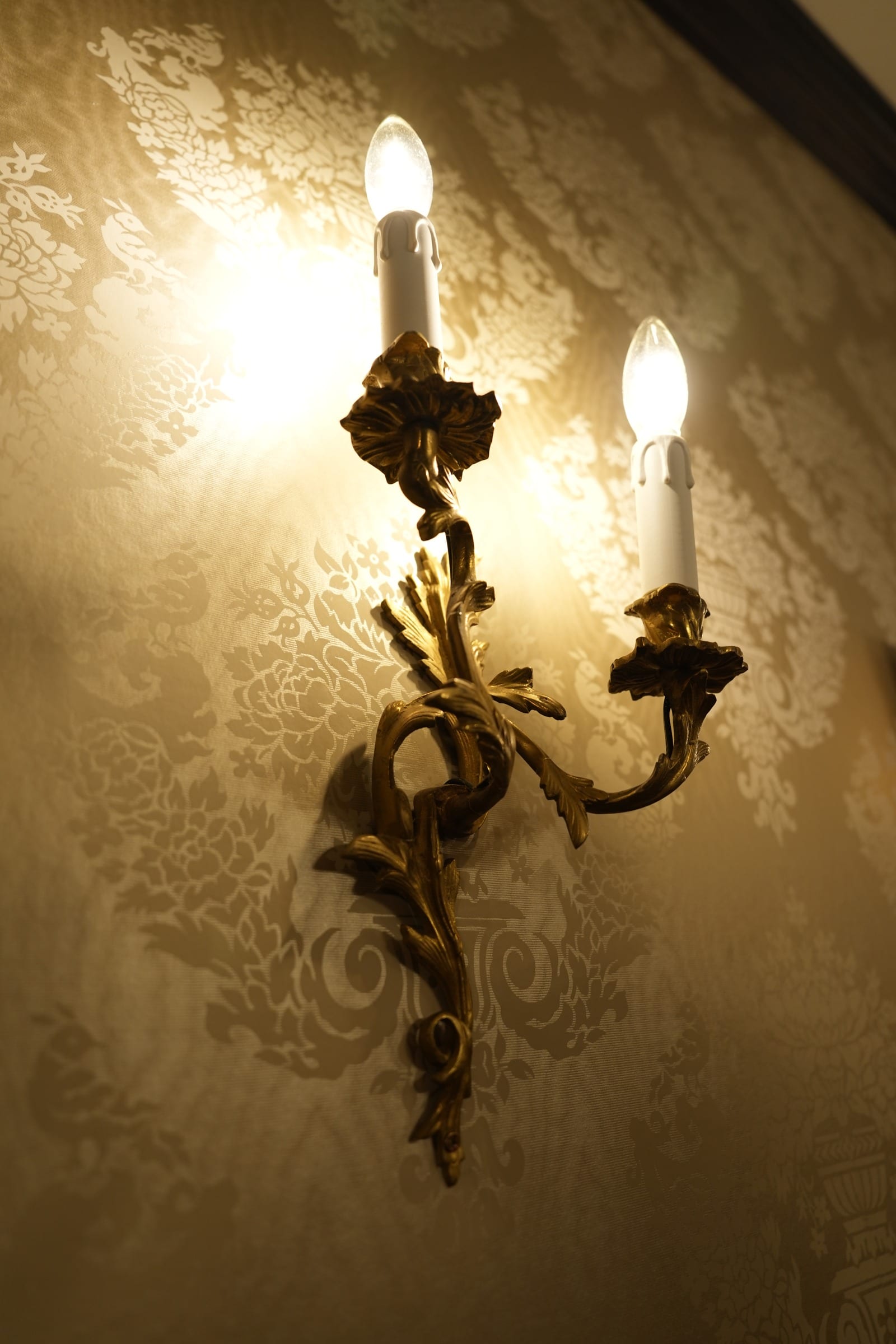
The diamond capitonné
Widen your gaze from a single button to the whole repeat, and compare light and shadow.
Read more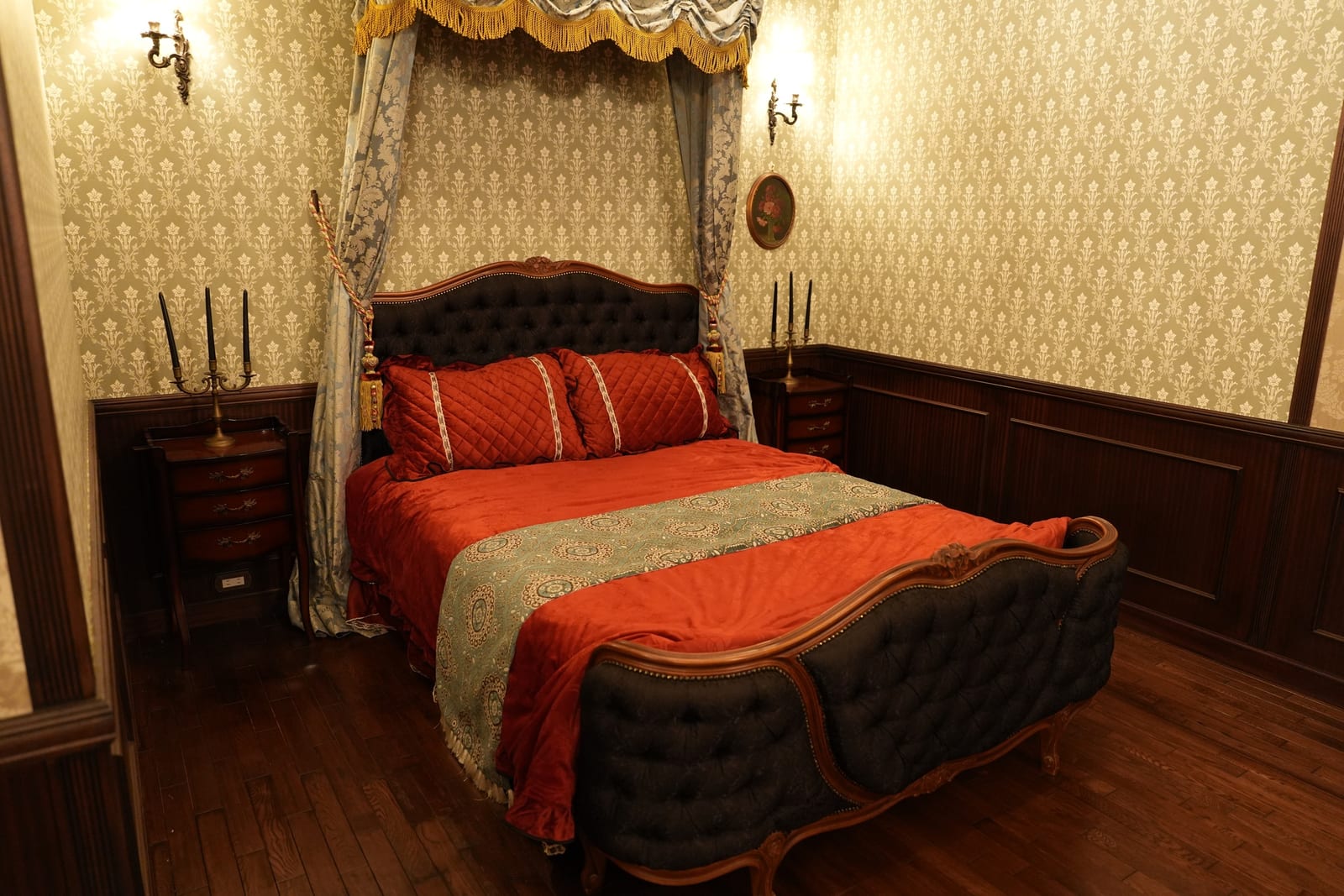
The colour and embroidery of the linen
Look at the deep red, the gold and the black upholstery in turn, and read the layers of colour.
Read more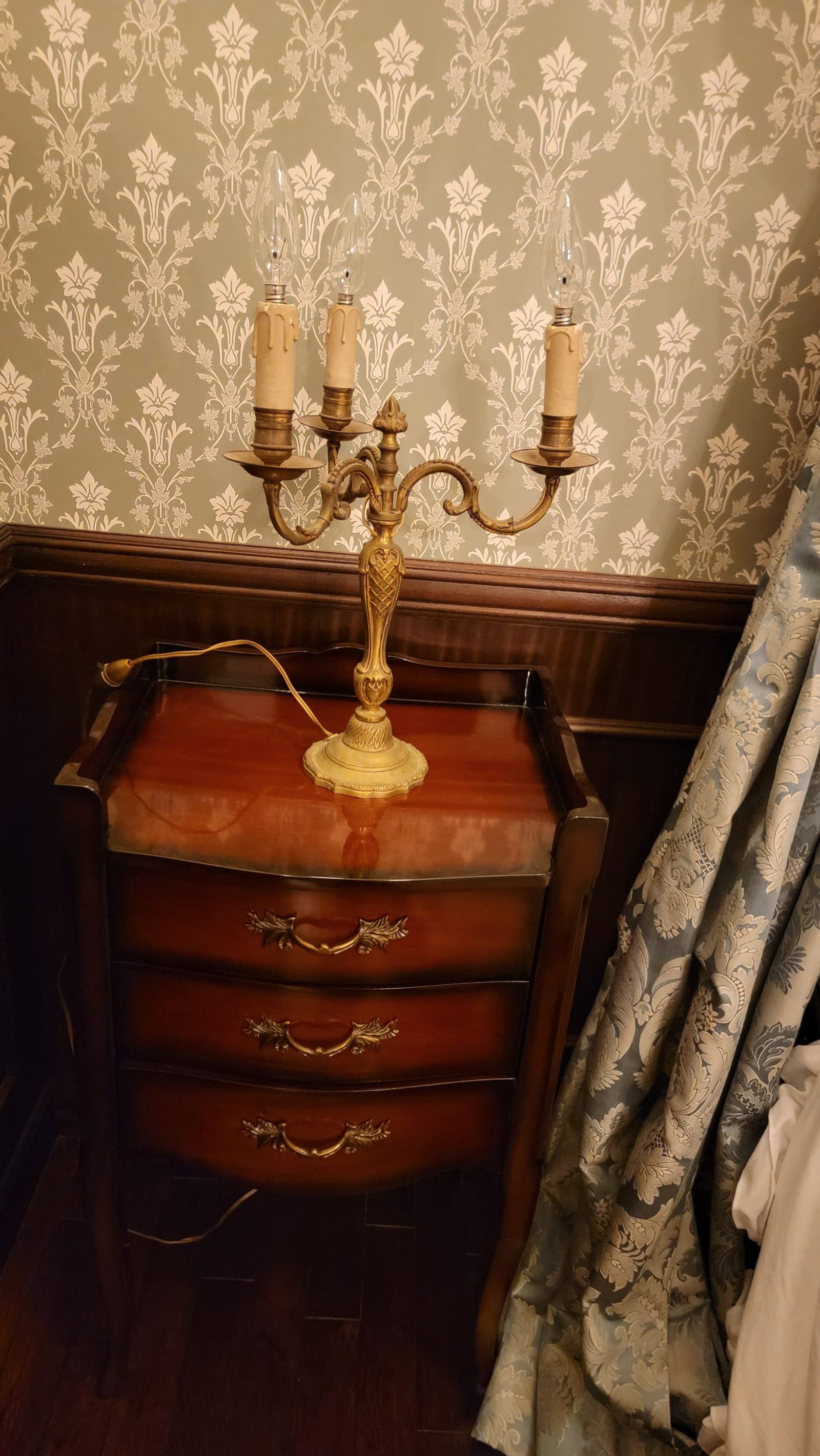
The lamps and chests to either side
Look beyond the centre to both sides, and read the balance of the whole bedroom.
Read moreResting on the bed is arranged by your butler in five steps
We ask your wishes
We first ask how long you wish to rest, how you would like the light, and whether photographs are wanted.
We check the bed
Your butler checks the linen, the frame and where belongings are placed nearby.
We guide you on footwear
We show you where the bed and floor can be protected, and let you prepare without haste.
We adjust the light
We set the wall and ceiling lights to your purpose, so that hands and feet are easy to see.
Your butler stays close
The Manor is never left unattended; your butler waits within call whenever you need.
What you may do beside the bed
- Resting on the bed, after your butler has checked the linen and surroundings
- Commemorative photographs of the whole bedroom, the basket-like curve, and hands at what could be morning tea, in that order
- Photographs in a costume you have brought, arranged first in the wardrobe before entering the bedroom
- Viewing for up to six guests, with those taking in the whole and those looking at details separated
- Having your butler place drinks you have brought at a safe distance from carving and fabric
What we ask you to refrain from
- Using the bed while the Manor is unattended, or receiving a key
- Getting onto the bed in shoes, or touching the linen at the foot
- Pressing hard on the carving or capitonné to test its form or tension
- Removing or moving the linen or canopy without your butler
- Eating or drinking on the bed
With shared terms, form and fabric can be explained consistently
| Corbeille | French for flower basket. A form of bedstead whose head and foot rise in tall curves, enclosing the body between them |
|---|---|
| Capitonné | A technique in which fabric is buttoned into diamonds, creating a regular pattern of swells and hollows |
| Damask | A fabric whose pattern appears in the weave. At the Manor it is seen in the black upholstery and the burgundy-and-gold linen |
| Cabriole leg | A curved furniture leg, seen on the chests to either side of the bed |
| Resting on the bed | Resting on a bed whose linen, light, footwear and belongings have been arranged, inside a Manor where your butler stays close. The house is never left unattended, and the door is kept by your butler |
QMay I actually rest on the bed?
Yes. Once your butler has checked its condition, you are welcome to rest on the bed. The Manor is never left unattended and your butler stays close by, so please tell us how you would like the light and how long you wish to rest.
QIs it a genuine 19th-century piece?
The corbeille bed at the Manor is a 19th-century French piece. The chests and lamps to either side each have their own separate origins.
QMay I touch the capitonné?
Please enjoy it with your eyes first, without pressing on the fabric or carving. When the bed is used, your butler checks its condition and shows you how and where it may safely be touched.
QMay I take photographs?
Commemorative photographs are welcome in the Manor. Taking the whole from the doorway, the curve from an angle and the capitonné up close, in that order, makes it easier to capture both the basket form and the details.
QHow many people may enter the bedroom?
The Manor accommodates up to six guests. As the passage around the bed is narrow, your butler separates those viewing from those photographing and guides each in turn.
QMay I be attended by a female butler?
We have both female and male butlers. If you have a preference, please let us know when booking.
About late-night stays
- We do not hand over keys. In this manor, guarding the door is also the butler's duty
You may also wish to read


Rest within the flower basket.
Tell us what you have in mind, and your butler will guide you.