
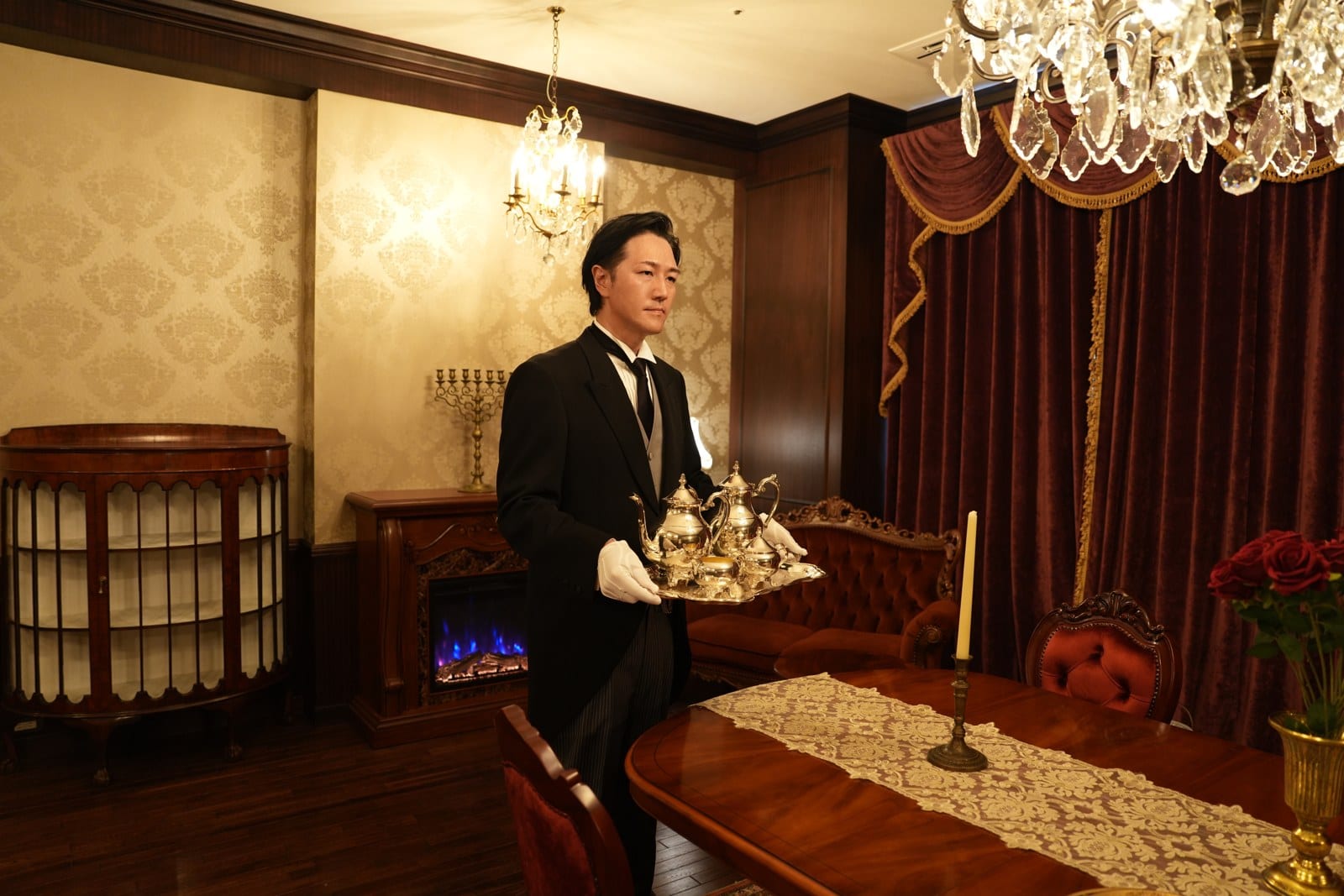
Silver and Porcelain
Beyond the maker's name lie the stories of pattern and manner.
About Silver and Porcelain
A knowledge of silver and porcelain is more than admiring lustre and decoration: it is reading, one by one, the maker, the origin, the source of the pattern, the form, the use, and the butler's way of handling. At this Manor, a collection including Christofle, Limoges porcelain and Wedgwood is not kept on display but presented as pieces you may touch.
ISilver and porcelain are a collection you may hold
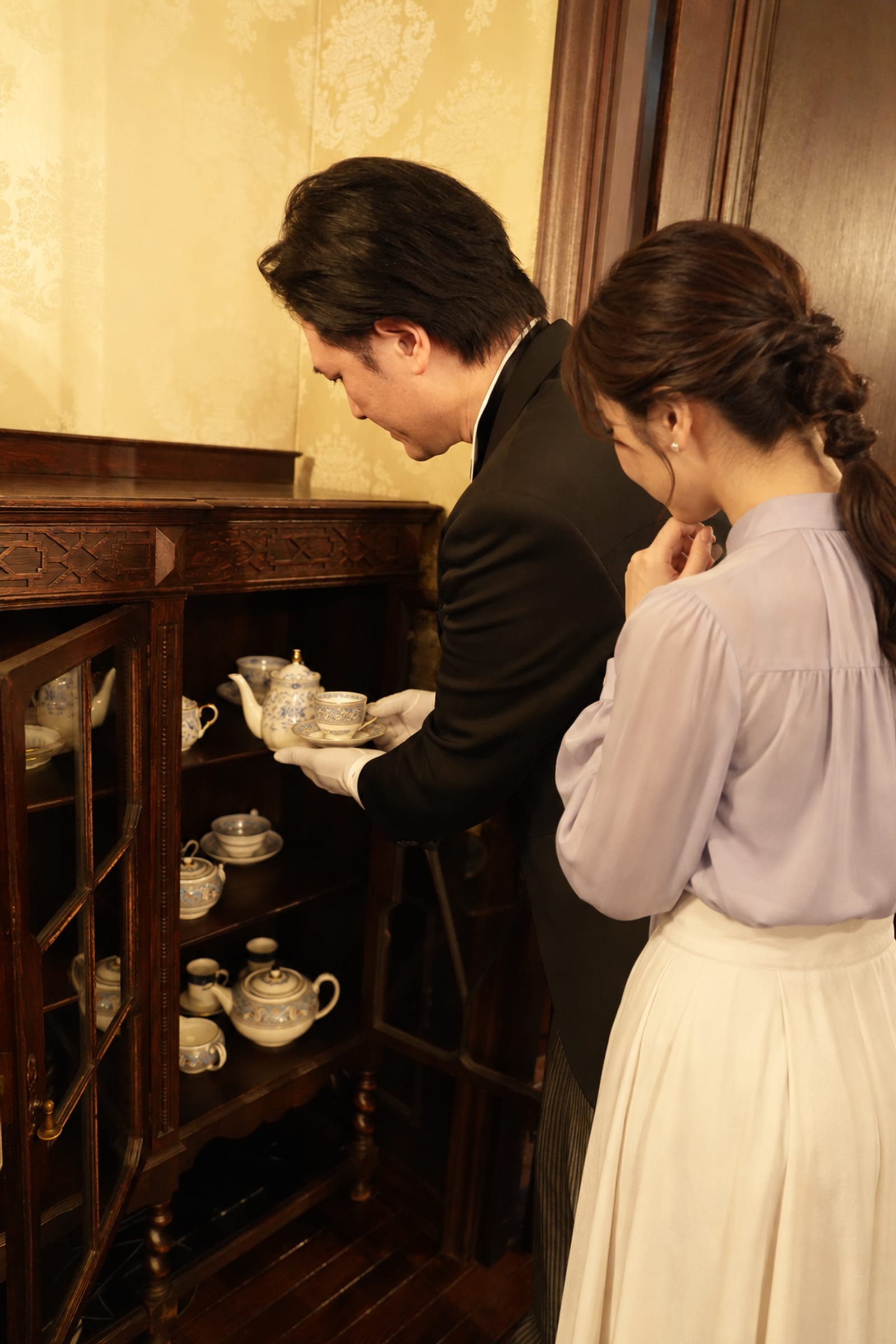
The curved-glass display cabinet holds the silver and porcelain. Its back is not mirrored but wooden, receiving the white light of metal and the colours of porcelain with warmth. The butler opens the doors and chooses a cup, a plate or a set to suit the scene of the day.
The value lies not only in admiring named pieces from afar. To feel the weight in the hand, to see the gilded rim up close, to know the butler's hands setting silver down without a sound: this Manor returns its collection to the realm of manner. The moving and putting away of delicate pieces is left to the butler.
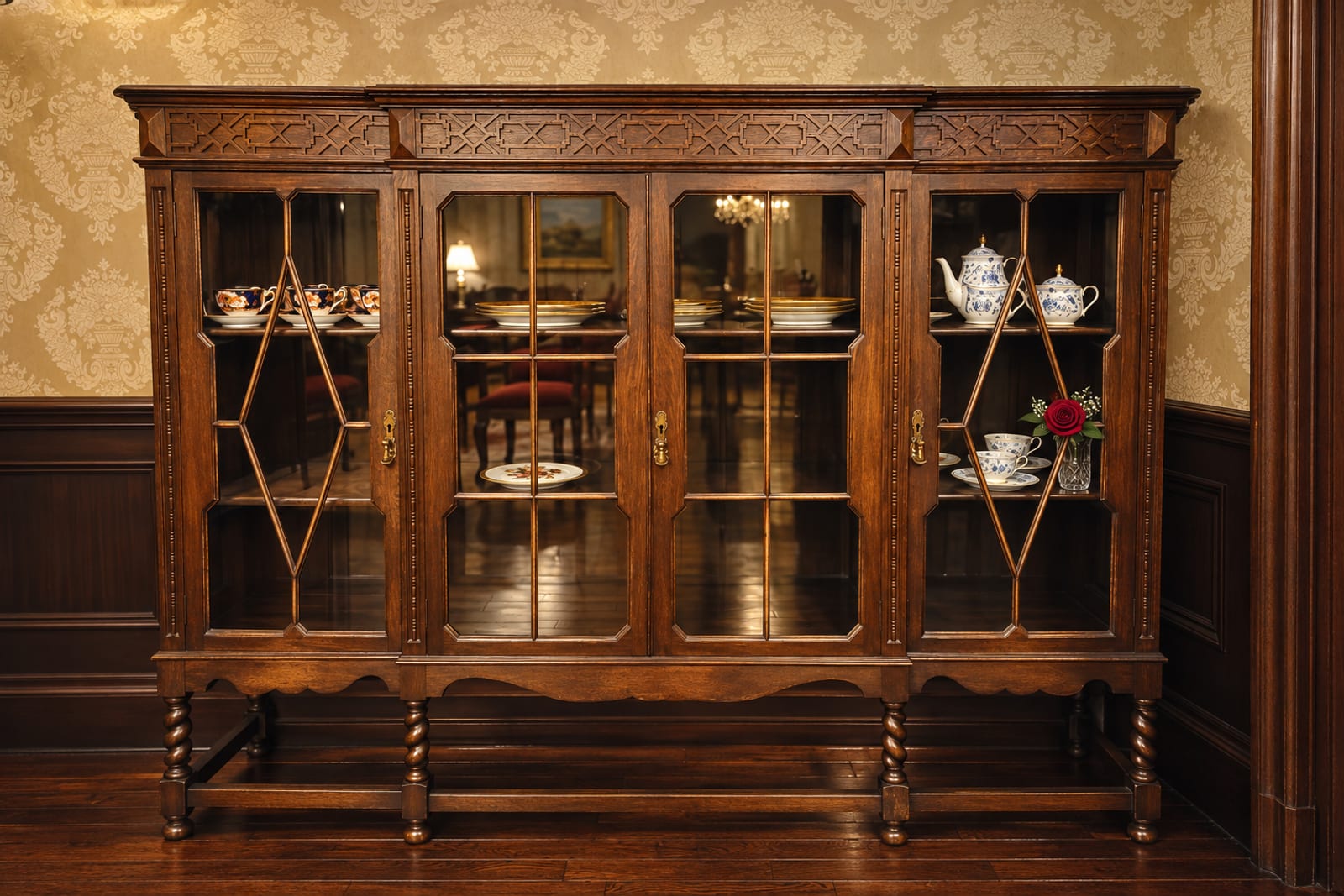
From display to use
When the butler opens the doors, the collection returns to the life of the Manor.
IIChristofle Marly inherits the name of a royal retreat
Christofle, founded in Paris in 1830, is a great name in silversmithing that has supplied the French court and embassies around the world. The Marly pattern takes its name from the Château de Marly, the retreat Louis XIV built to escape the bustle of Versailles.
The Manor's collection is twelve pieces for six: table spoon, fork and knife, the same three for dessert, fish knife and fork, and, in addition, consommé spoon, butter knife, ice-cream spoon and hors d'oeuvre fork.
What we value at the Manor is guiding you beyond the number, "a full set of twelve for six", to the form and role of each piece.
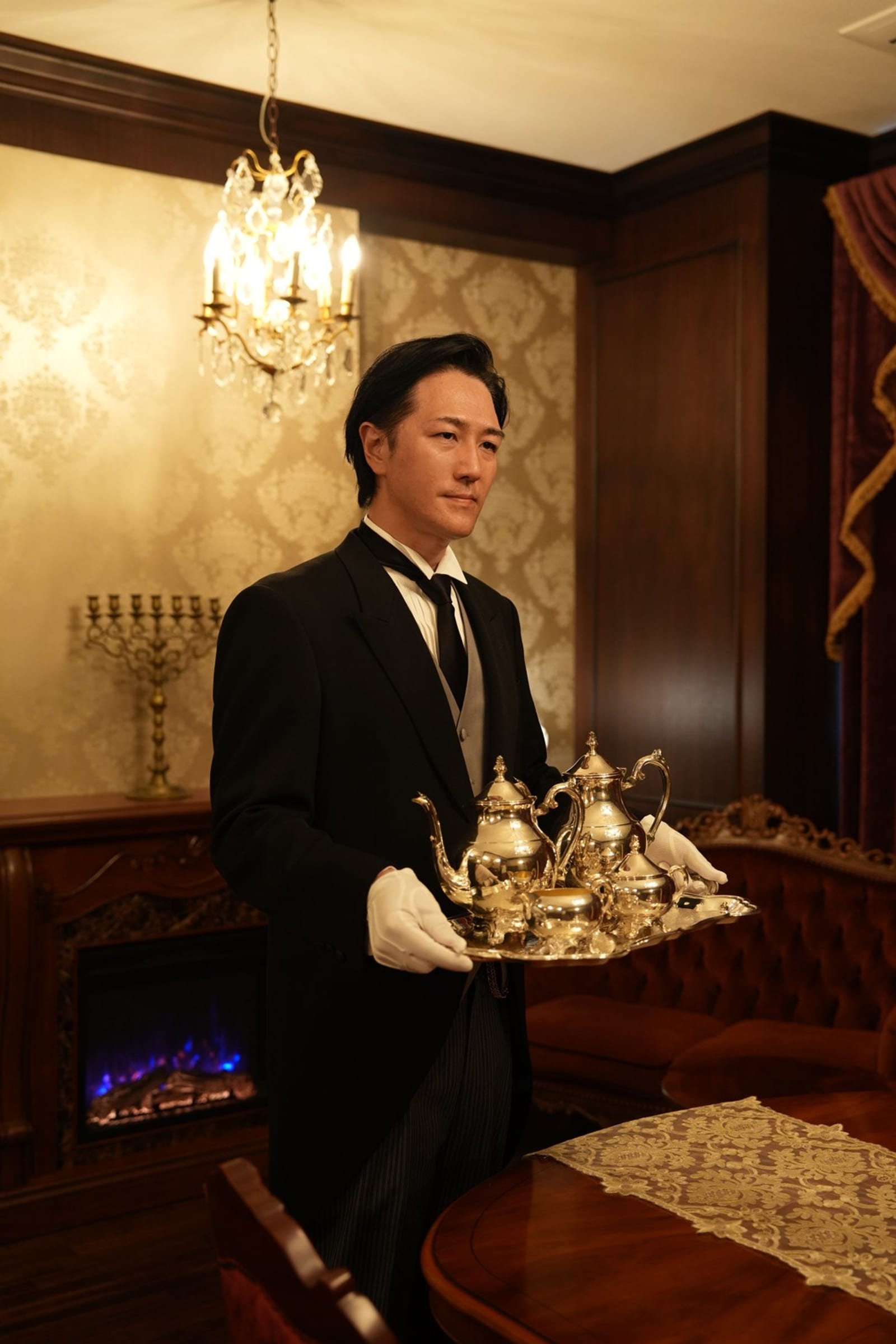
The splendour of Marly in the relief of the handle
Shell and scroll motifs cast fine shadows beneath white-gloved fingertips.
IIIThe twelve pieces differ in tip and length
Even within the Marly pattern, the shape of the tip, the width and the length differ by role. The fish knife and fork, the rounded consommé spoon, the small ice-cream spoon. The butler lays them in a row so that the shared pattern and the differing functions may be compared.
If you hesitate at table, there is no need to remember every name. Rather than reciting rules such as working from the outside in, learn why the pair before you has that shape. The butler watches your hands and, only when needed, quietly indicates the next piece.
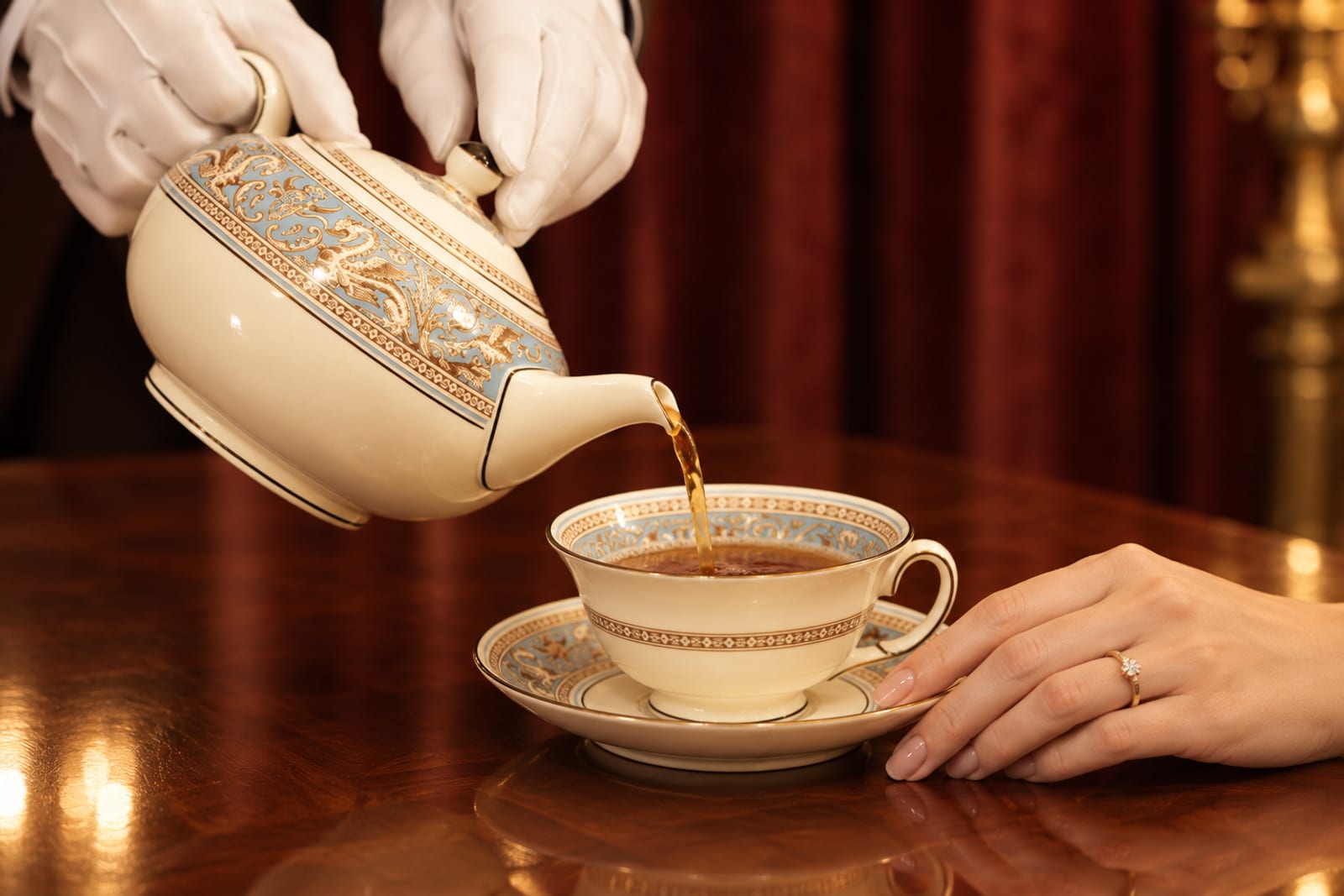
The manner of choosing is part of the collection
Male and female butlers alike keep metal from touching metal, quiet even in sound.
IVLimoges is the origin; Bernardaud and Legle are the makers
Limoges is a porcelain-making region of France. The Manor holds Bernardaud Volubilis and plates by LIMOGES LEGLE. Separating the name of the origin from the name of the maker makes the explanation clear.
LIMOGES LEGLE is a 25 cm plate in cobalt blue with real gilding. Though both bear the name of Limoges, the softness of a floral pattern and the contrast of deep blue and gold create different expressions on the table. The butler does not rely on the backstamp alone, but guides you by colour, rim and diameter together.
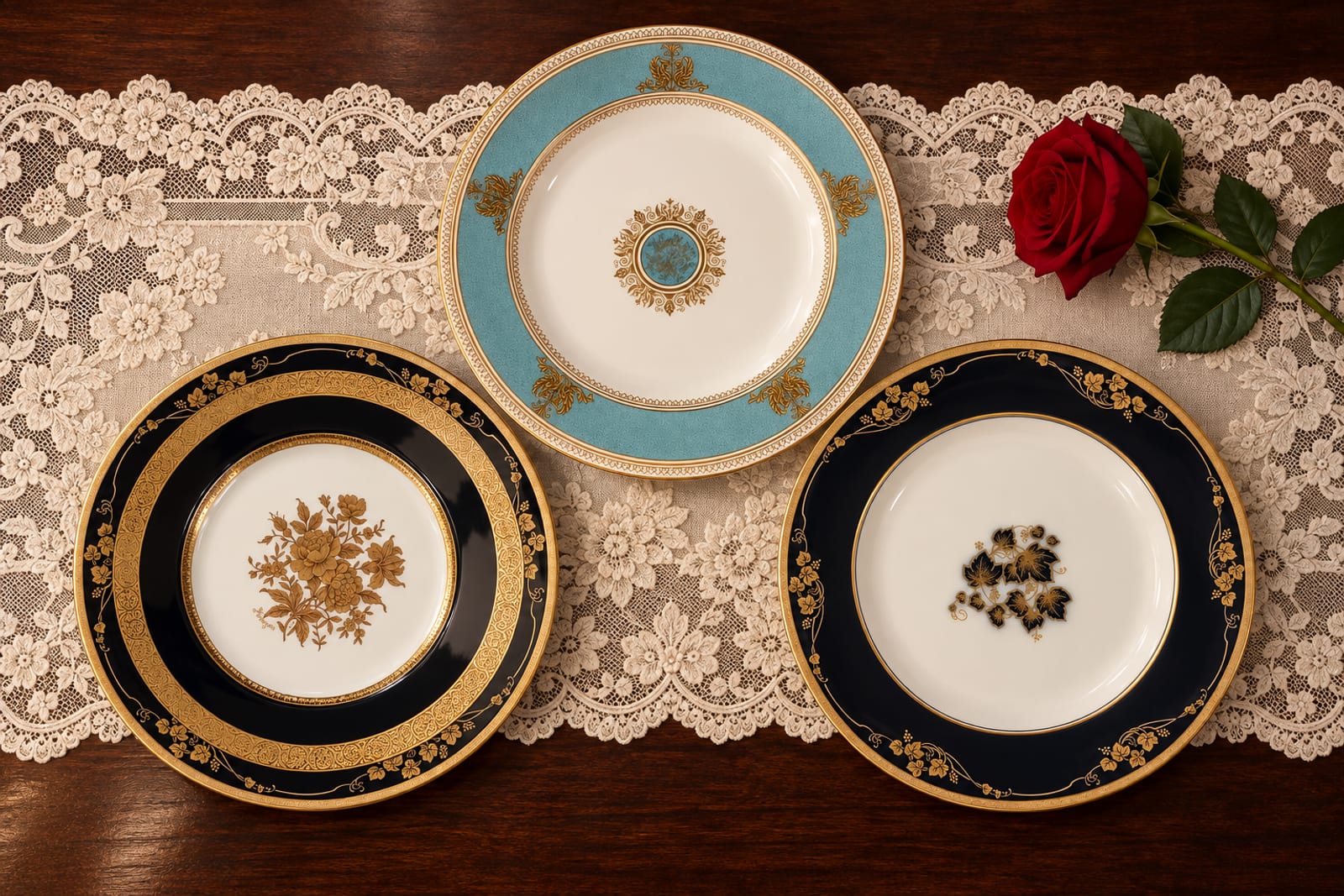
Within one place of origin, differing designs
Even among Limoges, checking pattern, colour and dimensions reveals the character of each plate.
VIn Wedgwood, look for turquoise and the griffin
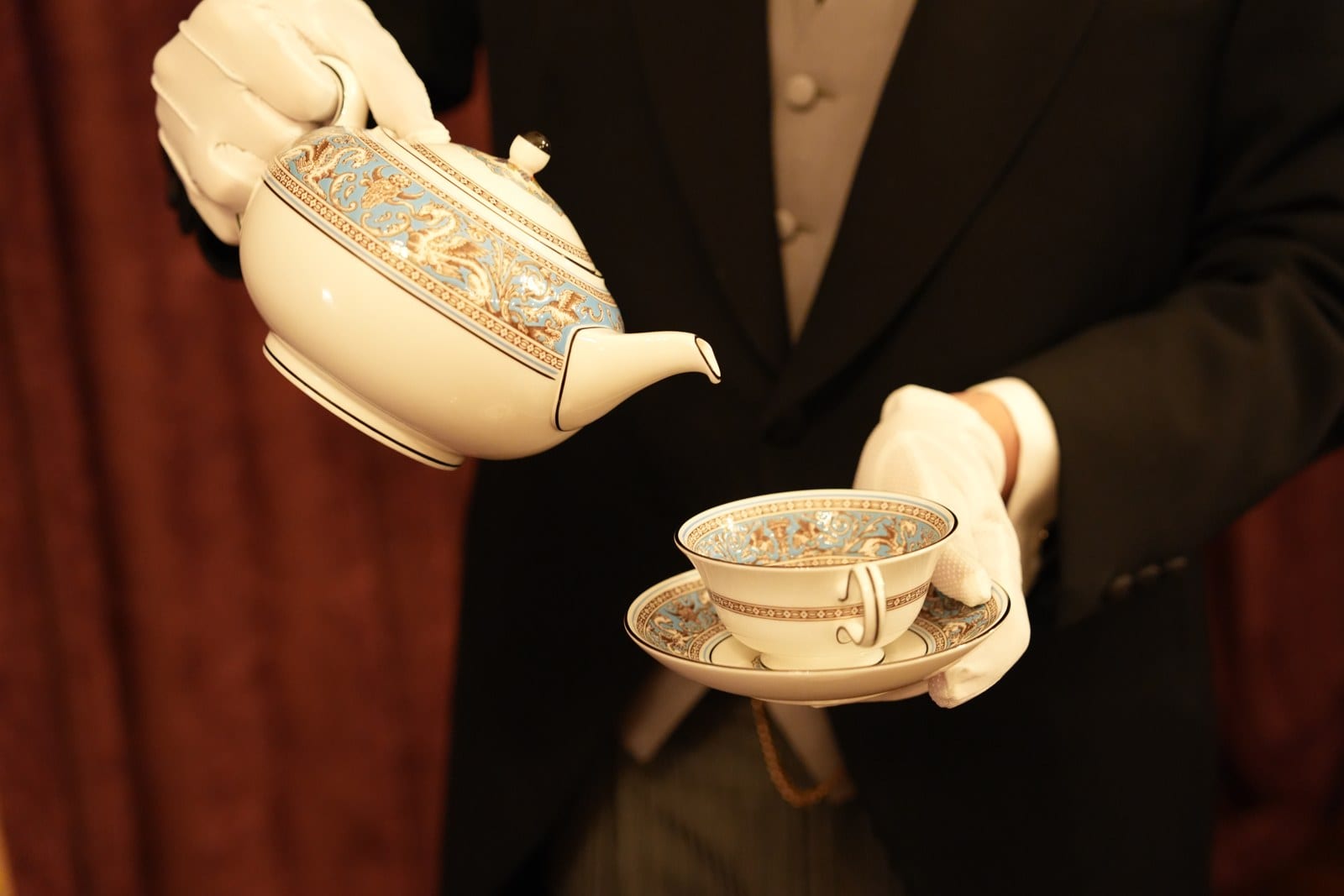
In the lineage of English porcelain, the Manor holds WEDGWOOD Florentine Turquoise. Teapot, sugar bowl, creamer, cup and saucer share the vivid turquoise and the motif of the griffin, the eagle-lion.
As a charger there is also WEDGWOOD Columbia Turquoise, 34 cm. Florentine and Columbia both carry the brand name and the word turquoise, but they are not the same pattern. The butler never abbreviates the name, adding the type of piece and its dimensions to prevent confusion.
The name of a colour does not make the pattern the same
Florentine and Columbia: each proper pattern name is confirmed.
Telling apart the Manor's silver and porcelain
| Maker / origin | Held at the Manor | What to look for |
|---|---|---|
| Christofle Marly | Twelve pieces of cutlery for six | Rocaille ornament; tip and length by use |
| Bernardaud Volubilis | Plates of 25.5 cm, 21.2 cm, 22 cm and 16.5 cm | Floral pattern and gilded rim |
| LIMOGES LEGLE | 25 cm plate | Cobalt blue and real gilding |
| WEDGWOOD Florentine Turquoise | Pot, sugar bowl, creamer, cup and saucer | Turquoise and griffin motif |
| Royal Albert / Royal Doulton | Cups and saucers, plates of various kinds | Type of piece and pattern name |
| Okura Art China / WEDGWOOD | Chargers of 30 cm and 34 cm | Ruri Kinshoku Budo and Columbia Turquoise |
Reading origin, brand, pattern name and type of piece separately keeps similar colours and forms from being confused.
VIEnglish porcelain and Japanese white porcelain, compared at the table
Among the English porcelain are six Royal Albert Heirloom cups and saucers, and Royal Doulton Carlyle bread plates, dessert plates, and demitasse cups and saucers. As the types of piece differ by maker, we look not only at the number but at which forms are present.
As chargers, there are the Okura Art China Ruri Kinshoku Budo, 30 cm, and WEDGWOOD Columbia Turquoise, 34 cm. A Japanese white porcelain plate layered with lapis blue and etched gold, and an English plate, set at two places. Rather than pitting one origin against another, the setting invites you to compare the two scenes made by colour, the placing of gold and diameter.
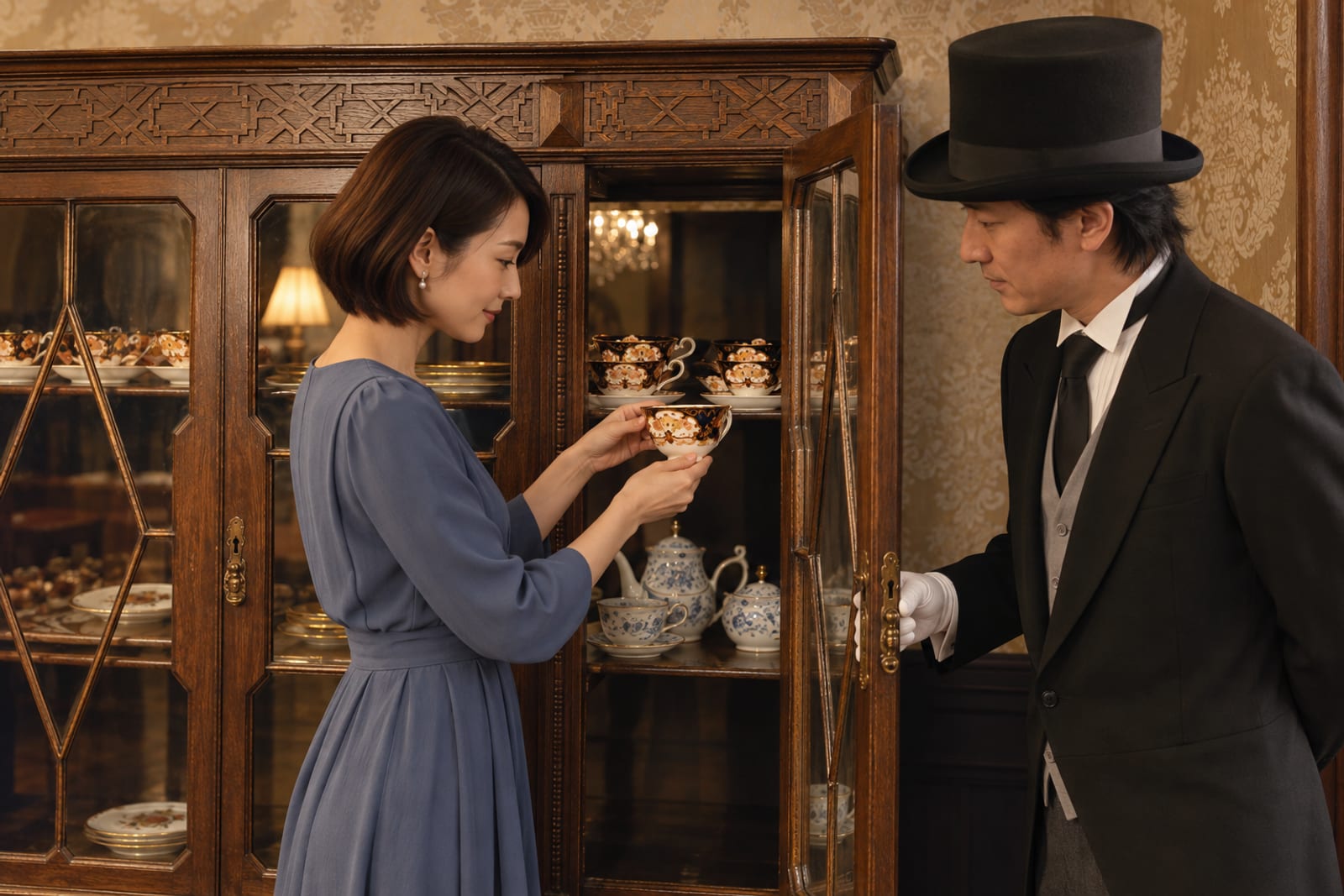
Learn the type of piece along with the name
Cup, saucer, plate, pot. Each gives the collection its outline.
VIIThe silver tea service is seen as a set, in form and light
The F.B. Rogers silver tea service is a five-piece Victorian-style silver-plate set, with pot, sugar bowl, creamer and more, together with its tray. The point is to see it not as single vessels but as a set that receives the sequence of pouring, adding and carrying.
The glassware is sorted by form: Cristal D'Arques diamond-cut with gold rims, Chef & Sommelier balloon glasses for red and 250 ml tulip glasses for white, and OPEN UP Effervescent for champagne.
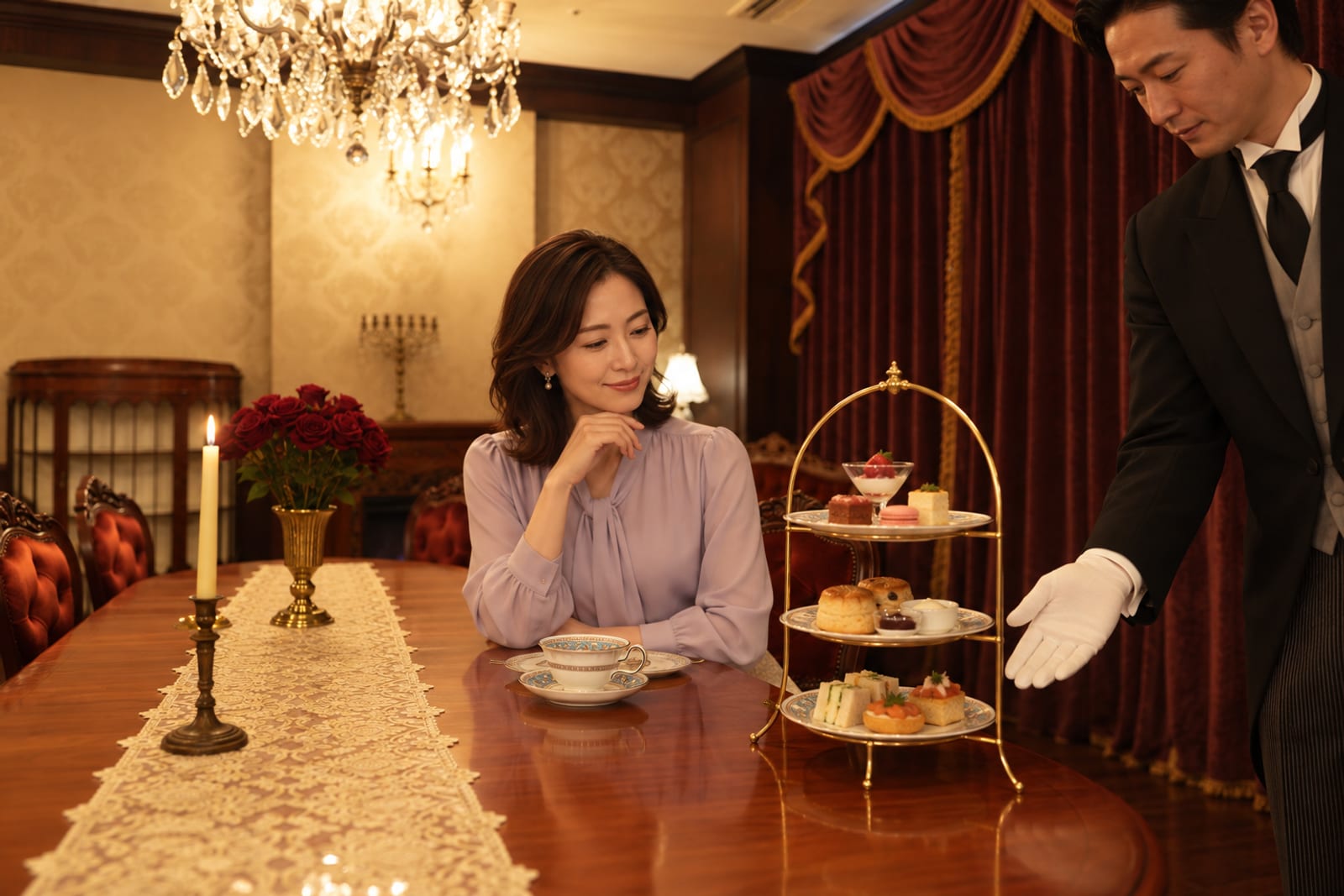
A set is arranged in the order of movement
The vessel that pours, the one that adds, the one that receives. The order of the butler's hands explains the arrangement.
VIIIWhy does the butler attend even to the sound of silver set down?
Handling silver is not only a matter of showing its lustre; it is placing it without metal touching metal, and without interrupting the conversation at table. The butler supports the centre of the handle steadily, checks the spacing from the next piece, and lets go only when the tips are aligned in the same direction.
Christofle Marly has fine relief in the rocaille ornament covering the whole handle. White gloves are not there to hide the ornament; they belong to the manner of holding the handle steadily and keeping the fingertips in a constant position. When laying for six, the butler surveys the line of the whole table, not a single place.
The silver bell, the five-light candelabra and the Italian single candlestick share the same table. The butler does not let each piece compete in splendour, but leaves space for a hand to reach the bell, a height that does not block the view, and a path for carrying the pieces. Only when sound, light and movement are in order does silver enter the manner of the Manor.
IXHow should porcelain be viewed, beyond the pattern on its face?
Viewing porcelain means not judging by the central design alone, but checking in turn the gilding of the rim, the thickness, the curve, the diameter and the backstamp. The butler sets a plate on a flat surface, turns it to an angle where the light does not glare, and then shows you pattern and rim.
Bernardaud Volubilis, with its floral pattern and gilded rim, comes in plates of 25.5 cm, 21.2 cm, 22 cm and 16.5 cm. Even in the same pattern, the dinner plate, plate, soup plate and side plate differ in margin and rise. Rather than comparing diameter alone, see how the pattern sits within the surface.
The Okura Art China Ruri Kinshoku Budo, 30 cm, and WEDGWOOD Columbia Turquoise, 34 cm, are set as chargers at two places. Beyond the difference of Japanese and English origin, the setting lets you compare at once the lapis, the turquoise, the placing of gold and the diameter.
XFor a first look at the collection, in what order is it easiest to compare?
A first comparison is not about memorising makers, but about narrowing the differences in order: silver against porcelain, different patterns from the same origin, different patterns sharing a colour. First distinguish how the materials catch the light, then look at form and use, and finally connect the backstamp and the proper name.
The butler does not set out many pieces at once, but centres on the cup that caught your eye and adds one piece to compare. If the turquoise interests you, Florentine and Columbia; if floral patterns, Volubilis; if the relief of silver, Marly. Proceeding from a question to a single piece, even a first-time visitor never loses sight of the differences.
The Japan Butler Association, which operates this Manor, is a general incorporated association. Its male and female butlers hold equally dear the careful handling of pieces and the accuracy of their names. After showing you, the butler restores the spacing so that no rims touch, and sets each piece at the angle at which the whole looks orderly through the curved glass of the cabinet.
The order in which the butler shows the pieces
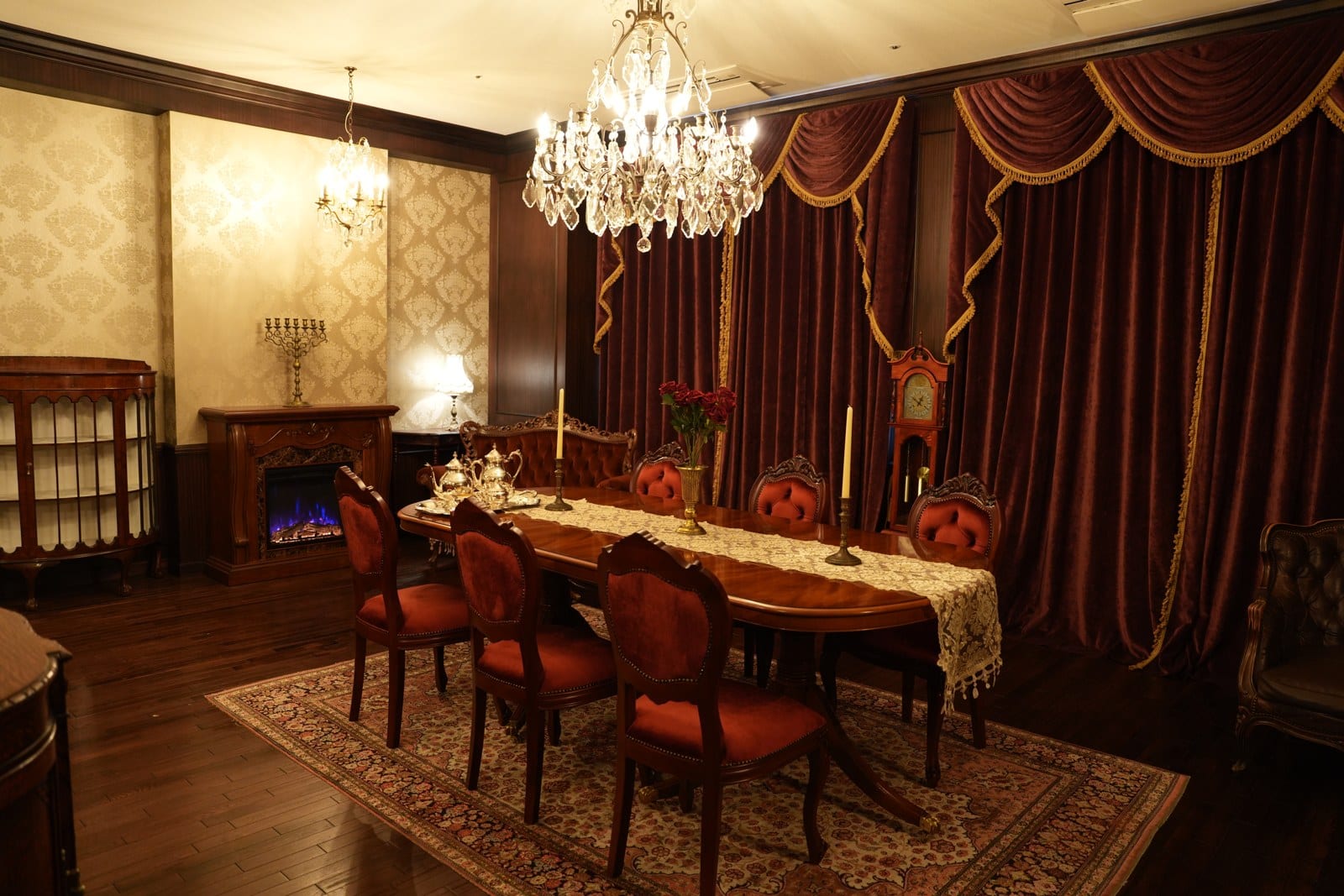
Survey the cabinet
See which makers are present, and in which types of piece.
The butler takes out a piece
Delicate pieces are supported in white gloves, turned so that neither rim nor pattern is hidden.
Examine front and back
Pattern, gilding, form, dimensions and backstamp are viewed in turn.
Compare side by side
The same origin, the same colour, a different pattern: set beside each other, the differences are read in detail.
The butler returns the piece
Spacing and angle are set so that neither metal nor porcelain touches, and the piece is put away.
Four layers of naming keep the pieces clear
| Origin | The name of the region where porcelain is made, such as Limoges |
|---|---|
| Maker | The name of the manufacturer, such as Christofle, Bernardaud or Wedgwood |
| Pattern | The name of the design, such as Marly, Volubilis or Florentine |
| Type of piece | The name of form and use, such as pot, cup, charger or fork |
| Material | What the piece is made of: silver, silver plate, porcelain, crystal |
Handling that protects the collection
- The butler takes each piece from the cabinet one at a time
- Pattern, rim, dimensions and backstamp are shown in the order easiest to see
- Pieces of similar colour or the same origin are compared two at a time
- Pieces are returned with spacing so that metal and porcelain do not touch
What is not done with the collection
- Presenting the pieces as vessels for laying out food and drink
- Treating the name of an origin and the name of a maker as the same thing
- Moving delicate pieces without the butler's guidance
Choose your first piece by the colour and form that draw you
For the relief of silver, Marly
Compare the rocaille ornament of shell and scroll across twelve pieces of differing use. Though the tips change, the splendour of the handle unites the set.
Read more
For flowers and gilding, Volubilis
Four sizes with floral pattern and gilded rim, set side by side, show how margin and curve change with the size of the plate.
Read more
For two shades of blue, the two Wedgwoods
Florentine Turquoise and Columbia Turquoise, distinguished by their proper names, with differences of griffin, rim and type of piece.
Read moreQHow many kinds of Christofle Marly are there?
The Manor holds twelve pieces for six. Beyond the basics of table, dessert and fish, they include the discontinued ice-cream spoon and hors d'oeuvre fork.
QIs Limoges a brand name?
Limoges is a porcelain-making region of France. The Manor holds Bernardaud Volubilis and LIMOGES LEGLE, each of a different maker and pattern.
QIs there only one Wedgwood turquoise?
The Manor holds Florentine Turquoise and Columbia Turquoise. Both bear the word turquoise, but they are different patterns.
QMay a female butler present the pieces?
Yes. Male and female butlers are in residence and guide you through moving, comparing and putting away the pieces. Please let us know your preference when booking.
QCan I enjoy the pieces without knowing their names?
Yes. Tell the butler what catches your eye: a colour, a pattern, a form. We connect origin, maker, pattern and type of piece in that order, without piling up many names at once.
QCan silver and porcelain be compared at the same time?
Yes. The butler takes out one piece at a time and arranges them so that you may compare the reflection of silver with the colour of porcelain, and weight with curve. The moving and putting away of delicate pieces is left to the butler.
You may also wish to read

The rest of the pattern, in the butler's hands.
Silver and porcelain set side by side, with the differences of maker, origin and form explained.