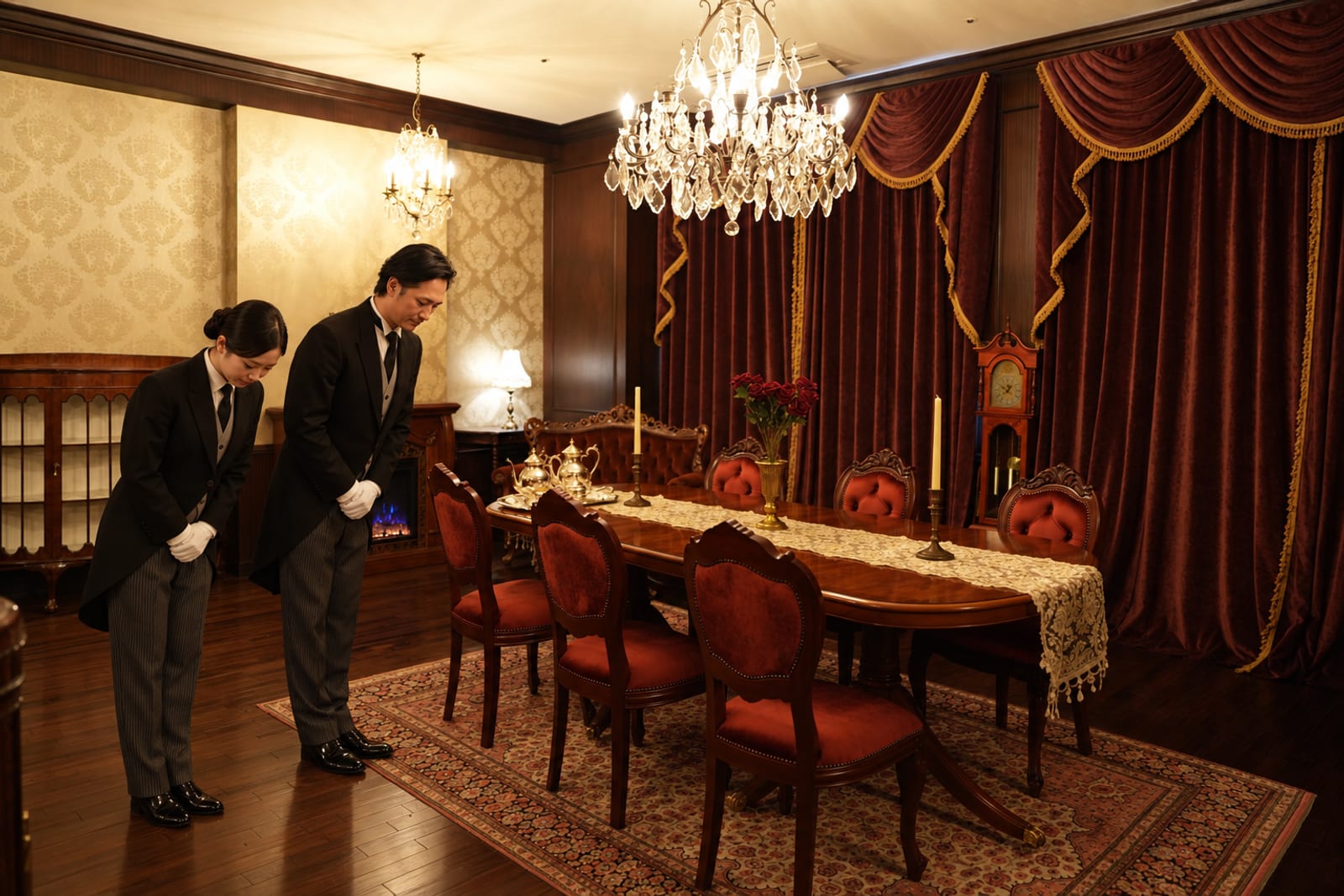
How a Butler Stands and Bows
Posture, the hands, the depth of the bow and the pause, as one continuous whole
About How a Butler Stands and Bows
A butler's stance and bow are a posture that waits without hindering another's movement, and a bow that shows respect suited to the occasion. The back, shoulders, hands, gaze and feet are settled in turn, and a quiet pause is held with the upper body lowered. In The Footman, you stand beside the butler and go through the flow of standing, walking, stopping and bowing.
IA butler's stance is a quiet readiness, with attention turned towards the other
A butler's stance is not simply a matter of a straight back: it is a posture that keeps a margin in which to respond to the movement of the person served. The shoulders are relaxed, the back naturally upright, the feet settled. The chest is not thrust out; the body is ready to take a step the moment it is called upon.
In the experience, you stand before the mirror and adjust little by little from your everyday posture. As the butler shows the same stance beside you, there is no need to grasp it from words alone. Looking in turn at shoulders, back, chin, hands and feet spares you trying to correct the whole body at once.
Even in the moments when you hold nothing, consideration for the other shows. Attention is turned to the sign of a door opening or someone rising from a seat, without making your own presence loom large. A quiet, waiting stance is also the preparation for the movement to come.
IIWith the hands folded in front and the fingertips at rest, the posture settles
The position of the hands is an important measure of the impression given when doing nothing. Both hands are lightly folded in front of the body, the elbows not spread, the fingertips together. Gripping hard stiffens the shoulders too, so no needless force is put into the palms.
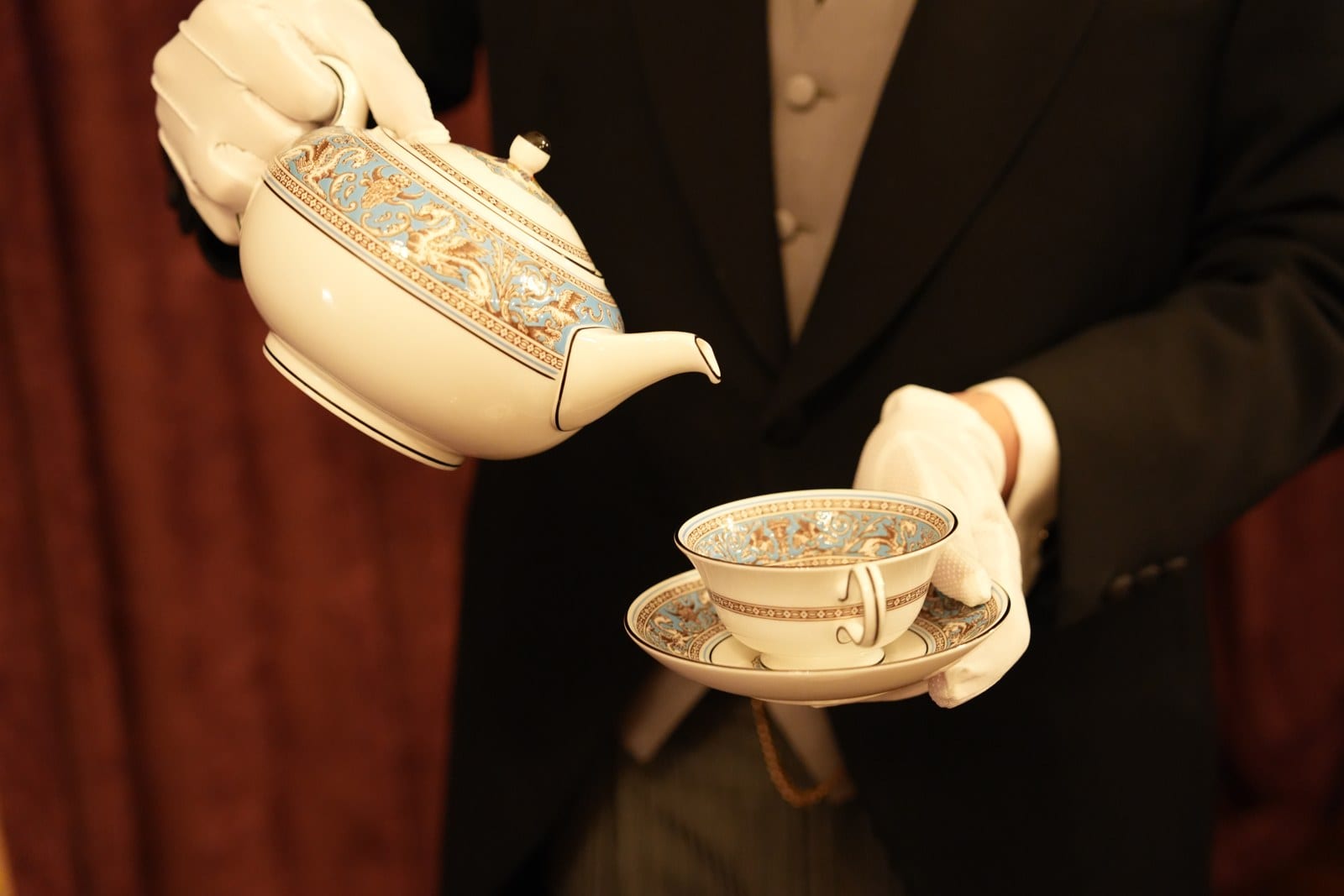
In white gloves, the bend and overlap of the fingers show clearly. The butler corrects not only the hands but the line that runs from elbow to shoulder. Hands held too low or too high look unsettled, so you look for the position in which you can breathe naturally.
When receiving an object, the folded hands part; when the task is done, they return to their place. If this return is abrupt, the movement appears broken. Keeping the same pace to the end, and waiting for the next sign only once the fingertips have settled, is the deportment of a butler.
IIIThe gaze is neither too lowered nor fixed; it is shared between the other and the way ahead
Placing the gaze means a way of looking that does not stare at the person served, yet misses no necessary sign. The chin is not tucked too far; the gaze rests gently a little below the level ahead. Movements such as the other rising, reaching out or turning towards a door are caught in the periphery of vision.
Looking down continually leaves no attention for the way ahead or the furnishings. Holding the other's eyes continually, on the other hand, disturbs their ease. The butler raises the eyes when needed and returns them to a quiet resting place once the task is done.
When walking along the corridor, the feet and the way ahead are checked in turn. When waiting in the Dining Room, attention rests on the other's hands and on the table. Where one looks changes with where one stands, but the habit of judging with the other at the centre does not.
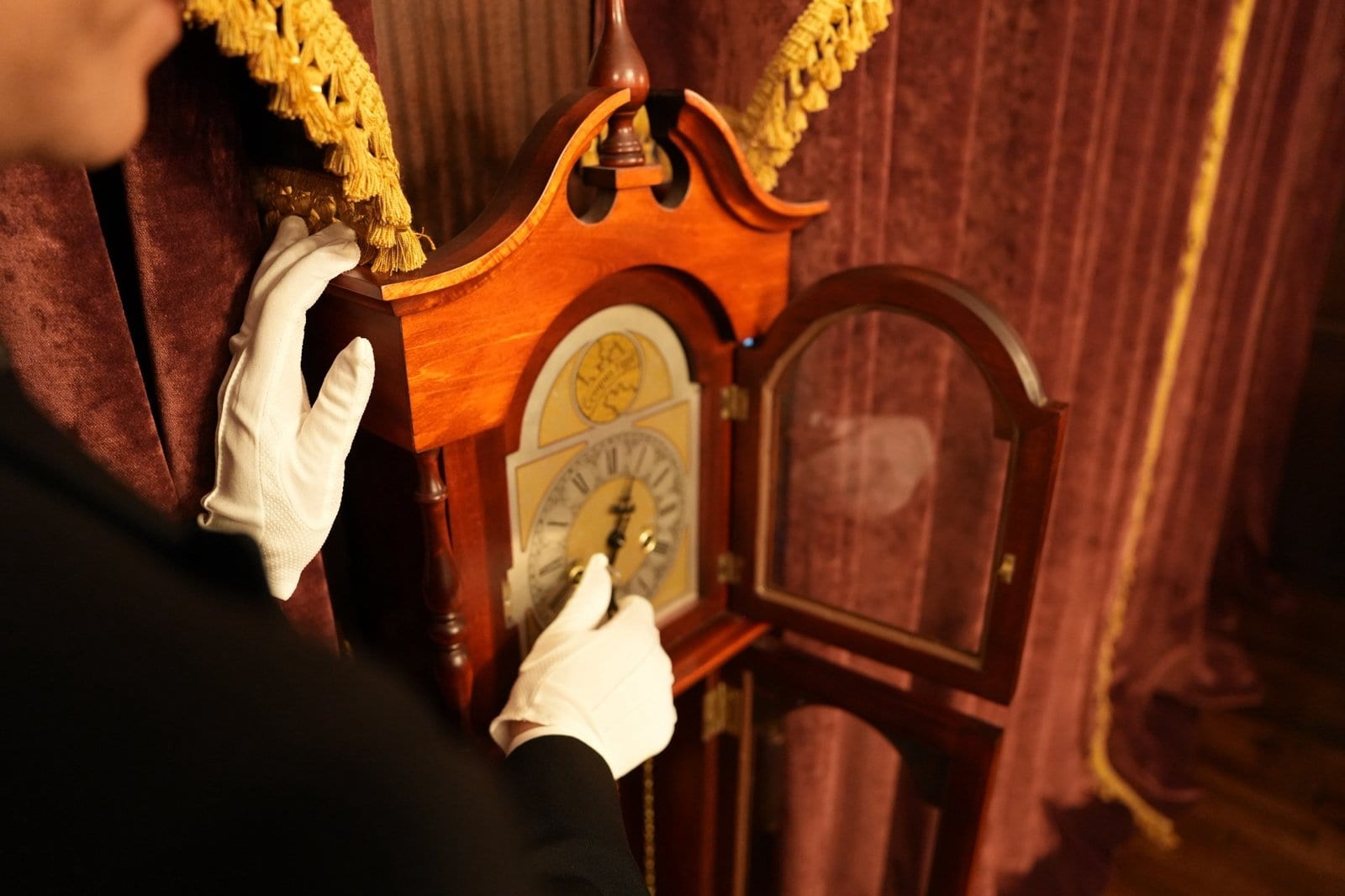
Waiting, too, has its role
Attention turns to the other's movement before being called, ready for the step that will be needed.
IVWhen walking, footfall and sway are kept down, and the way ahead is seen first
A butler's walk is not a display of speed but a way of moving that does not disturb the other's time or the quiet of the Manor. The stride is not forced wide, and the upper body does not sway from side to side with each step. Attention is also paid to the hem of the outfit and to the feet.
When leading the person served, the butler checks that nothing lies in the way before setting off. When following, the distance is not closed too far. On stopping, the body is not brought up abruptly; the last step is taken small.
When carrying a tray or silverware, it is also important not to keep watching the hands alone. The way ahead, the other's movement and the object held are checked in turn. In the experience, you walk first with nothing in hand, then move on to the serving posture and feel the difference.
VThe bow is made not by dropping the head alone, but by keeping the line of the back
The essence of the bow is to keep the back settled in the standing posture and to incline the upper body quietly as a single plane. The head is not dropped first; the hands stay folded in front. Neither the start of the bow nor the start of the return is hurried, and no seam shows between the movements.
Before bowing, the feet are brought to a halt and attention is turned to the other. Lowering the head while still moving blurs the moment in which respect is shown. The order is kept: stop, settle the hands, lower the upper body, hold the pause, return.
On returning, care is taken not to appear more hurried than in lowering. The gaze is not raised first; back and head return together. A breath taken after coming upright leads naturally into the next guidance or word.
VIThe depth of the bow is chosen by the meaning of the moment, not by a number
The depth of a bow is chosen to suit the respect being conveyed — a greeting, thanks, a farewell. A light greeting calls for a shallow bow; heartfelt thanks for a deeper one. Rather than memorising an angle, one first considers what the bow is to convey.
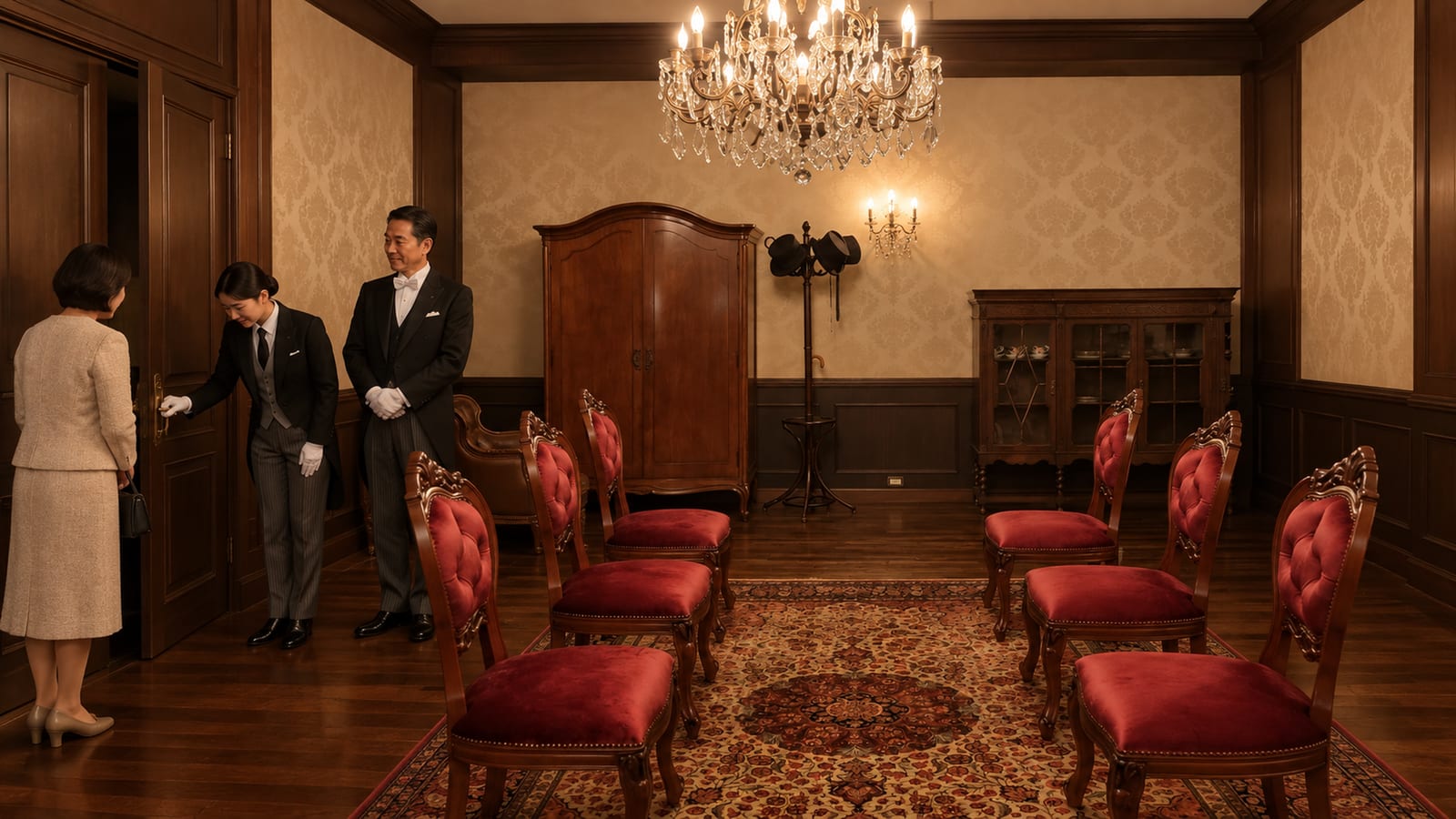
On arrival, the butler opens the door, takes in the sight of the guest and then bows in welcome. On departure, the bow carries thanks for the day's time, with the body turned towards the way the guest will go. Rather than repeating one form, the moments before and after are gathered into a single gesture.
In the experience, you stand beside the butler and compare in the mirror how shallow and deep bows appear. As build and dress change the impression of the same movement, you settle the line of the back and the pause within what is comfortable for you.
VIIThe pause held at the lowest point carries the feeling of the bow to the other
The pause of a bow means stopping with the upper body lowered and allowing time for respect to be conveyed. Returning at once makes the bow look hurried; holding too long leaves the other unsure. The quiet length that suits the moment is learnt by following the butler's movement.
While holding the pause, no needless force is put into the shoulders or hands. The breath is not held, and the line of the back is kept. When the breathing stays even, the return is smooth too, and the next word follows calmly.
'The pause held at the lowest point is the weight of the bow' expresses a way of thinking in practice: what matters is not a number but time turned towards the other. Rather than hurrying to complete a form, one chooses a gesture the other can receive.
The pause held at the lowest point is the weight of the bow.
VIIIStanding, walking, stopping and bowing are practised as one continuous flow
A sequence of deportment means not separating posture from bow, but linking entering the room, moving to one's place, stopping, bowing and waiting. In the experience, you use the Dining Room and the corridor, repeating the sequence while picturing the real scene.
Taking part alone, you can concentrate on detail while comparing your reflection with the butler's figure. With two or more, you also learn the timing of waiting for the other's movement to finish and bowing together. The Manor receives up to six, and we advise in advance on how the session proceeds for your number.
On a rainy day, it is also important to settle the feet just after coming in from outside and not to set off in haste. You check the feel of the outfit and shoes before moving on to the deportment. The butler watches the season and how you are on the day, and shapes the movements so that nothing is forced.
IXOnce the posture is settled, stillness too is part of the deportment
In settling the posture, it is also important not to keep shifting the body before the person served. Each needed correction is made once, and once settled, you are still. It is because there is time held still that the next step or bow shows clearly.
Where the hands rest in front looks different according to dress and build. Rather than forcing them to one fixed point, you choose a place that does not hide too much of the waistcoat or coat front and lets the elbows hang naturally. Where the left and right white gloves overlap is also checked in the mirror, to see that the fingers are not splayed apart.
Rather than endlessly correcting the form in the mirror, you stop once it is settled and check your breathing and the feel of the outfit. Only when the stance is calm can attention move to the other's movement. Stillness is not time spent doing nothing but time spent ready for the next request.
XGaze and stride change with the position of doors and furnishings
The gaze is linked to the moments before and after the bow as well. You confirm that you have turned to the other before lowering the upper body, and only after returning do you move the gaze to the way ahead. Looking elsewhere first makes the bow seem to end midway. It is a small matter of order, but a judgement that makes clear the time given to the other.
Before a door, you first look at the direction it opens and the side the other will pass. Near a chair, you check the distance from its legs and the table. Rather than repeating the same walk everywhere, you vary stride and direction according to the furnishings and the other's position. It is because you actually move through the Manor that posture is bound to judgement in the moment.
XIWhen several bow together, the start and the return are matched without looking sideways
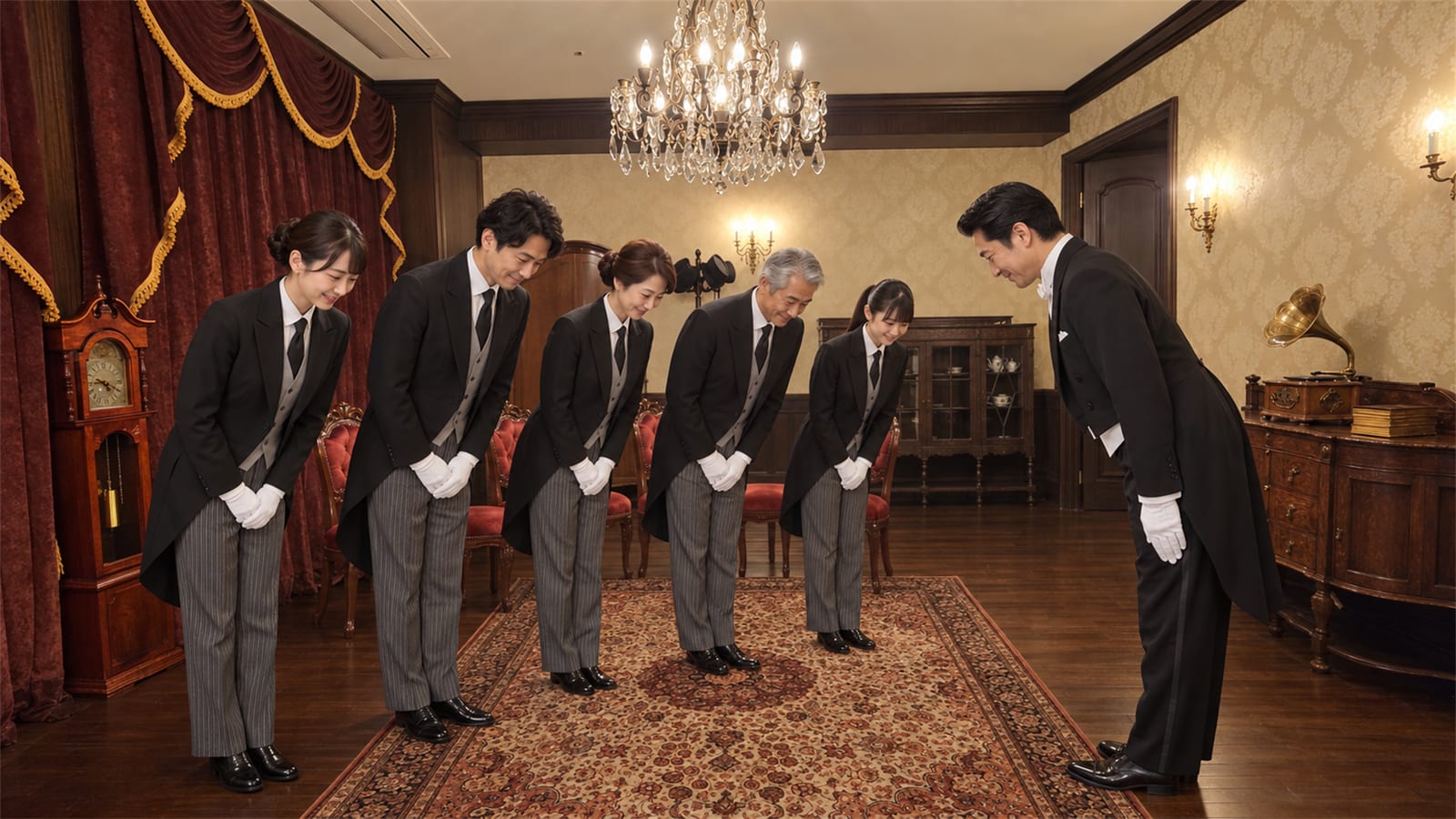
When several people bow together, not only the depth but the cue to begin and the pace of return are matched. Turning to check breaks the posture, so you move by sensing the butler's breathing and the rustle of cloth. In the commemorative photograph, this matched instant quietly conveys the dress and the air of the Manor.
As an experience run by the Japan Butler Association, a general incorporated association, we do not stop at outward form. Looking at the way ahead before opening a door, waiting for the other's words, and remaining quietly in attendance after the bow are taught as a bearing that carries into real service.
XIIFor a first visit, begin with the order in which attention turns to the other
If this is your first encounter with such deportment, take home not so much a perfectly matched form as the order in which attention turns to the other: look at the place before standing, at the way before walking, at the other before bowing. With this foundation, the form settles little by little.
As Queen's Butler, run by the Japan Butler Association, a general incorporated association, we convey the respect for the other that lies beyond the form.
The bow is made in five unbroken movements
Bring the feet to a halt
Do not begin the bow while walking; settle on the position that faces the other.
Settle the hands and shoulders
Fold the hands in front, relax the shoulders and bring the back upright.
Compose the gaze
Turn attention to the other, and do not let the gaze drop first.
Lower the upper body
Do not bend the neck alone; move while keeping the line of the back.
Hold a quiet pause
Stop at the lowest point and convey the respect the moment calls for.
Shallow or deep, the bow is chosen by the feeling to be conveyed
| Kind of bow | Suited to | Points of deportment |
|---|---|---|
| Shallow bow | The start of guidance, or a light greeting | Stop the feet, hold a short pause and lead into the next movement. |
| Deep bow | A farewell conveying thanks | Keep the line of the back and return without haste. |
| Bowing side by side | The commemorative photograph, or scenes with two or more | Sense the presence beside you and begin on the same cue. |
| Bows before and after carrying | Moving on to serving | Settle the hands before bowing, and handle the object only once the bow is done. |
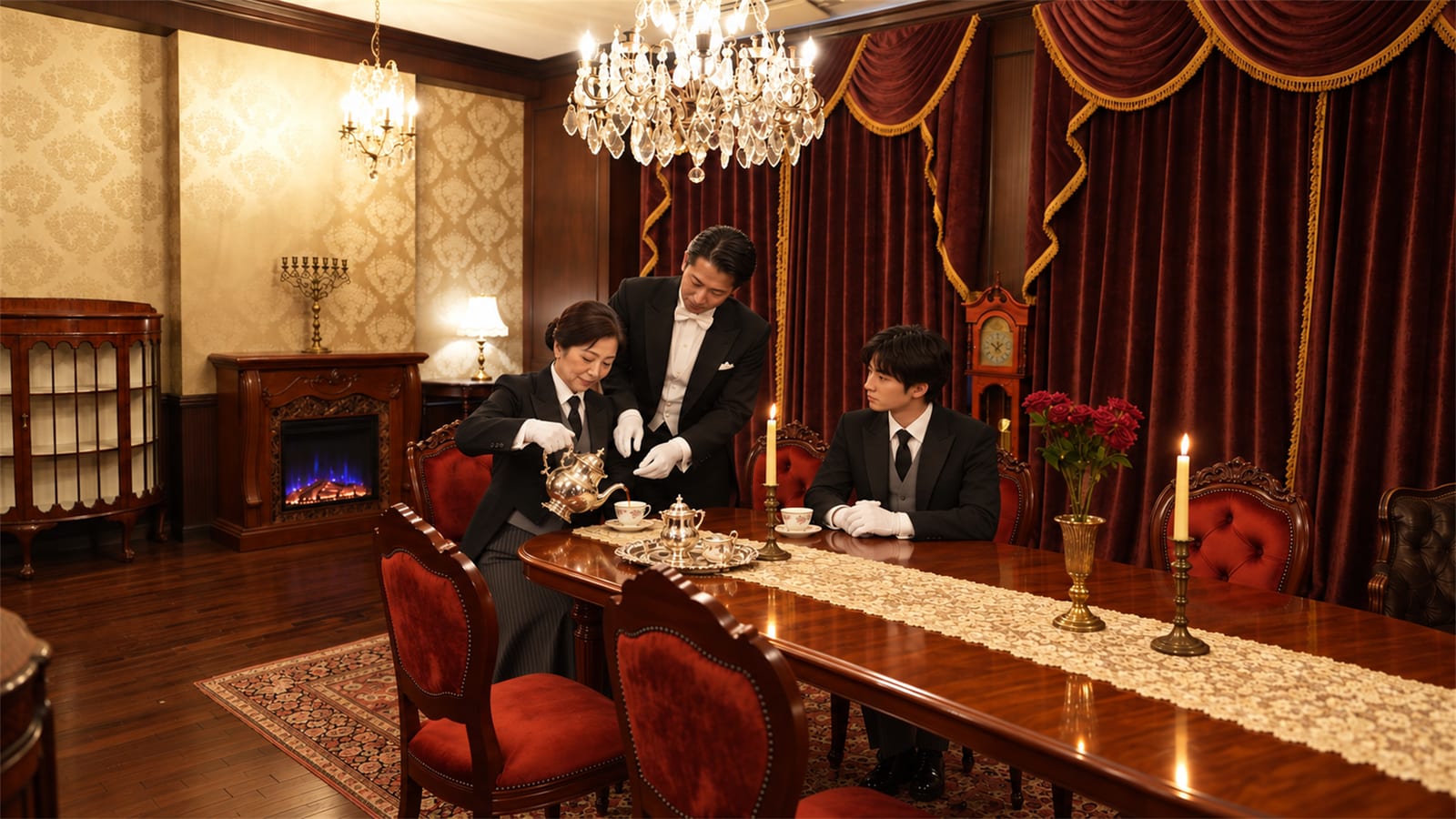
What the butler checks in your stance
| Shoulders and back | The shoulders are not raised; a natural line that allows breathing is kept. |
|---|---|
| Hands and fingertips | Lightly folded in front of the body, elbows not spread, fingertips together. |
| Gaze | Not too lowered; placed where the other's movement and the way ahead can both be caught. |
| Feet | Settled so that the next step can be taken, with the hem of the outfit checked too. |
| Where to stand | A position that does not block the other's path and from which you can respond when called. |
Stance and bow are used differently in three scenes of the Manor
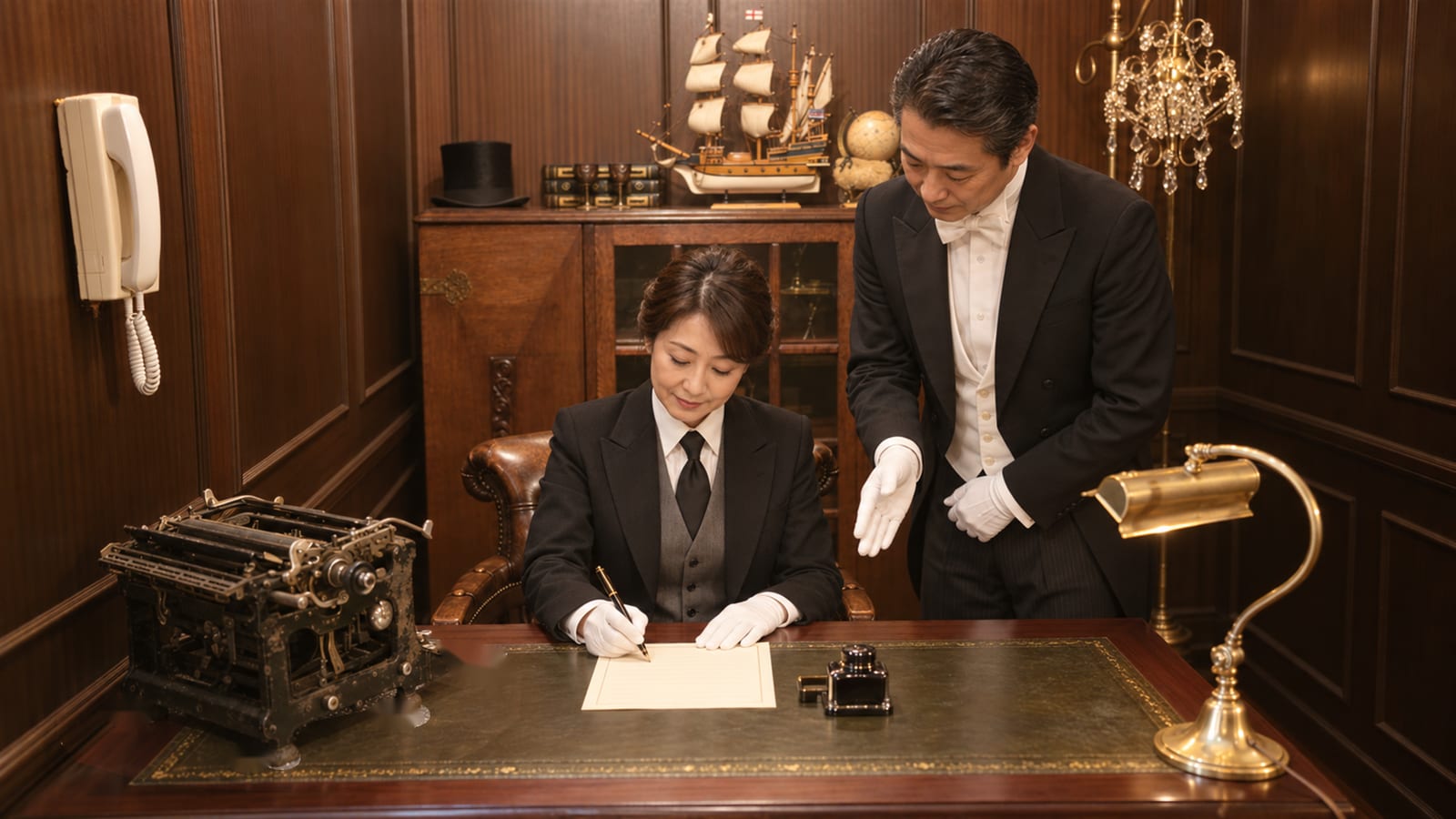
Welcome at the door
Open the door, clear the way, and lead from the bow of welcome into guidance.
Read more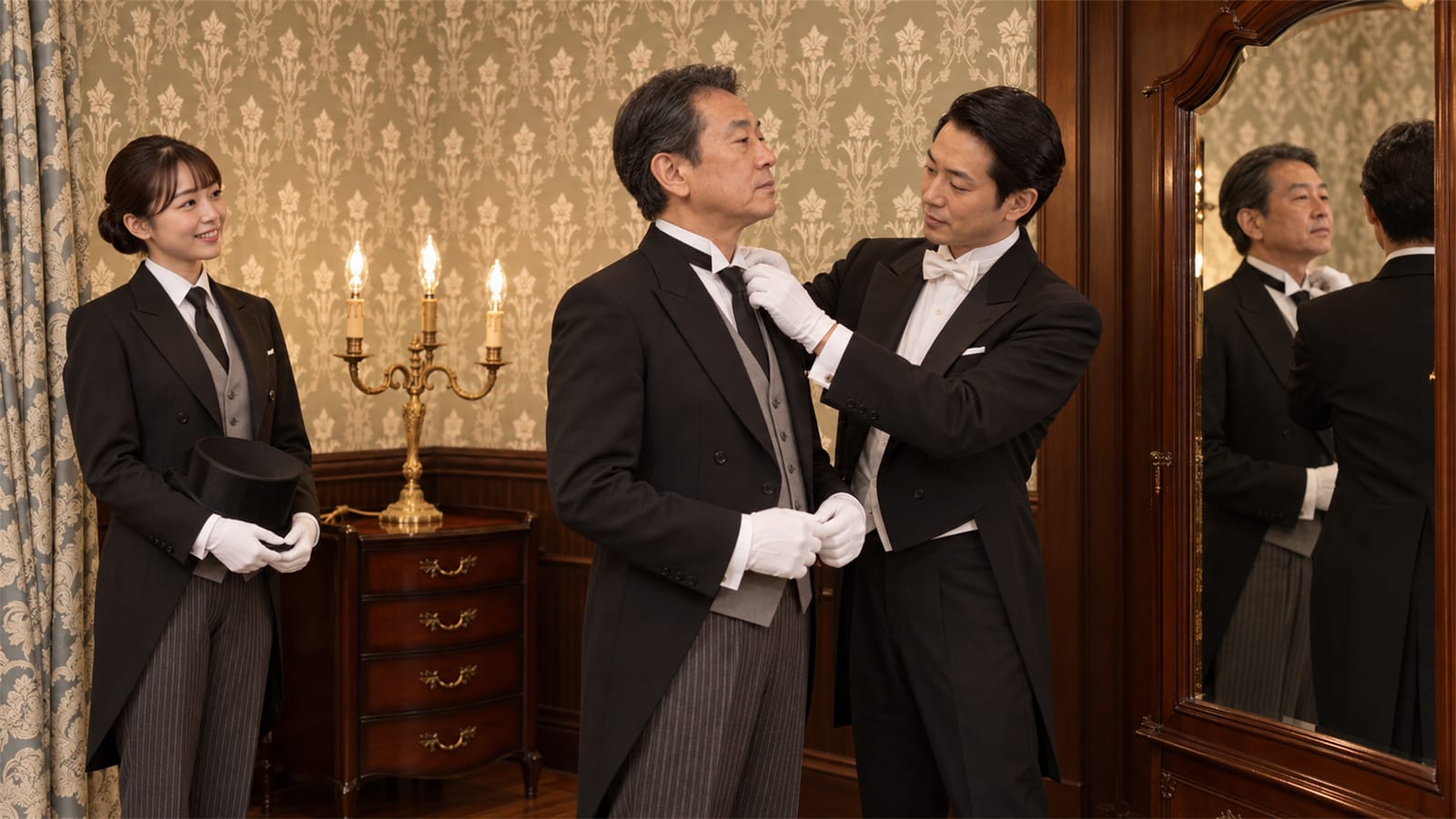
Waiting in the Dining Room
Keep attention on the table and the other's hands, and return to a quiet stance once the task is done.
Read more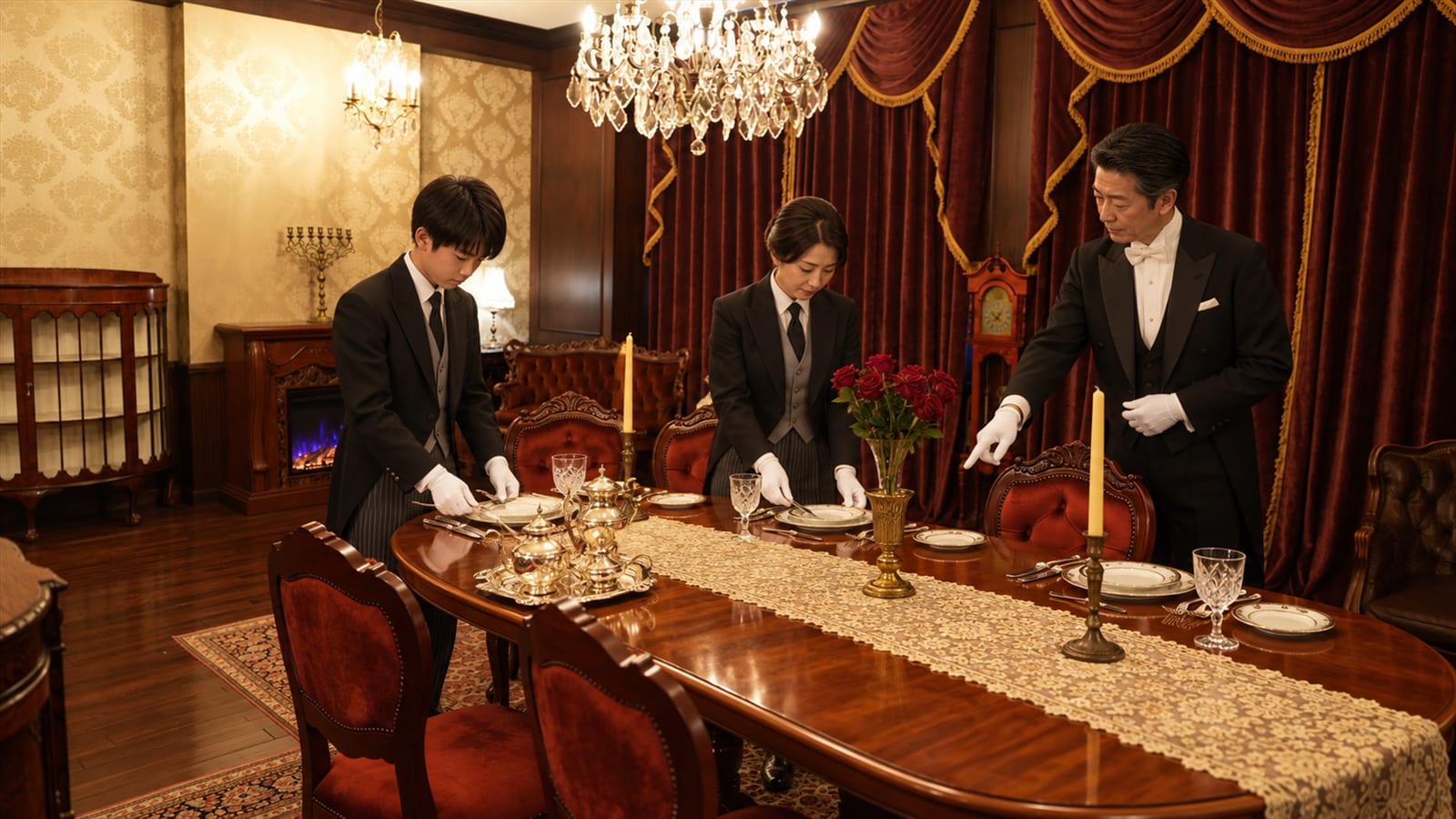
Farewell at departure
The bow carries thanks for the day's time, and we see you off beyond the door.
Read moreWhat you do in the experience
- Check your stance and the position of your hands before the mirror
- Go through walking, stopping and bowing with the butler
- Use shallow and deep bows to suit the moment
What you need not force
- There is no need to memorise angles
- There is no need to arch the back or hold the breath
- Rather than getting it right at once, proceed while watching the butler's movement
QCan I take part if I am not confident in my posture?
Yes. We adjust little by little from your everyday stance. As you check shoulders, back, hands, gaze and feet in turn with the butler, there is no need to correct the whole body at once.
QDo I need to remember the angle of the bow?
There is no need to memorise numbers. The butler shows shallow and deep bows to suit the moment — a greeting, thanks — and checks with you a movement that is comfortable for you.
QWhere should I put my hands?
When holding nothing, fold both hands lightly in front of the body. Keep the elbows in, the fingertips together, and settle them where no tension reaches the shoulders.
QWhere do I look when bowing?
Do not lower the neck alone; move back and head together. Hold a quiet pause at the lowest point, and on returning do not raise the gaze first.
QCan a woman butler show me the deportment?
Both men and women serve as butlers at Queen's Butler. If you have a preference as to who attends you, please let us know when booking.
QIs there a moment when two people bow at the same time?
Yes. There is a moment in which you bow beside the butler and match your timing. If two or more of you take part, you can also experience sensing one another's presence and moving as one.
About the attire
- Sizes and styles are limited. Before booking, please tell us your height and usual clothing size
- Please ask about sizes other than those listed
You may also wish to read

Before the mirror, beside the butler.
Tell us your height, build and shoe size, and your preferred date and time.