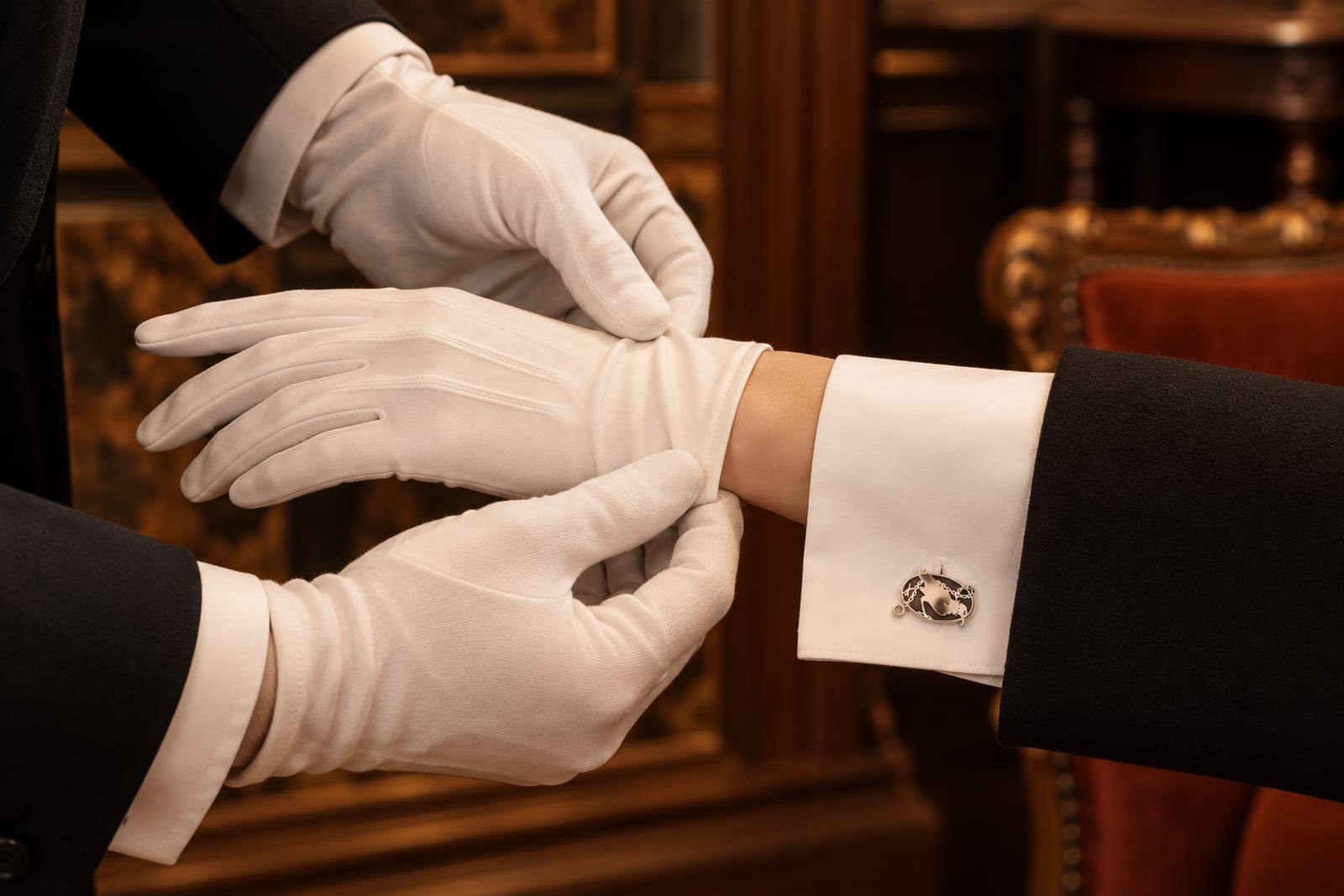
Handling White Gloves
From the moment the gloves go on, a butler's time.
About Handling White Gloves
Handling white gloves means that a butler puts on a clean pair as the last step of dressing, leaves no prints on silver or porcelain, and puts the hands in order the moment damp or a mark is noticed. They are worn not to show their whiteness but to protect the objects and to offer the other person a clean hand. In the Apprentice Butler Experience, putting on, holding, offering and taking off are practised as one sequence.
IWhite gloves go on last, after dress and hands are in order
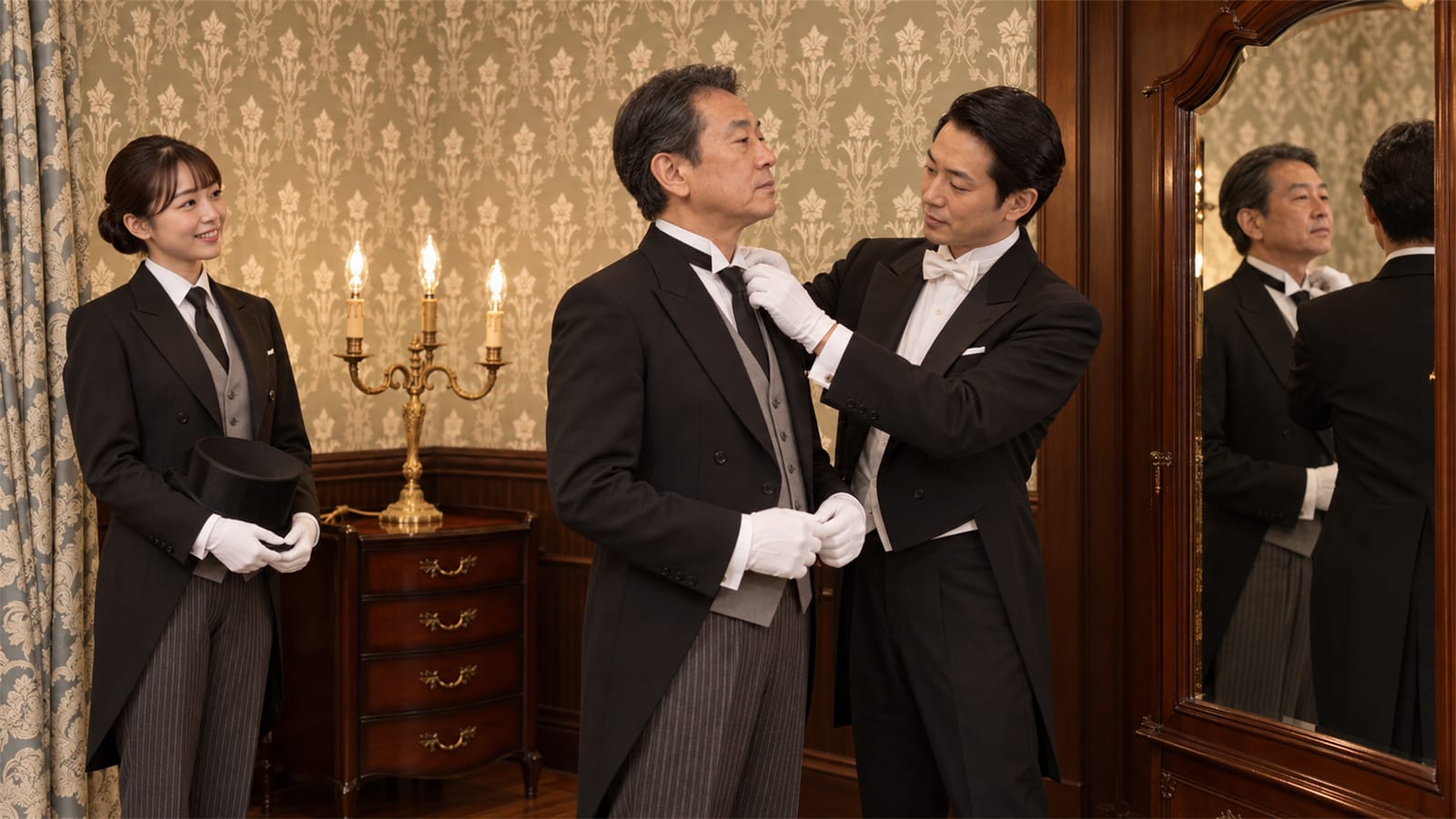
The gloves are put on last so that they are not soiled while tying the tie, fastening buttons and putting on shoes, and so that the end of dressing is clearly marked. Once the morning coat is on and your hands are clean, the fingers go in one hand at a time.
Pulling hastily at the wrist leaves the fingertips loose and twists the seams. Keep the fingers together, settle them quietly to the base, then smooth the palm and wrist. Your butler compares left and right, checking the whiteness and where creases fall.
Once on, rest your hands lightly together in front and open and close the fingers to feel the fit. Objects slide differently from bare hands, so you do not pick up silver at once. Only when the gloves have settled and the fingertips are calm do you move on.
IISettled from fingertip to wrist, white gloves work as a tool
Settling the gloves does not mean pulling the surface tight, but letting the length of the fingers and the seams follow your hand. From thumb to little finger, check each fit and see that no slack has gathered between the fingers.
Large creases in the palm make it hard to feel the handle of a piece of silver. Enduring a tight fit, on the other hand, puts strain into the hand and stiffens the shoulders. If anything feels wrong, tell your butler and it is put right on the spot.
White gloves are part of the dress and, at the same time, a tool that protects silver and porcelain. Do not put appearance first; make sure you can hold things safely. When standing, rest the hands quietly together; when handling objects, keep only the fingers you need free to move.
IIIWhen holding nothing, the white fingertips rest together in front
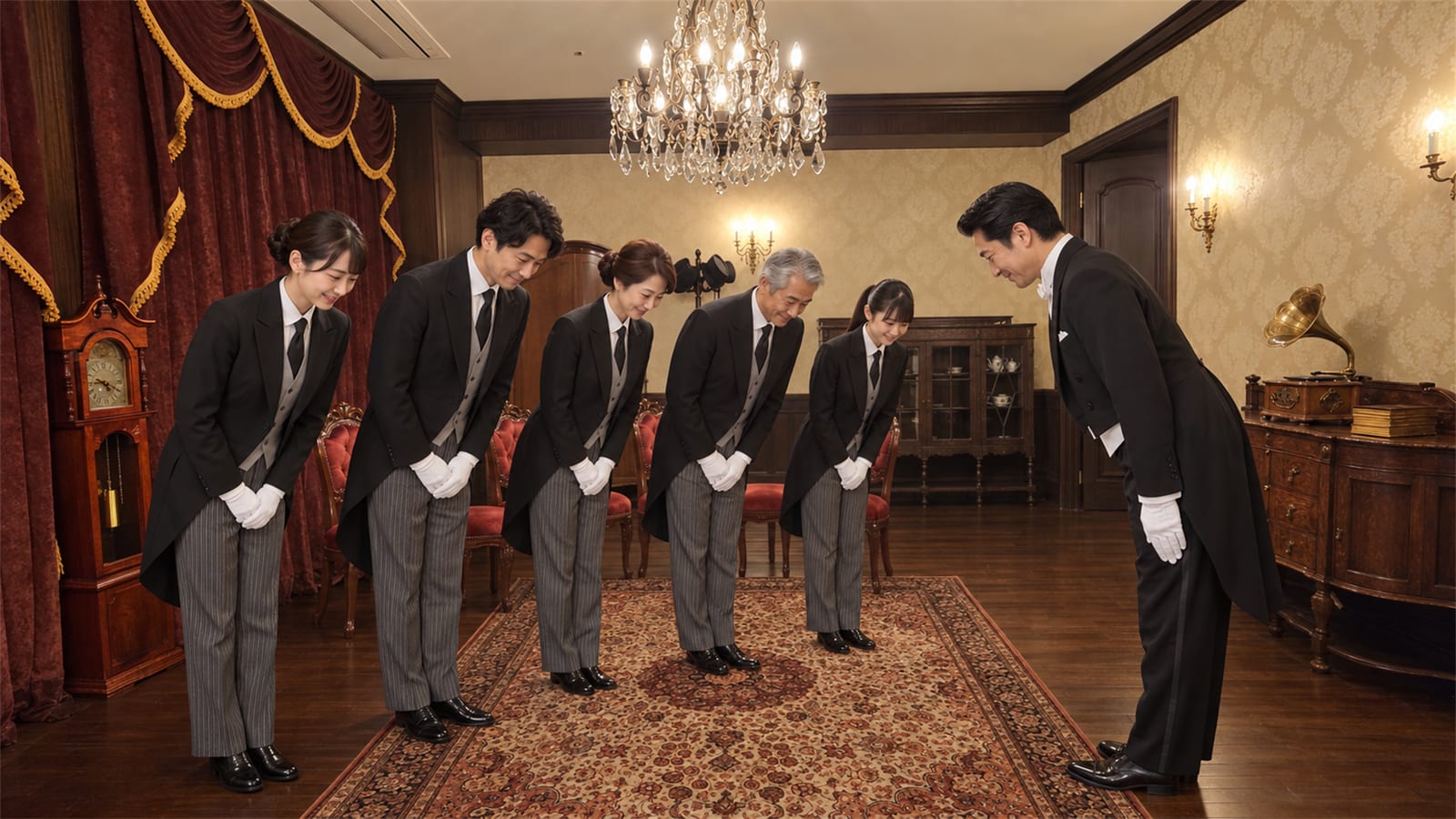
The waiting hands are lightly clasped in front of the body, with no strain in the elbows or shoulders. The fingers are not clenched; they lie together so the outline of the gloves is not disturbed. When the hands are calm, the whole posture looks still.
When called, the hands unclasp and prepare to receive. The fingers do not fidget before moving, and once the task is done they return to the same place. Hands with a clear beginning and end give the other person confidence.
In the commemorative portrait, too, the white gloves draw the eye. Do not raise them too high to the chest, and do not hide the front of the coat. Your butler checks elbow, wrist and fingertips from beside you, so that dress and posture read as one.
IVWith silver, choose the handle and avoid what touches the mouth
The rule for holding silver is to avoid any part that touches the diner's mouth or food and to take the handle or grip. Cutlery is not touched at the blade or tines, and is handled in the orientation in which the other person will naturally pick it up.
Wearing white gloves does not mean anything may be held anywhere. The gloves serve both to leave no prints and to keep things hygienic. Change your grip as little as possible, and decide where a piece will go before you receive it.
The Manor's silver, with its lustre and ornament, is part of the furnishings. When setting it on the table, do not let it strike other pieces; keep the sound low. In the Apprentice Butler Experience, you see how the white-gloved hand appears against the silver as you practise a quiet exchange.
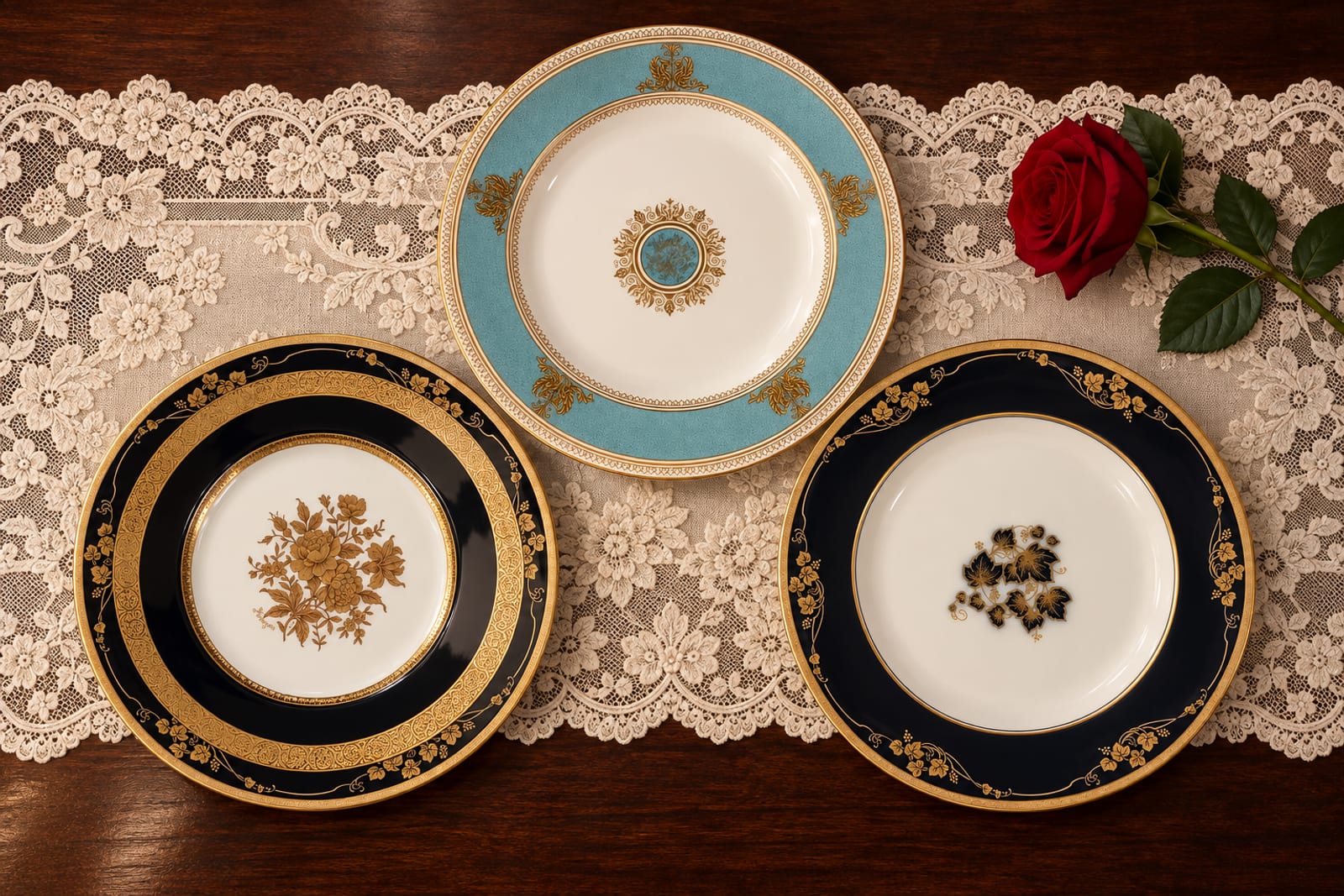
Even in white gloves, choose where to touch
Avoid the blade and what touches the mouth; handle quietly by the handle and grip.
VWith porcelain, avoid the rim and give each hand its role
Handling porcelain means keeping the fingers off the rim of the cup and the surface of the plate, and steadying the handle or the base. Since white gloves slide differently from bare hands, decide which hand goes where before lifting.
When carrying cup and saucer together, do not tilt them, and do not let the pieces ring against each other. Set the orientation for offering first, and do not turn the piece round and round in your hand. Check there is room where it will go before taking a step.
Even with Limoges or Wedgwood, safety comes before speaking of names and origins. Your butler knows the background of each piece, but gives priority to hands from which the person before them can receive naturally. Before the silver and porcelain of the Queen's Butler Manor, you learn where to hold and how quietly to set down.
VIWith tea, keep the white gloves out of the steam and the drips
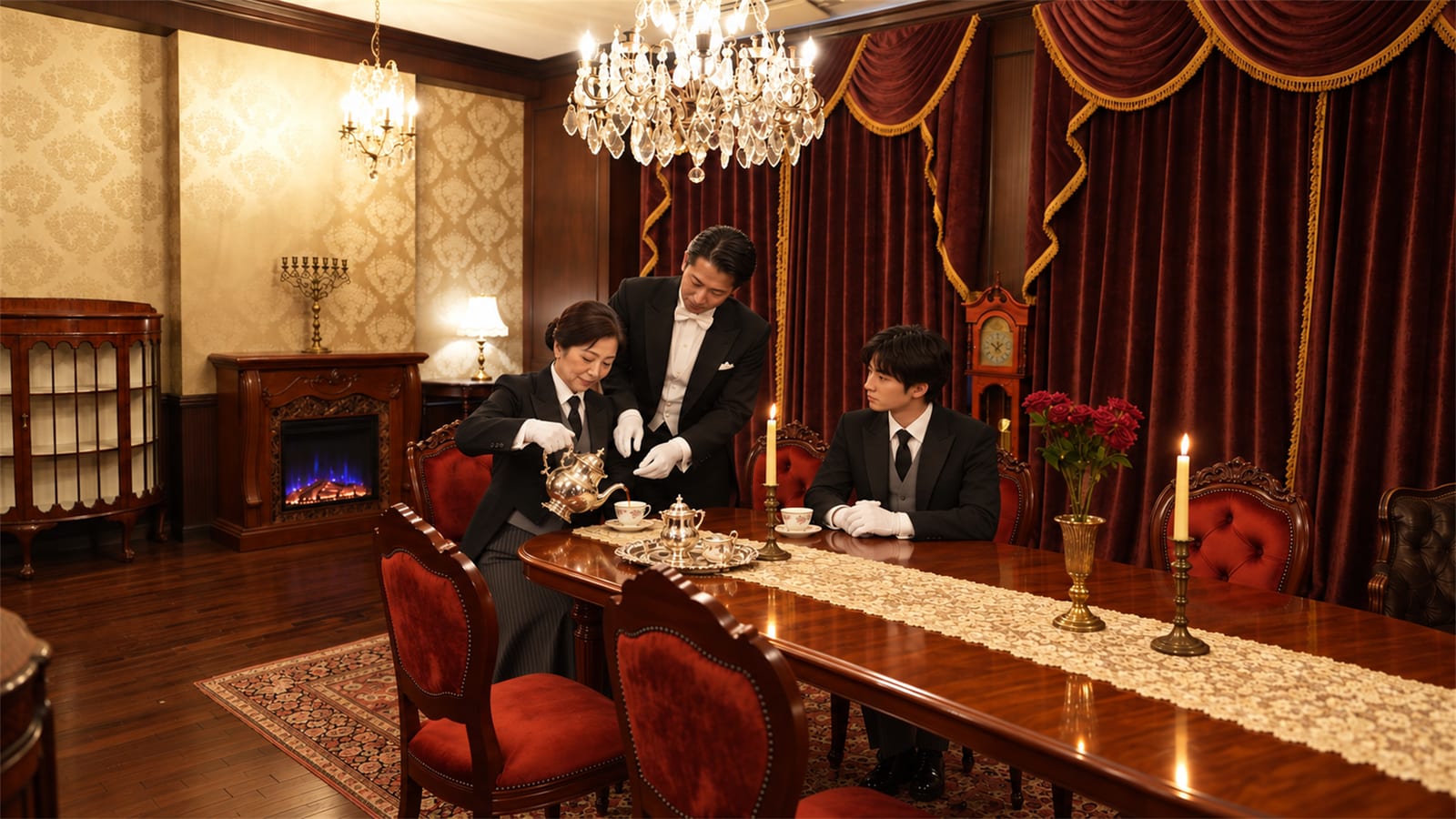
Pouring tea means steadying the handle and lid of the teapot without bringing the white gloves under the spout or the steam. A damp glove leaves a mark on porcelain, so both hands are placed before you pour.
When tilting the pot, do not move the wrist abruptly; watch the tip of the spout. When you finish pouring, wait for the drips to settle, and do not let the gloves touch cup or saucer. Like silence, leaving no damp is part of quiet service.
If hot water or tea touches the glove, do not go on to touch other silver or porcelain. Stop, tell your butler, and put things right. Stopping to protect the objects and the other person matters more than hiding a slip and carrying on.
VIIIn receiving and offering, watch both hands and the other's movement
The exchange is not about showing the beauty of white gloves but about a movement that lets the other person let go, and receive, with confidence. Judge the shape and weight of the object, support it with both hands, and do not draw it away before they release it.
When offering, move to where the other's hand can reach and turn the object towards them. Do not stretch the arm fully; leave room to follow their movement. Look not only at the object but at their hands.
The same thinking applies to presenting a keepsake with both hands. Do not wrap it so the white gloves hide it; leave a place for the recipient to hold. Once their hand has taken it, bow, and carry the exchange through to its end with care.
White gloves are a tool for leaving no trace of a touch, and leaving only consideration.
VIIIOn finding a mark or damp, step back and put things right
Deciding to put the gloves right means not continuing with a soiled pair, but stopping before touching silver or porcelain. Even a small mark shows clearly on white cloth. Do not rub at it in front of the other person; tell your butler.
When you notice a mark or damp, withdraw to your place, set the object down safely and consult your butler. Then confirm how to handle the gloves and how to proceed, settle fingertips and wrist, and return to the scene.
The thought that it is better to step back and change than to touch silver with soiled gloves is not about keeping up appearances. It is the butler's attitude of valuing the object and the person before them, and choosing the right course even midway.
IXTaking them off, loosen the fingertips and return them ready for next use
Taking off white gloves does not mean tugging the wrist and turning them inside out, but loosening each fingertip before drawing out the hand. Once one glove is off, avoid touching its outside repeatedly with the bare hand.
Gloves that have been removed are not rolled up or pushed into a costume pocket. Pair left and right, keep their shape and hand them to your butler. When returning the costume at the end of the experience, respect for what has been used is shown in the manner of it.
The moment the gloves come off is the boundary between your time as an apprentice butler and your own dress. Do not free the fingertips in haste; keep a quiet pace to the end. When the beginning and end of dressing are joined, the whole experience becomes one memory.
XThrough white gloves, learn to watch the object and the person together
The white-glove experience is not only learning how to put them on, but time to consider what you touch, where you hold, and when to stop. Whether the object is silver, porcelain, tea or a keepsake, the centre, protecting the other person and the object, does not change.
Alone, you concentrate on the mirror and your hands; with two or more, you also watch the movement of the person you exchange with. Female butlers are on hand, and any wishes about costume or gloves are taken in advance. The Manor accommodates up to six, and a safe order is arranged for your number.
As an experience run by the Japan Butler Association, white gloves are treated not as ornament but as a tool for showing consideration through the hands. Even on a first visit, from the moment they go on to taking them off and returning them, practise each step with your butler.
XIPrepare the hands before gloving, according to season and weather
Handling white gloves according to the season does not mean changing their form, but making sure the hands are clean and dry before they go on. On warm days, settle your hands after dressing and do not hurry the fingers into the cloth. If anything feels wrong, tell your butler.
On rainy days, leave umbrella and luggage on arrival and let the damp from outside settle before changing. Do not handle white gloves with hands that have touched wet things, and do not bring moisture to the silver and porcelain of the Manor. The day's weather, too, is part of the judgement that protects the objects.
XIIIn the photograph, beyond whiteness, the fingertips and the distance to the other remain
A commemorative portrait with white gloves is not about making the hands look large, but about keeping the morning coat, the bearing and the relationship to silver or tea in a single image. Hands clasped in front, offering a cup, presenting a keepsake: the same gloves play different roles.
Before the shot, your butler checks that the fingertips do not hide the object, that the elbows are not splayed, and that you are not too close to the other person. Because the white hands stand out, even the smallest turn shows in the picture. Rather than shaping a pose for the moment, the image is taken at the end of a real exchange.
White gloves are handled in five steps
Dress first
Tie, waistcoat, coat and shoes are finished before you take up the white gloves.
Settle each finger
Match fingertips to seams and slide in quietly to the base.
Check palm and wrist
Smooth creases and twists, and make sure you can feel what you hold.
Choose where to hold
The handle of the silver, the handle of the cup: look for the parts that may be touched.
Offer to the other
Leave room for them to take it, and steady it with both hands until their hand is free.
Silver, porcelain, tea and keepsake each call for a different hold
| Object | Where to hold | What to check |
|---|---|---|
| Cutlery | The handle | Avoid the blade and what touches the mouth. |
| Cup and saucer | Handle and base | Watch for pieces ringing together and the direction the other takes it. |
| Teapot | Handle and lid | Keep the hands out from under spout, steam and drips. |
| Keepsake | Both ends, leaving room for the other to take it | Do not draw back until they hold it; steady it with both hands. |
| Holding nothing | Hands clasped in front of the body | Relax elbows and shoulders; keep the fingertips together. |
Where to check the state of the white gloves
| Fingertips | No slack or twist; you can feel the shape of what you hold. |
|---|---|
| Between the fingers | No bunched cloth; the hand opens and closes naturally. |
| Palm | No large creases or slipperiness. |
| Wrist | Meets the cuff naturally, without pinching. |
| Surface | Any damp or mark is put right before touching the next object. |
The white-glove movements are practised in three scenes
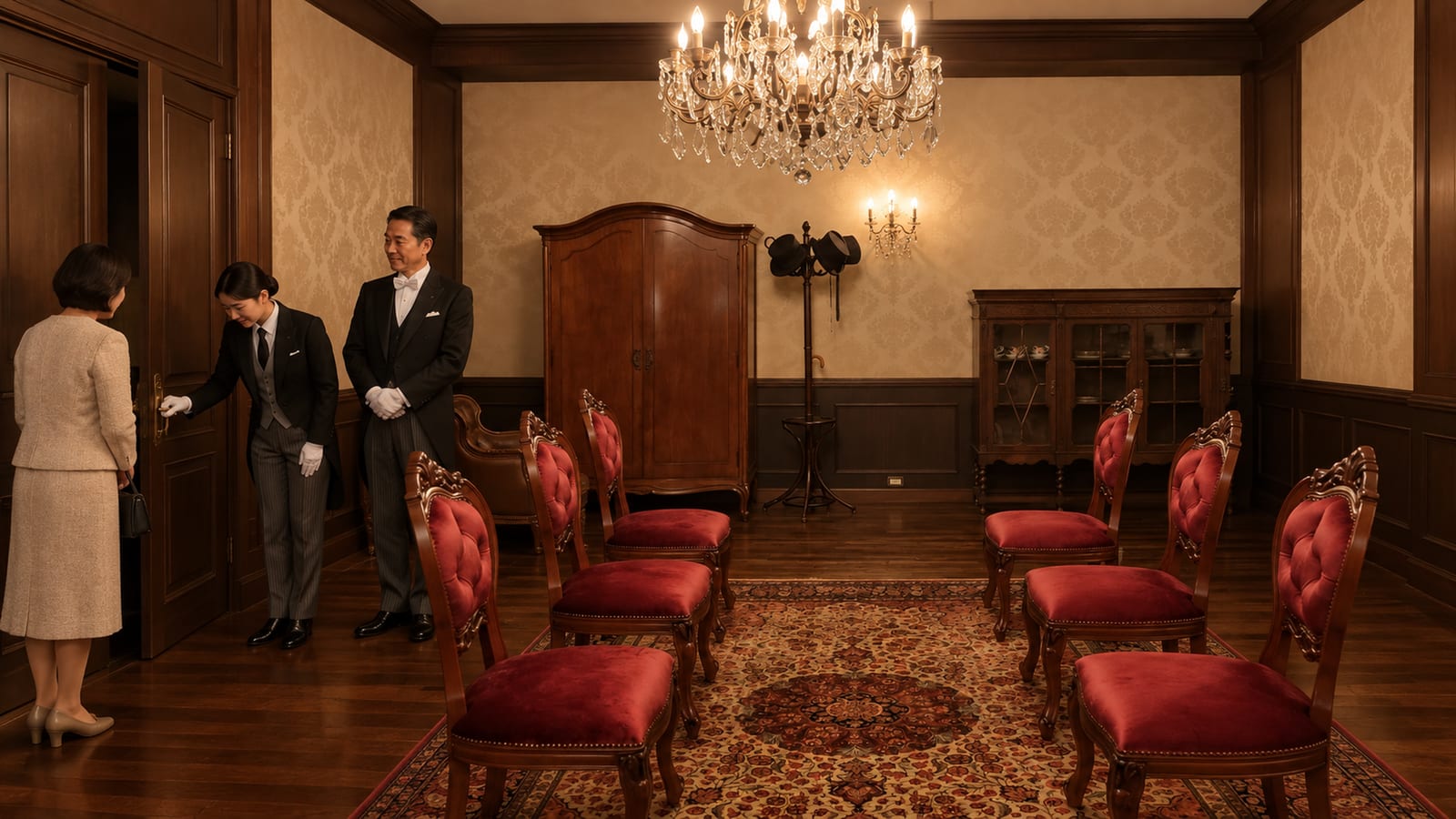
Laying the silver
Take the handle, avoid striking other pieces, and set it so the other can pick it up.
Read more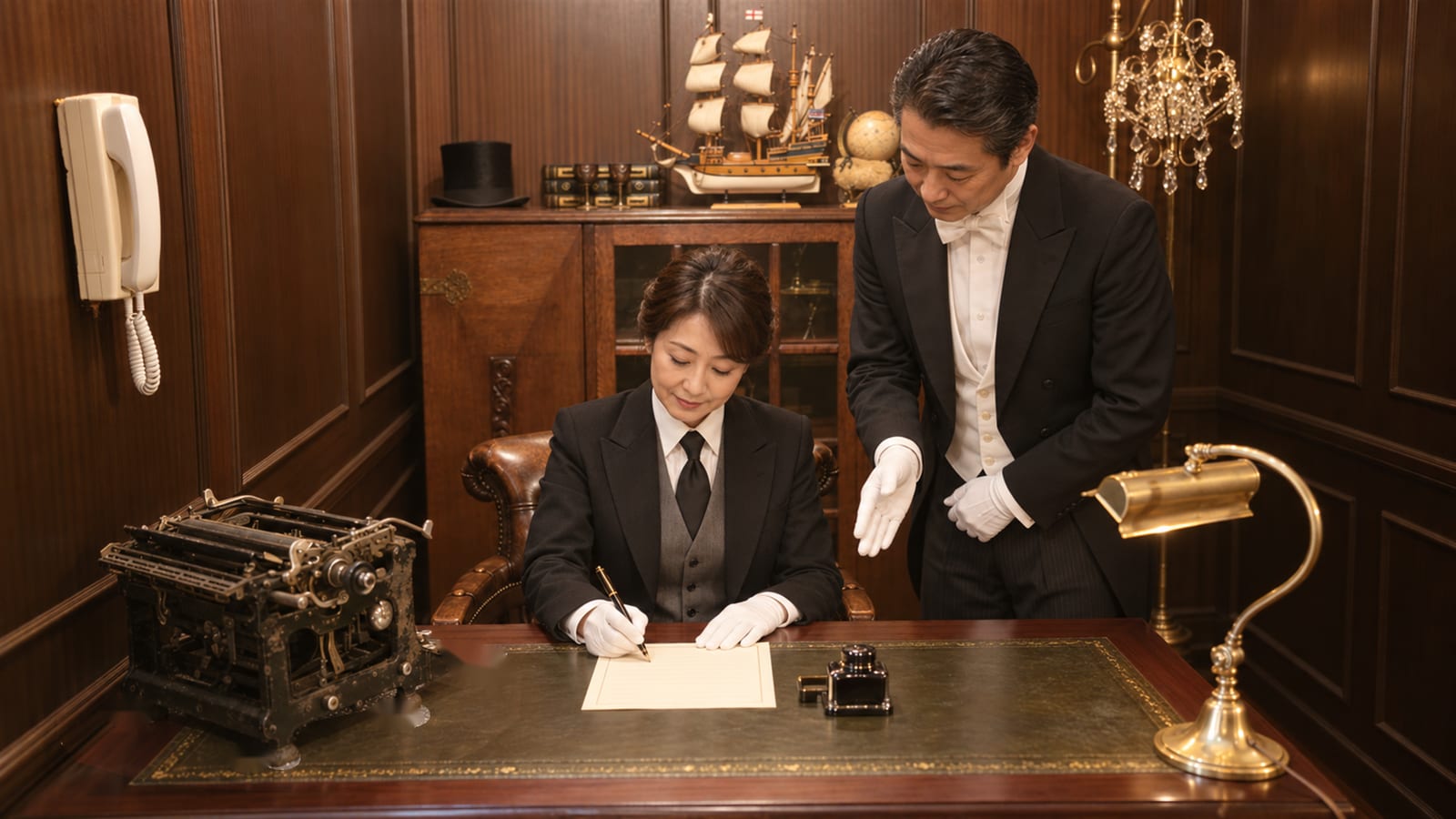
Offering tea
Avoid steam and drips, and turn the cup handle so it is easy to take.
Read more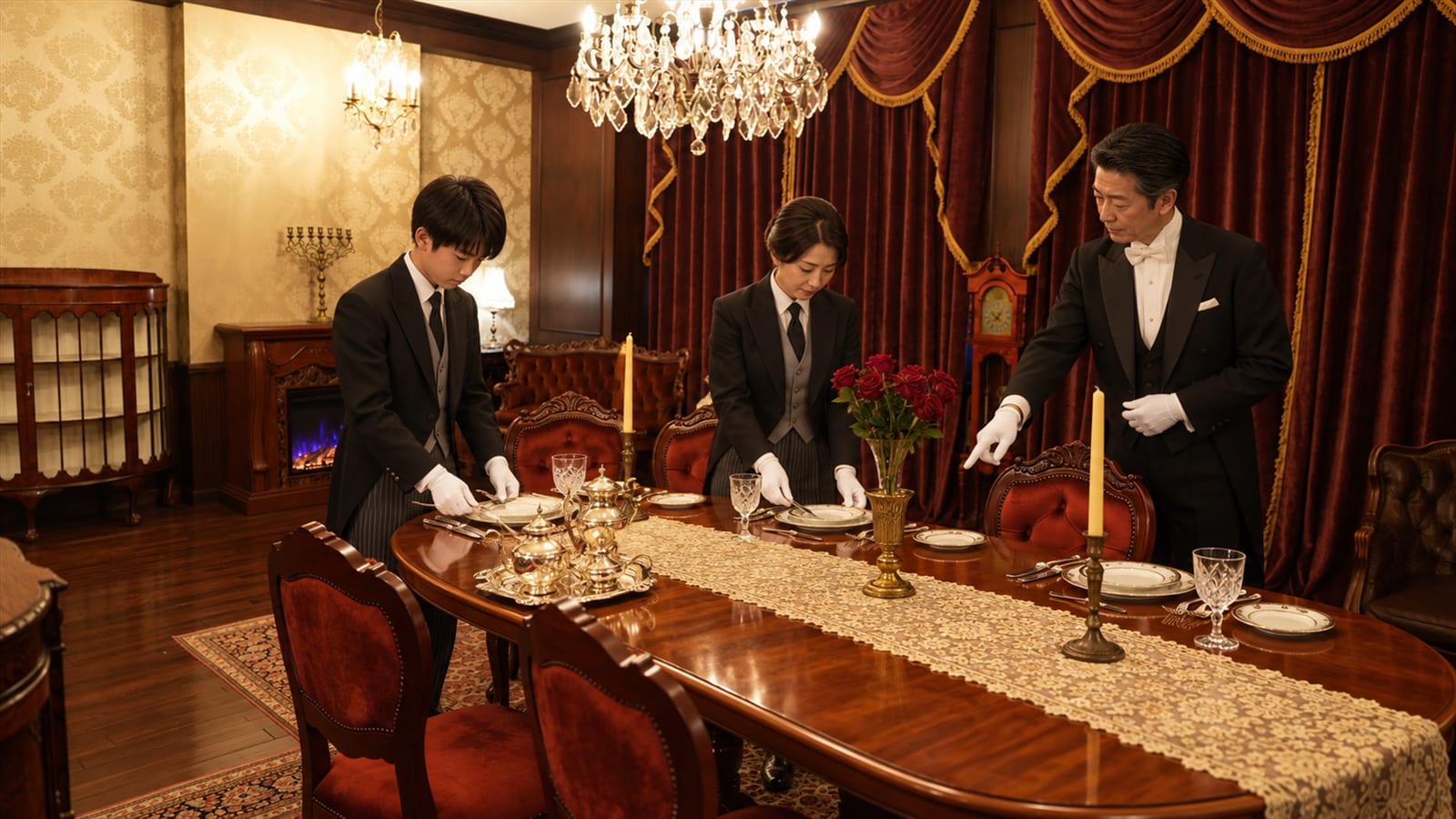
Presenting the keepsake
Leave room for the other to take it, steady it with both hands, then bow.
Read moreWhite gloves included in the price
- White gloves as part of the full costume
- Guidance from your butler on putting on, holding and taking off
- Handling silver, porcelain, tea and the keepsake
What is not provided
- The Manor does not serve meals. You are welcome to bring your own food and drink
- The Manor is never let without a butler present
QDo I bring my own white gloves?
No. They are provided at the Manor with the full costume. They go on last, after dressing, and your butler checks fingertips and wrist.
QIs it all right if I do not know how to put them on?
Yes. Your butler guides you from settling each finger. Without hurrying, we check together until you can hold things safely.
QWith white gloves on, may I hold silver anywhere?
No. Even gloved, you choose where to hold. Cutlery is taken by the handle, avoiding the blade and what touches the mouth.
QWhat if the gloves get wet while serving tea?
Do not touch another piece. Stop and tell your butler. Set the object down safely, then confirm how to handle the gloves and how to proceed.
QCan women practise the white-glove movements too?
Yes. All genders are welcome. Male and female butlers are on hand and check costume and hands one by one.
QCan I be photographed wearing the white gloves?
Yes. We photograph you standing with hands clasped in front, and handling silver, tea and the keepsake. Your butler chooses a position where the white hands and the morning coat appear together.
About the attire
- Sizes and styles are limited. Before booking, please tell us your height and usual clothing size
- Please ask about sizes other than those listed
You may also wish to read
The Apprentice Butler Programme
The seven movements, including white gloves, across the whole experience.
Read more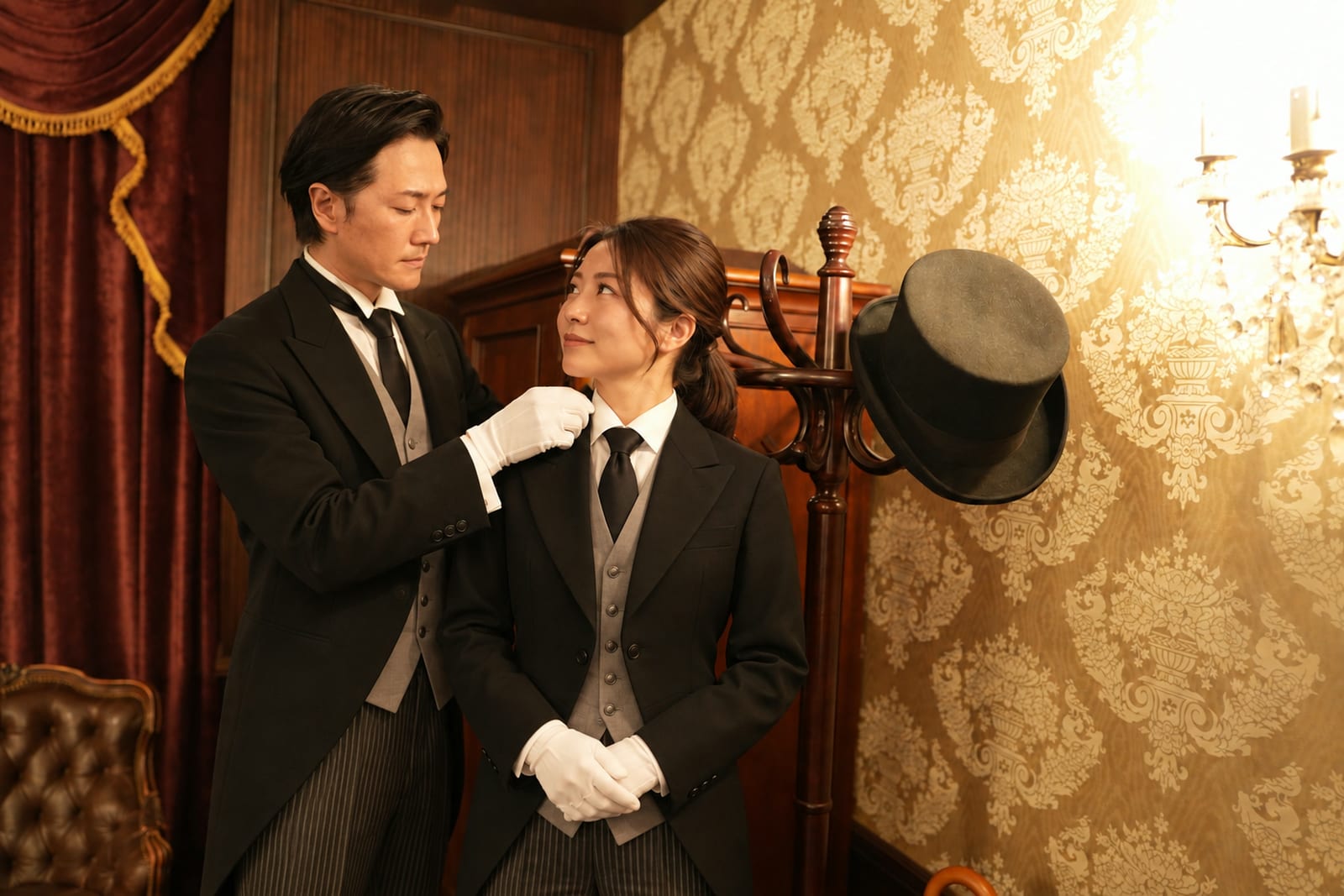
How to Wear a Morning Coat
The order of dressing, up to putting on the white gloves last.
Read more
How a Butler Stands and Bows
The posture of white-gloved hands clasped in front, and the bow, explained.
Read more

From the moment the gloves go on.
Please tell us your height, build and shoe size, and your preferred date and time.